
Some sites hand you a blank canvas. Others hand you a problem. The land on which Novantique now sits gave us the latter — a steep, terraced mountain slope with no room for the conventional logic of hospitality design. No flat ground to build across. No easy paths between points. No margin for the standard approach of scattering guest rooms across a site and connecting them with roads or walkways. What the mountain gave us instead was constraint. And constraint, at L’ART-QUI-TECTE, is where the most interesting design thinking begins.
Novantique is a boutique mountain hotel — a retreat of individual pod suites carved into a hillside, each one a private world suspended between land and sky. But before the interiors, before the architecture, before any of the experience could exist, we had to solve the fundamental question the site was asking: how do you move people through a hotel that is embedded vertically inside a mountain?
The Problem Was the Land
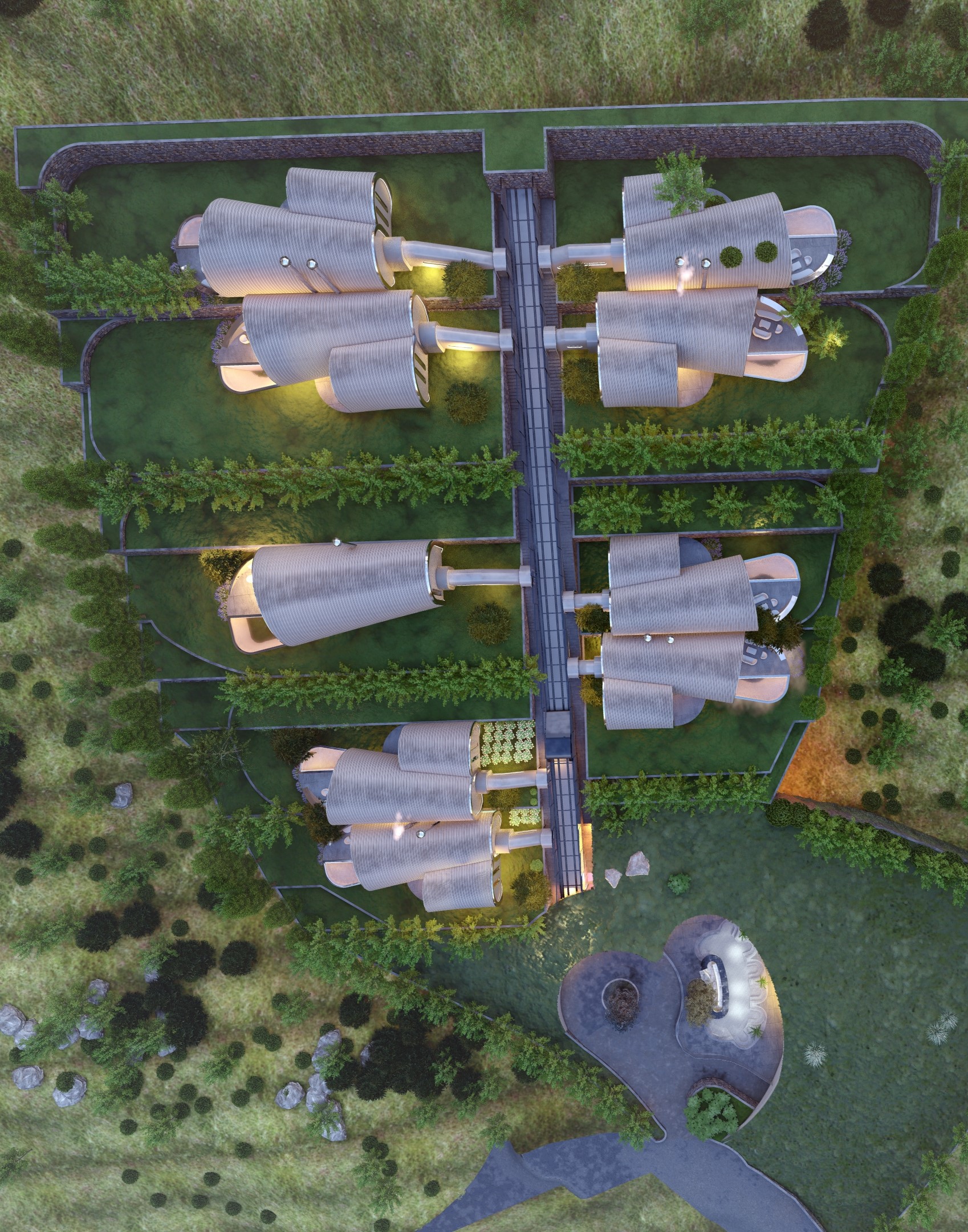
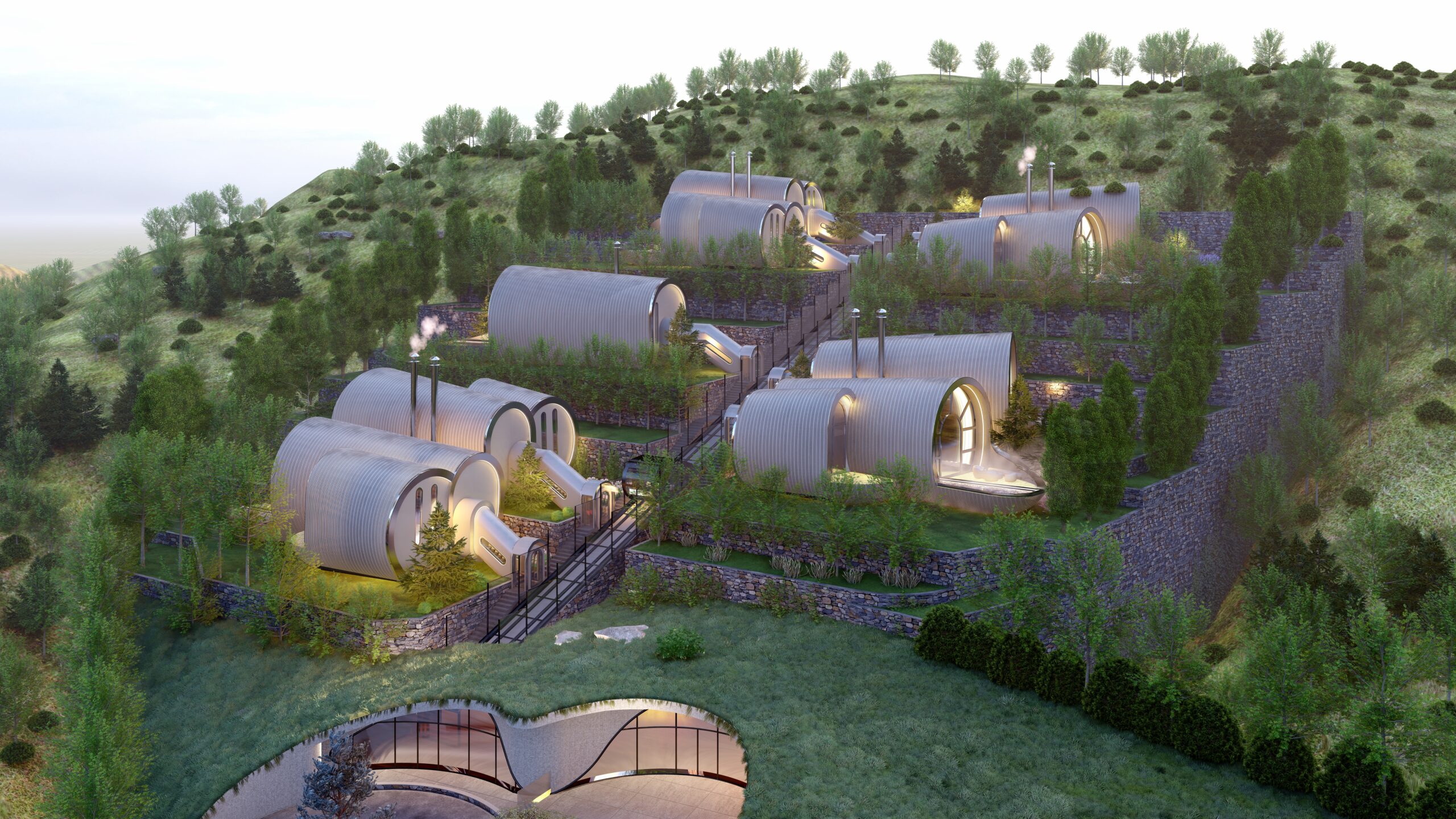
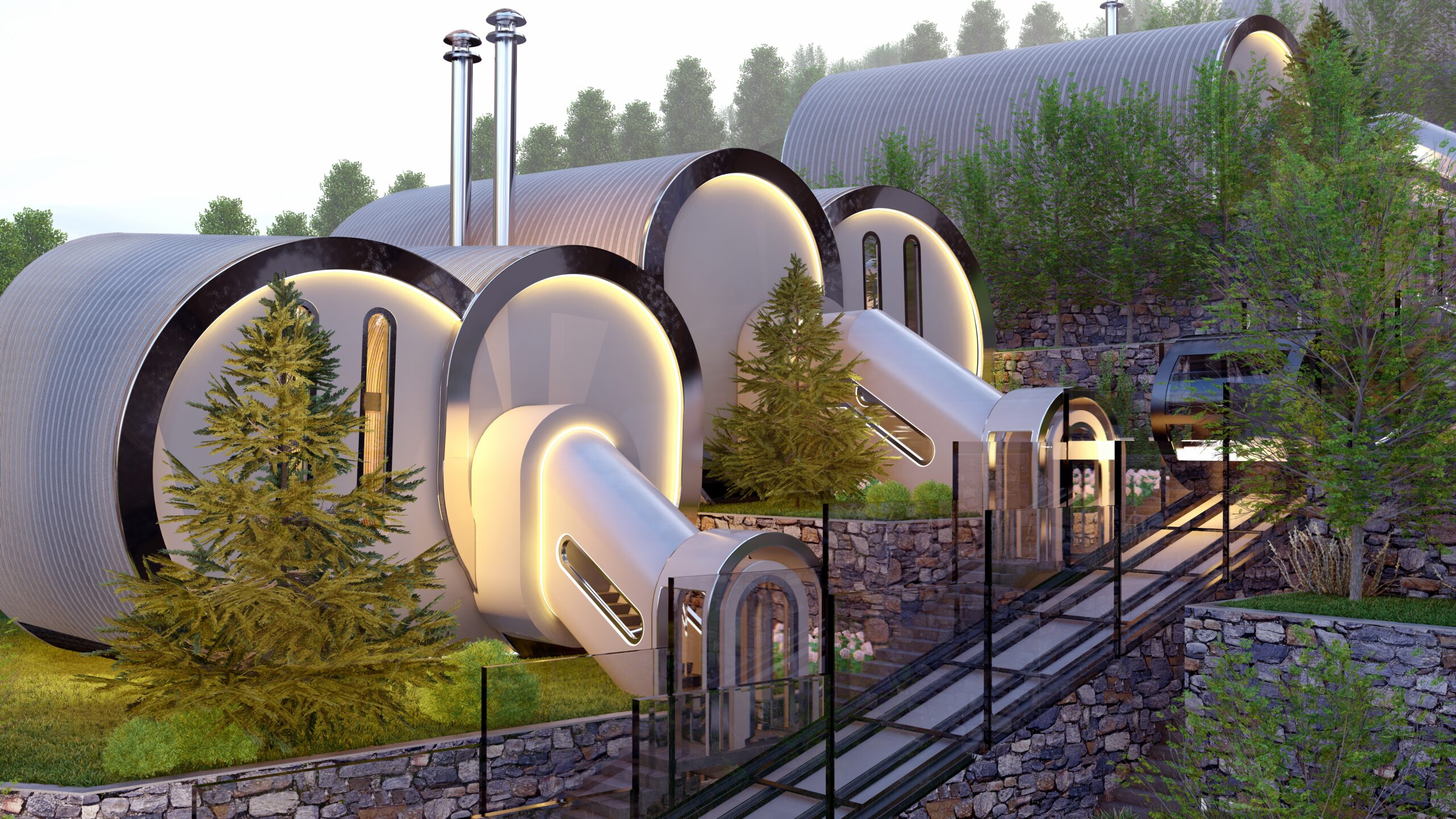
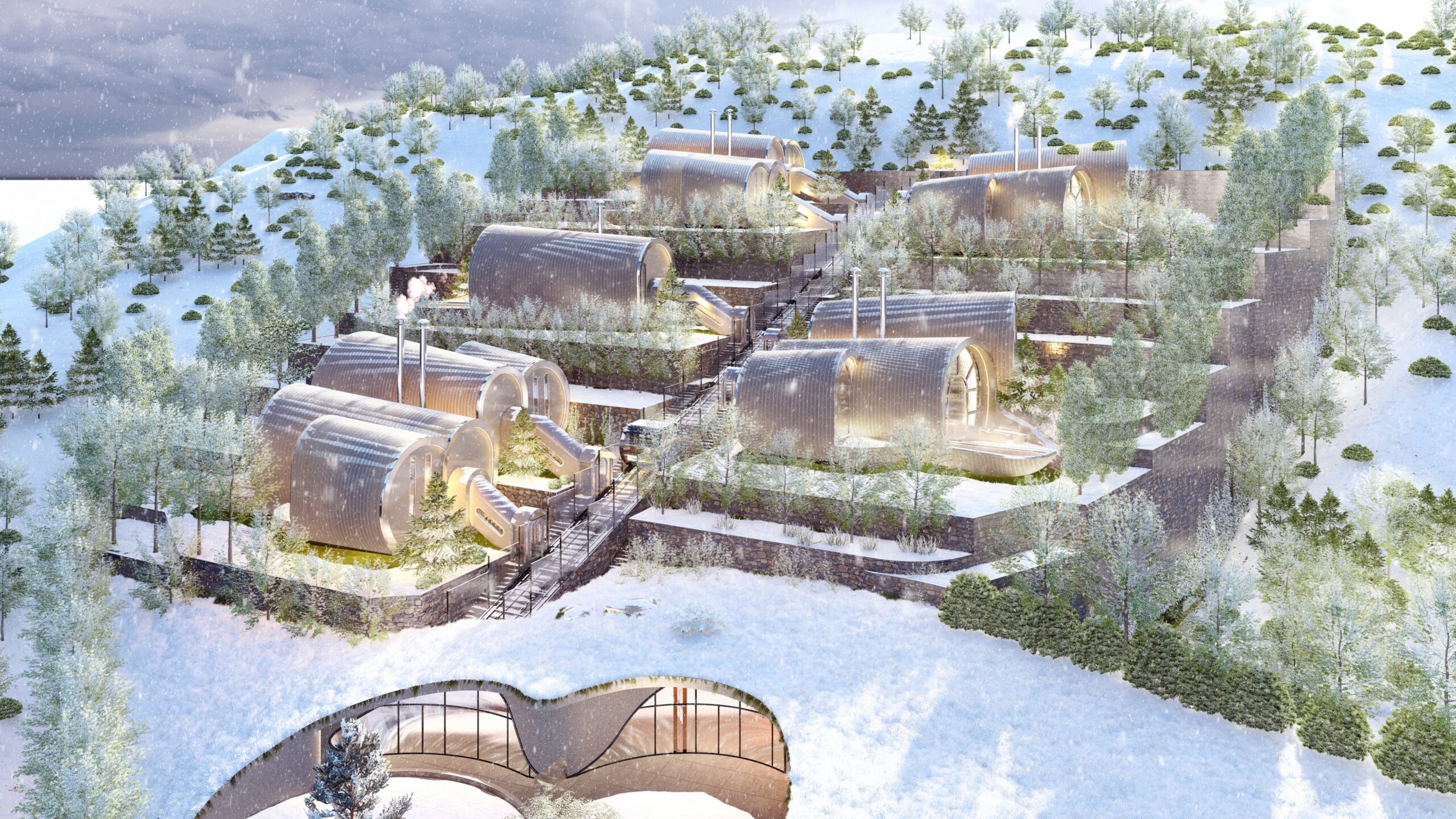
The site drops significantly in elevation. The guest rooms — barrel-vaulted pods that rest on terraced stone retaining walls — cascade down the hillside in three tiers, oriented to face the valley view below. From the aerial plan, the logic reads clearly: a central spine flanked by pods on either side, each unit set into the mountain with its own outdoor terrace and private hot tub. It is a considered layout, designed around the natural topography rather than against it.
But that very logic — rooms distributed across multiple levels, embedded into a slope — creates a circulation problem that most hospitality projects never have to face. You cannot build roads between these rooms. The elevation change is too steep, the land too tight, the stone retaining walls too integral to the structure to be cut through with vehicular access. And a network of staircases winding across the hillside, while possible, would fragment the guest experience into a series of climbs and descents that belong to a hiking trail, not a hotel arrival sequence.
The Invention: An Elevator Tram Through the Mountain
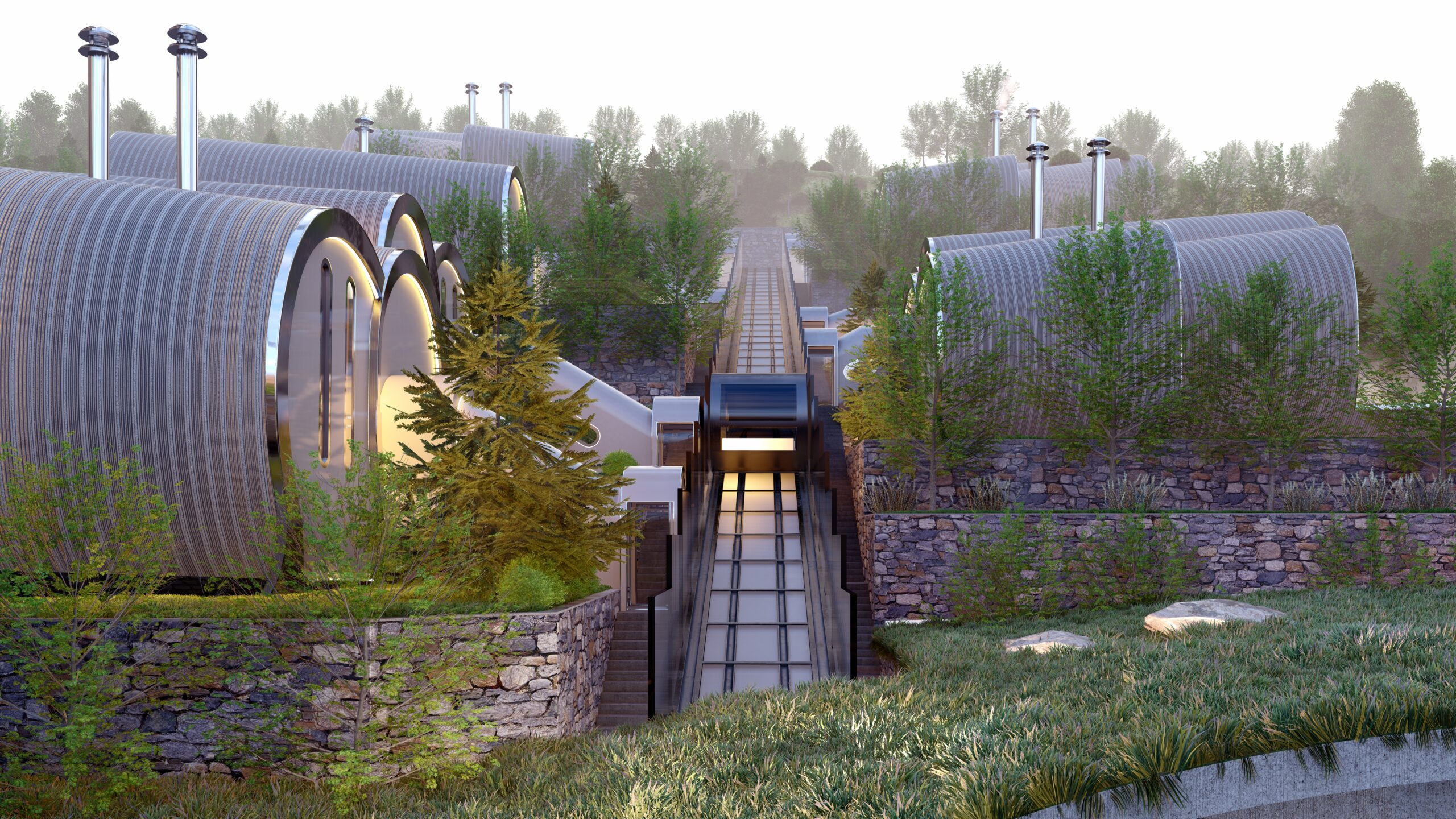
The answer we arrived at was not borrowed from another hotel project. It came from looking at the problem as a movement problem rather than a hospitality problem. If the mountain cannot be traversed horizontally, you move through it vertically — not with a conventional shaft elevator, but with a mountain tram: a glass-enclosed cabin that travels on a track cut directly into the hillside, from the reception level at the base all the way up to the uppermost tier of guest rooms.
From the reception, a guest steps into the tram cabin, and the mountain rises past them. Stone walls, the backs of the pod structures, glimpses of the forested terraces between levels. It is not a utilitarian transfer. It is the first experiential moment of the stay — a slow, deliberate reveal of the property as it ascends. The tram becomes the threshold between arrival and immersion.
What makes this solution architecturally honest is that it does not impose infrastructure onto the landscape. The track runs between the pods, occupying the central spine that would otherwise be dead circulation space. It reads, from the exterior, as a natural part of the architecture — a dark-toned rail line threading through the tiers, flanked by the illuminated pod facades on either side.
The Architecture of the Pods
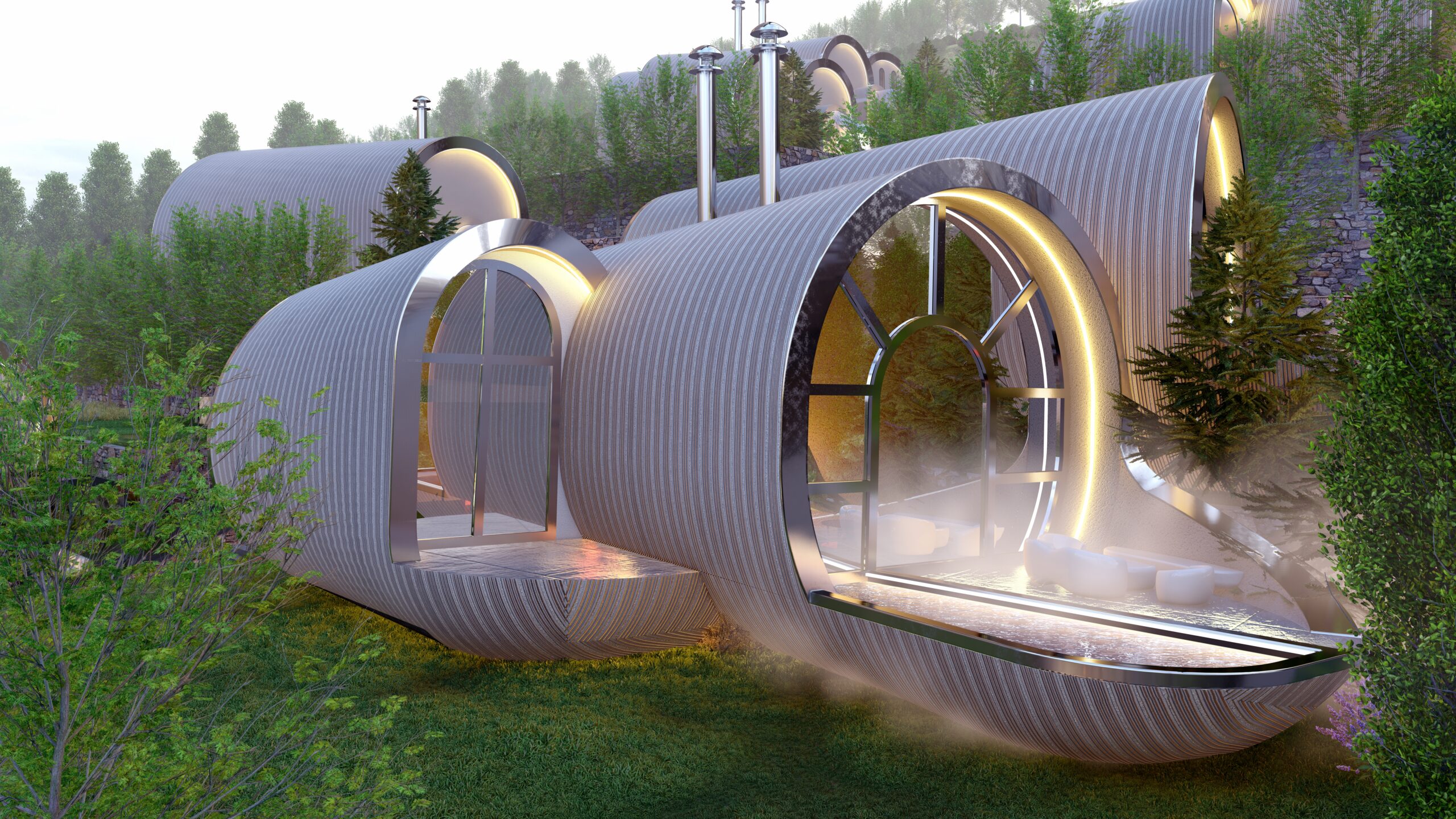
Once the circulation logic was resolved, the pod architecture could be developed on its own terms. The form language we chose is the barrel vault — a ribbed, cylindrical shell that references both the organic geology of a mountain and the structural tradition of vaulted stone architecture. Each pod consists of two or three interconnected cylinders: one housing the living level, the adjacent one containing the bedroom level above. A connecting tube links them, creating a sense of passage within the unit itself.
Seen from the exterior, the pods read as soft industrial forms — their ribbed metal skins catching light differently across the day: warm gold at dusk, silver-grey under cloud cover, luminous white under snow. The circular openings on the face of each pod — floor-to-ceiling arched glazing — are the visual signature of the project: eyes in the mountain, looking out at the valley below. Each pod sits on its own stone-walled terrace, with an outdoor hot tub positioned to face the view. The stone retaining walls that tier the site are not incidental — they are part of the architectural language, grounding the contemporary pod forms in the materiality of the mountain itself.

The Reception: Carved Into the Earth
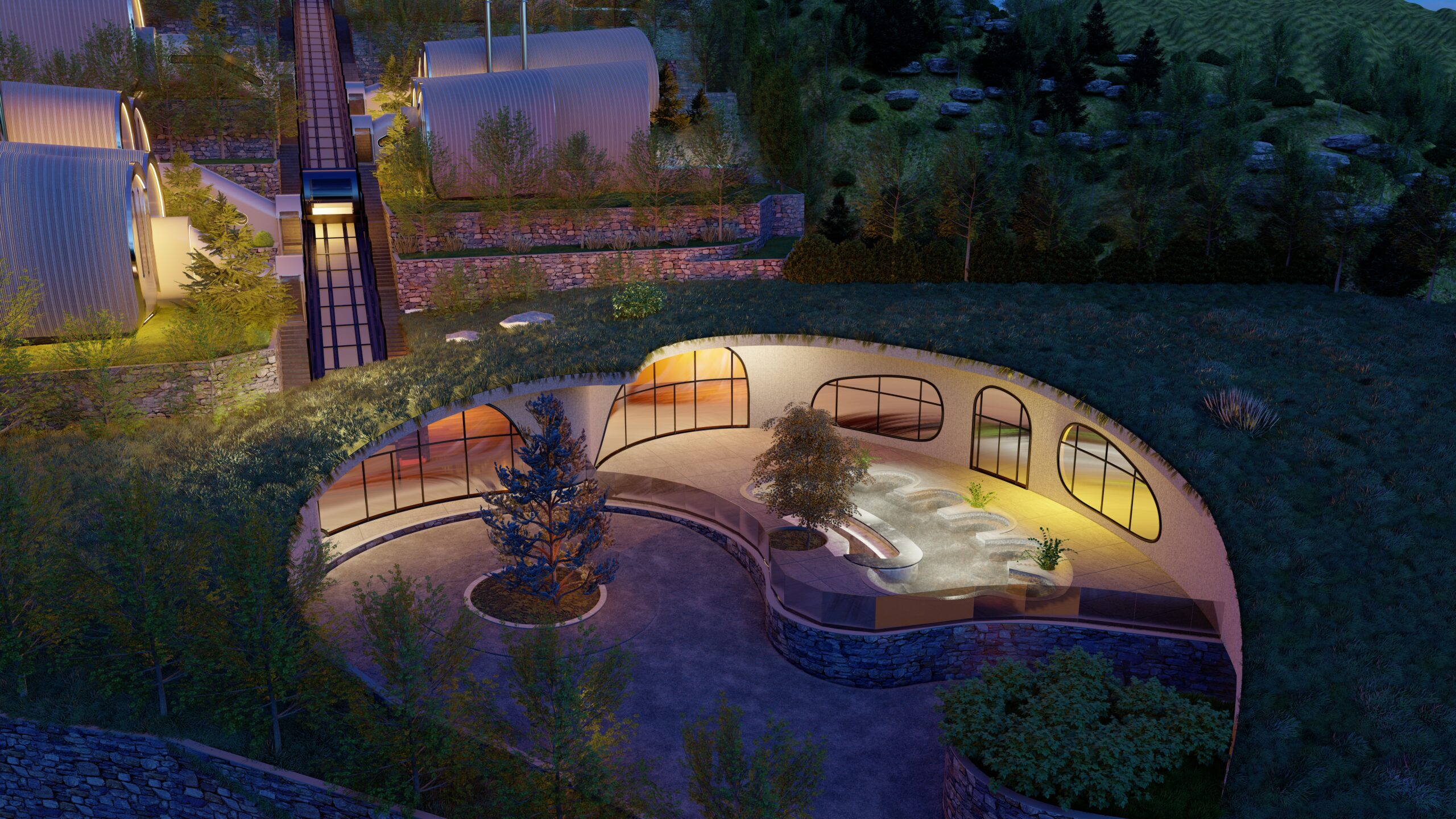
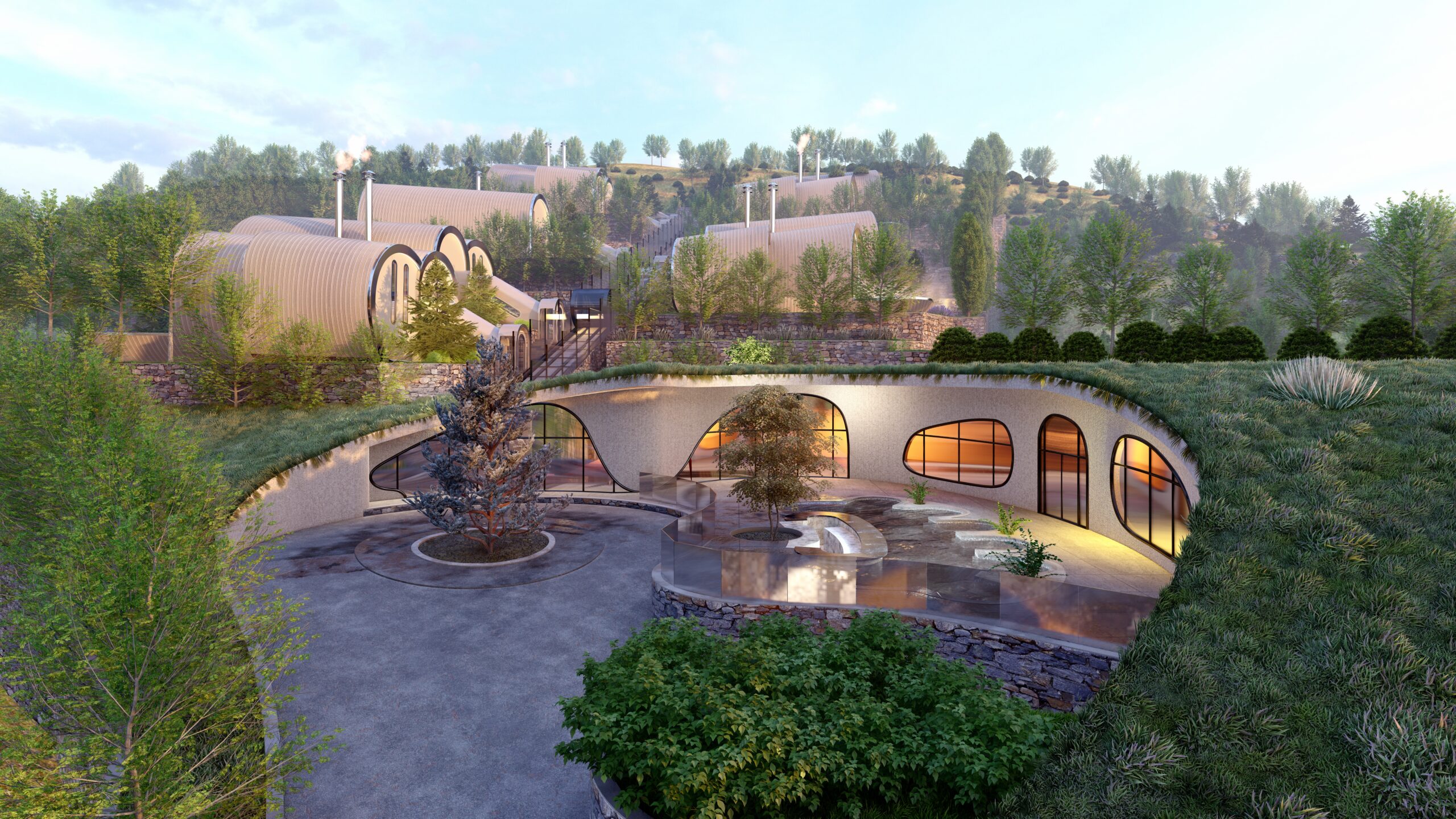
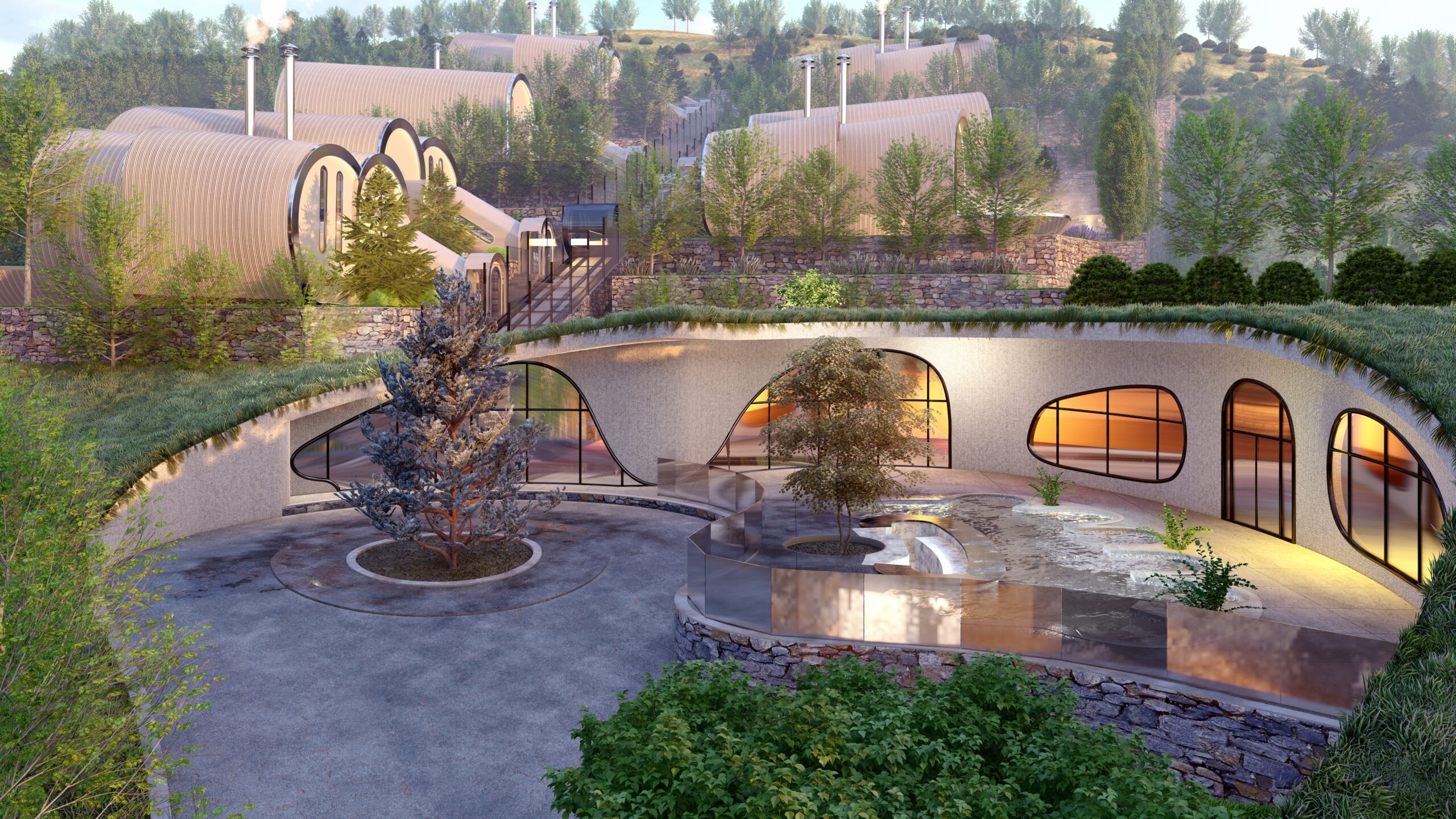
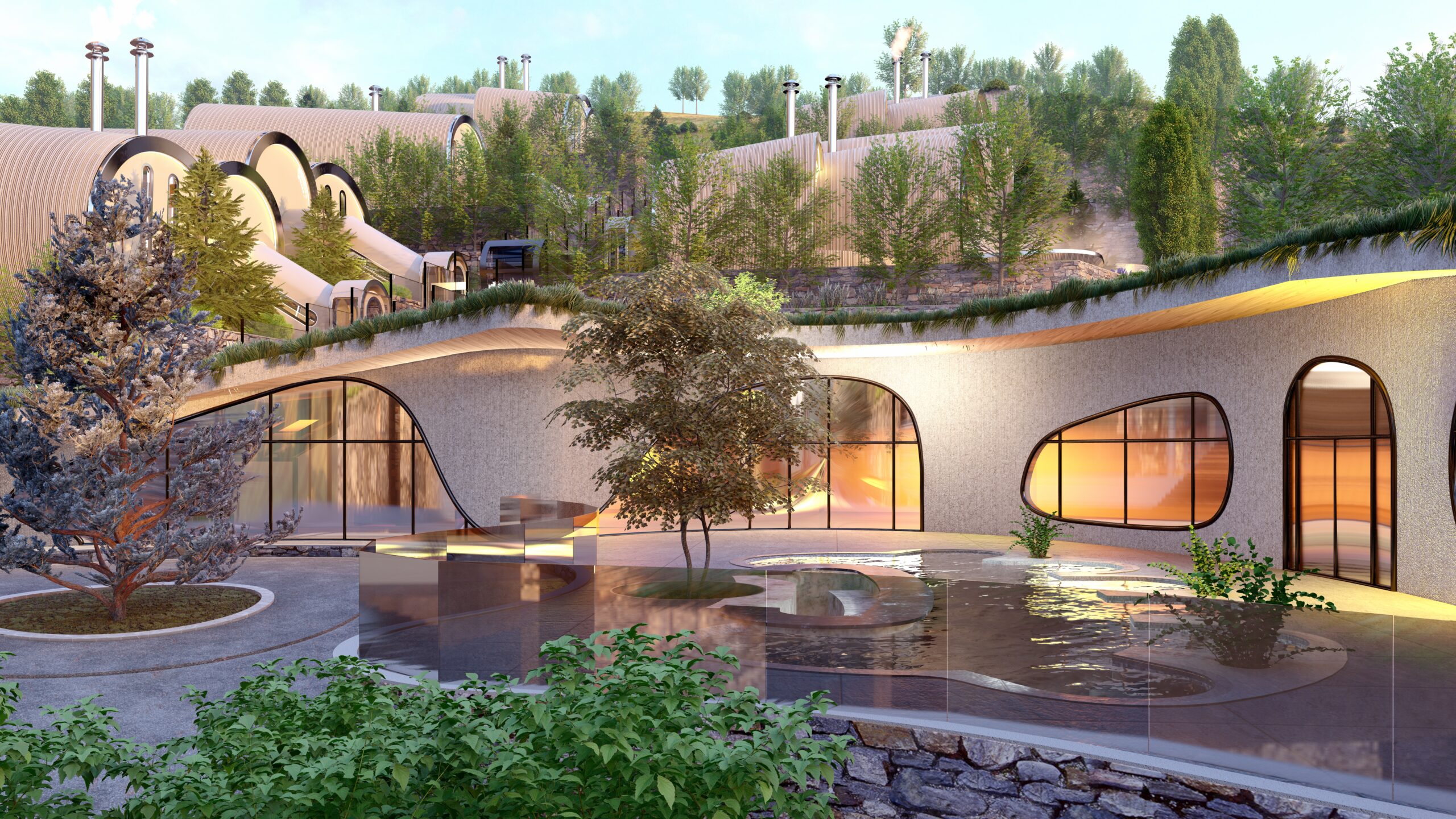
The reception building operates on a completely different logic from the guest pods above it. Rather than sitting on the landscape, it sits inside it. The structure is embedded into the base of the slope — a curved, semi-subterranean volume whose roof is the ground itself, edged in stone and planted with grass and low shrubs. From above, it is almost invisible. From the approach, it reveals itself as a sweeping organic arc, its exterior wall punctuated by a series of tall arched windows that glow amber from within.
The courtyard at the heart of the reception level is the arrival moment — an open-air space framed by the curved facade, with a reflecting water feature at its center, trees planted in circular stone surrounds, and the mountain rising immediately behind. It is designed to be the last moment of the external world before the guest ascends into the pod sequence above. Quiet, composed, grounded.
Two Floors, Two Worlds: The Interior Logic
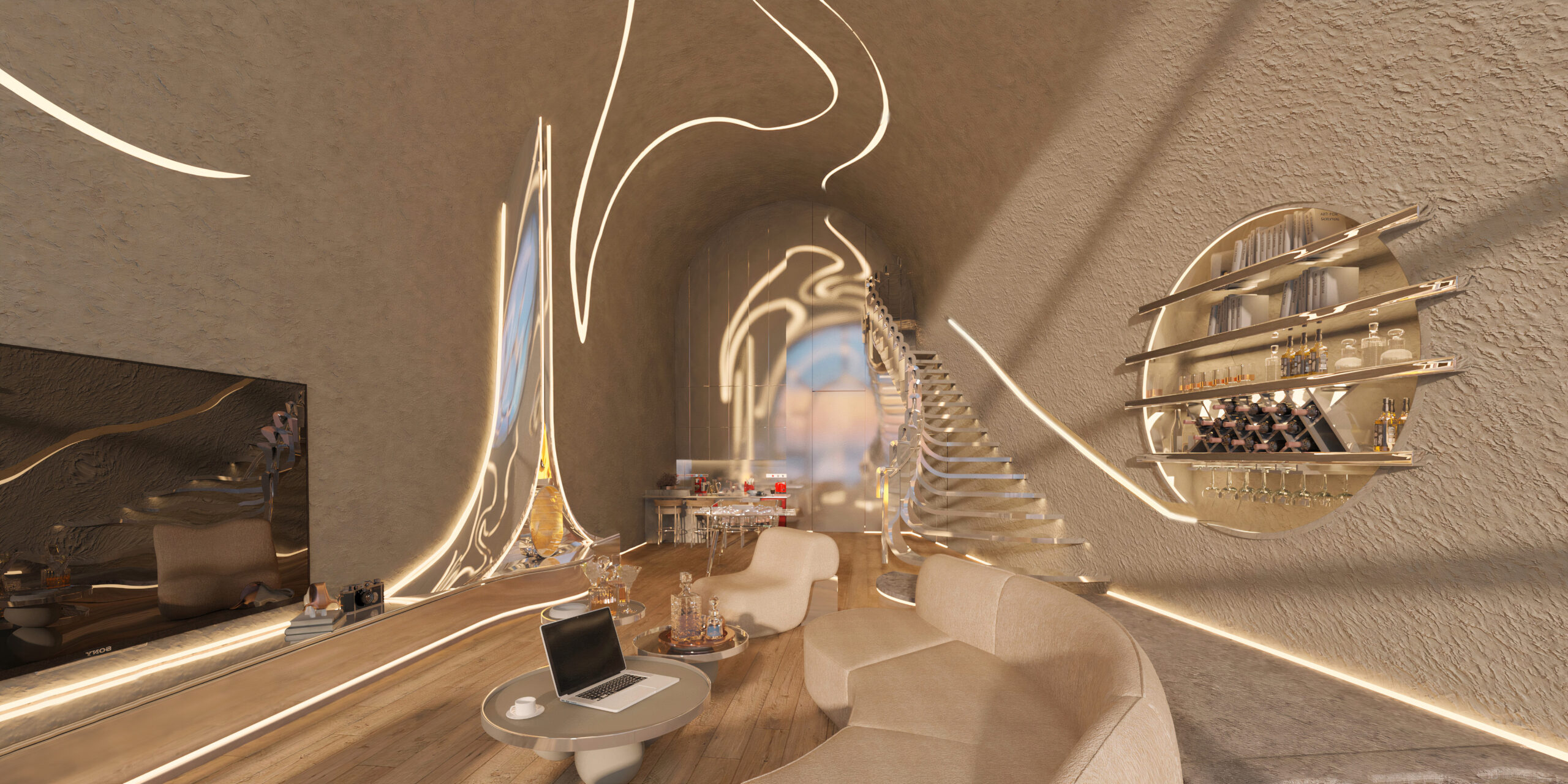
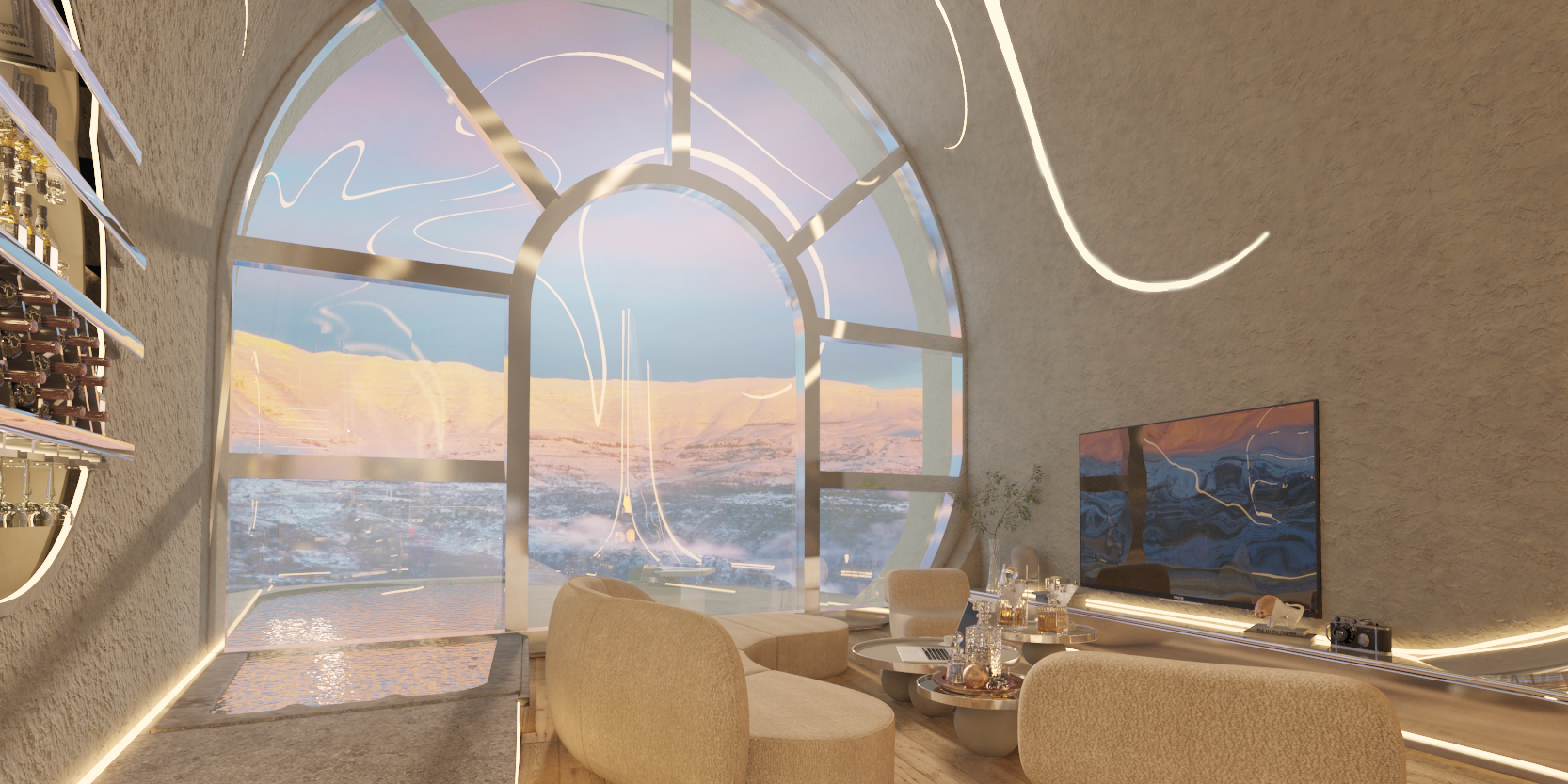
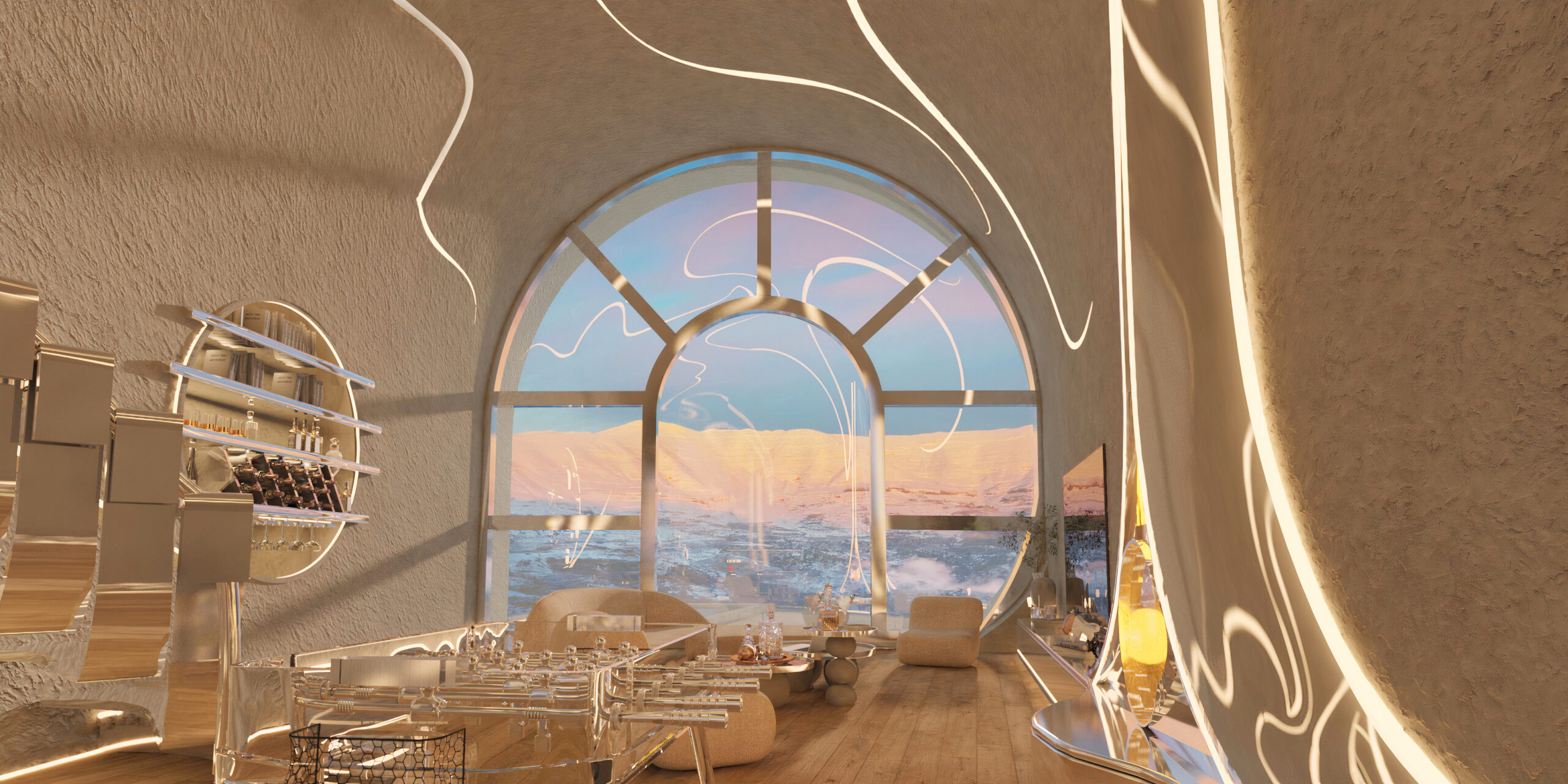
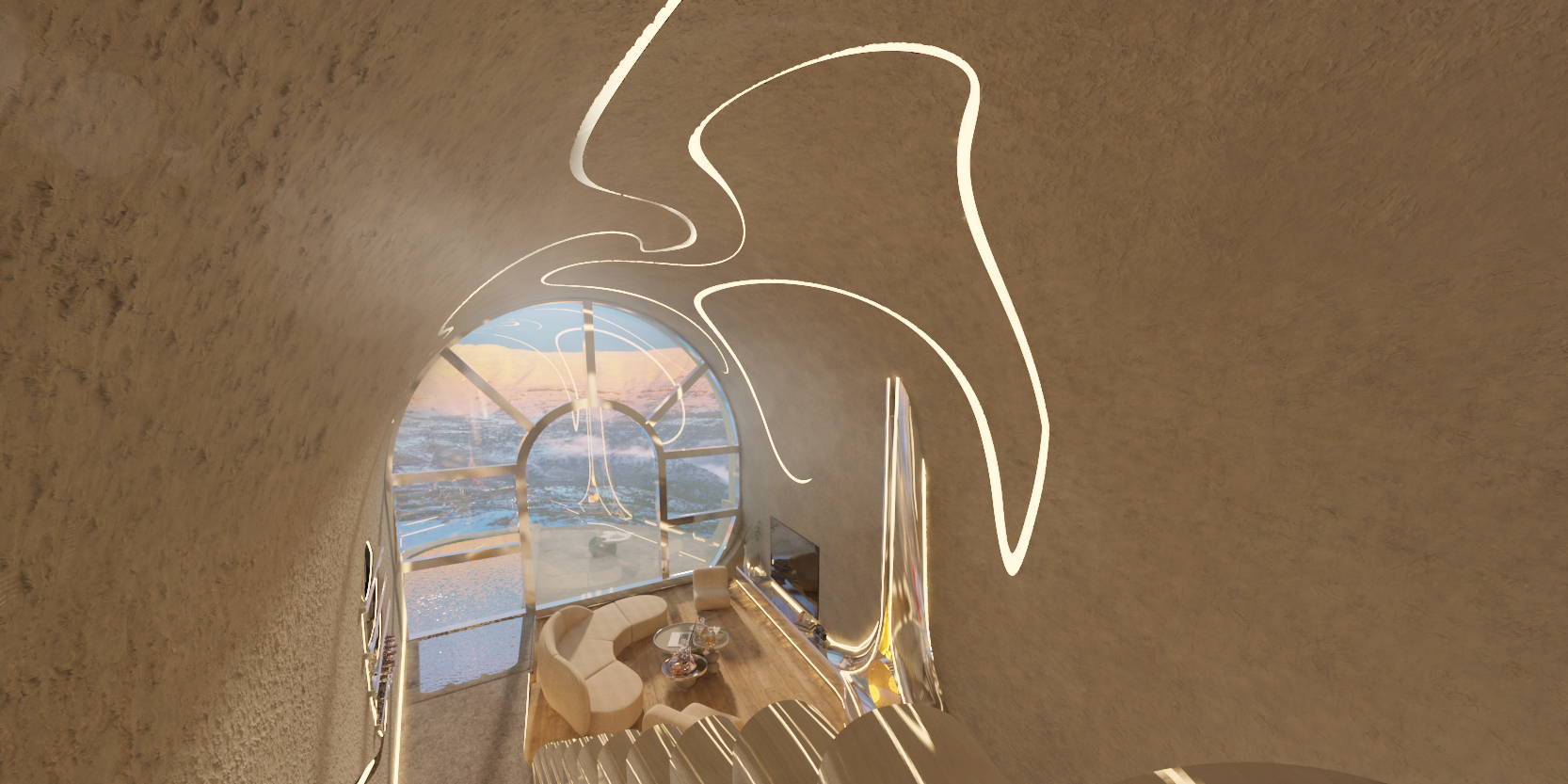
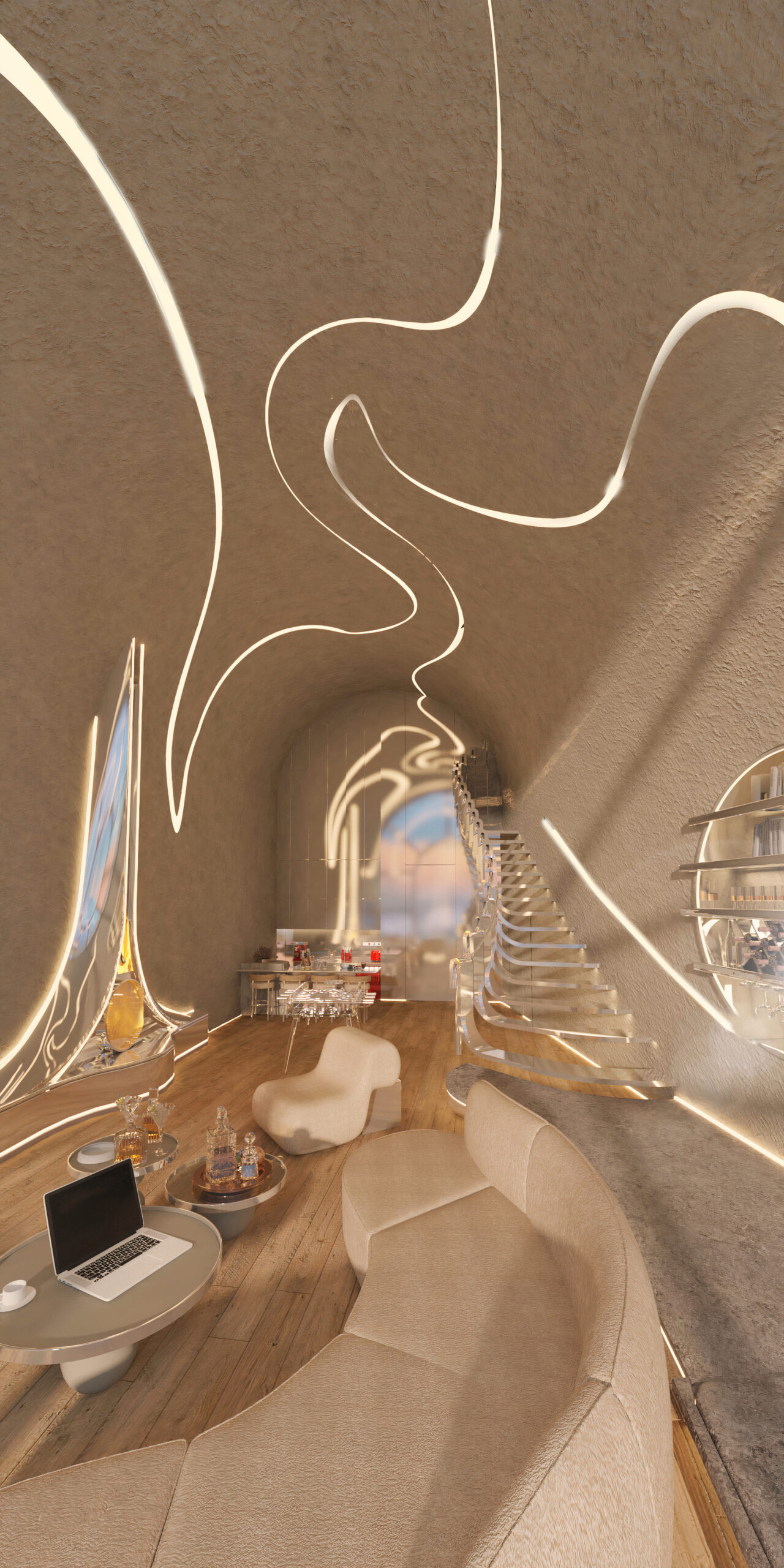
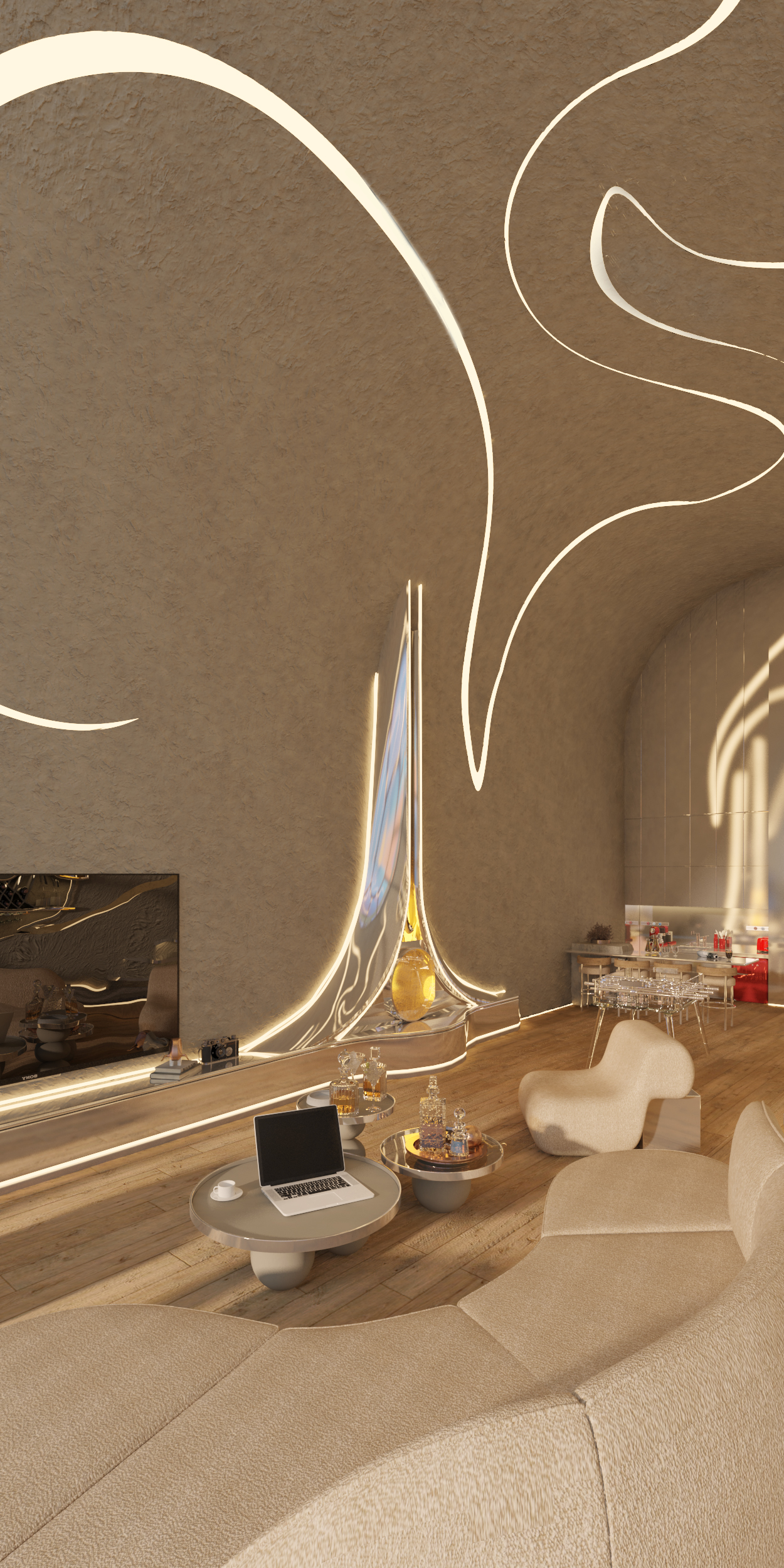
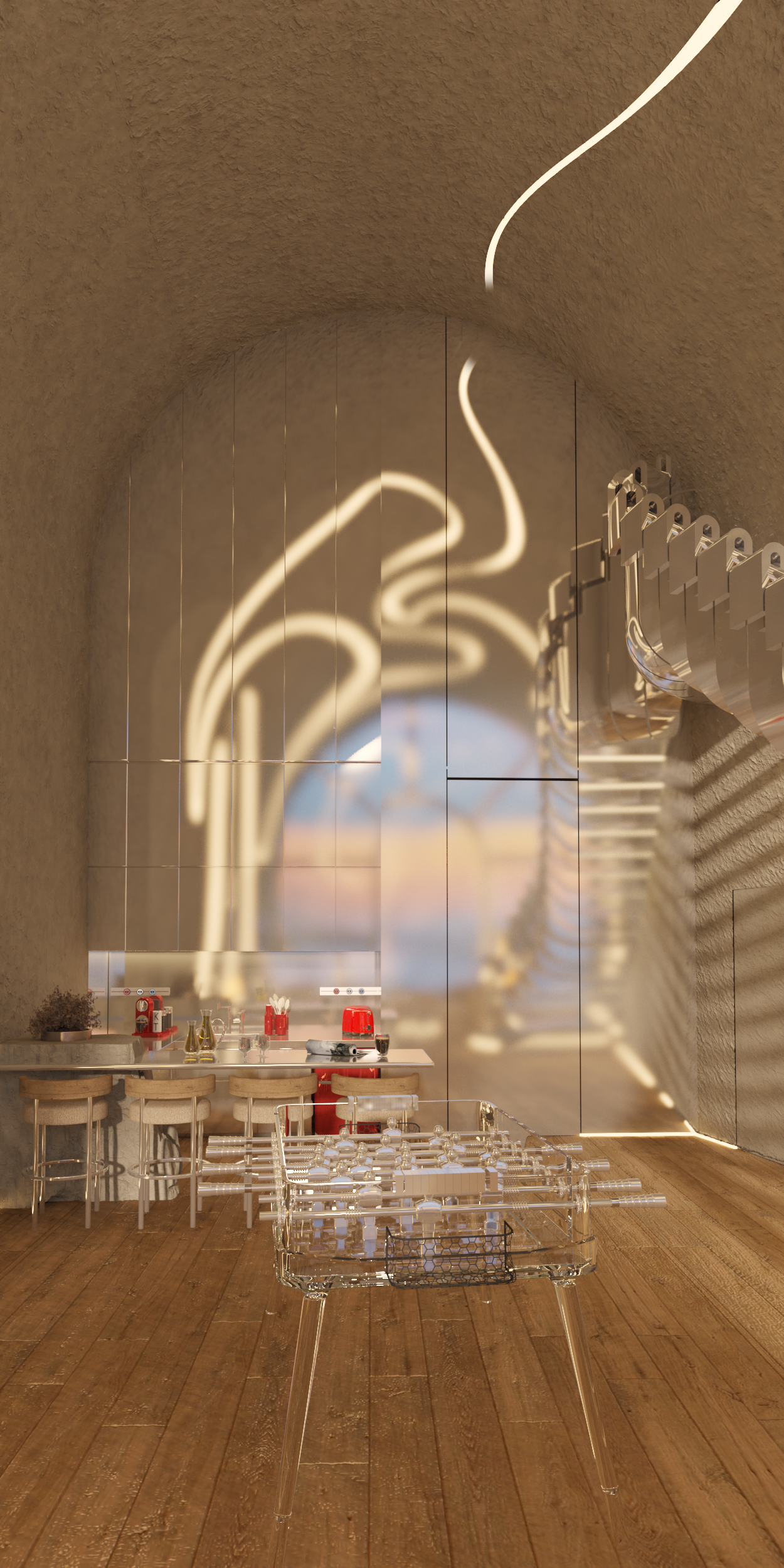
Inside each pod, the experience splits into two distinct registers — one for living, one for sleeping — and they could not be more different from each other. This duality is intentional. The living floor occupies the lower cylinder. The walls are raw plaster — textured, sandy, warm — and from them emerge neon light sculptures that trace fluid, calligraphic lines across the ceiling and down the surfaces. These are not decorative lighting fixtures. They are the architecture of the ceiling itself, lines of light that move like wind through the space, giving the vaulted interior the quality of something alive.
A curved cream bouclé sofa anchors the living area. A sculptural golden flame-like art piece rises from the centre of the room. Against the wall, a round-shelved bar niche in polished brass. The arched panoramic window at the end of the barrel floods the room with mountain light — the valley spread wide beyond the glass, framed by the arc of the pod itself.
Light as Architecture: The Neon Ceiling Sculptures
The neon light drawings that cover the ceilings and walls of the living floor are one of the most distinctive design moves in Novantique. They are not applied after the fact — they are conceived as part of the spatial composition, their lines choreographed to move with the curve of the barrel vault, pooling at the apex and trailing down the textured plaster walls. From certain angles, the light traces look like a face, or a figure in motion. From others, they read as pure abstraction — the trace of wind, or water, or thought.
The effect is that the living space feels inhabited by something beyond furniture and objects. The ceiling has a presence. When the mountain view through the arched window catches golden hour light, the neon drawings on the walls become almost invisible against the warmth of the plaster. At night, they dominate. The room changes completely depending on what the sky is doing outside.
The Kitchen and the Staircase
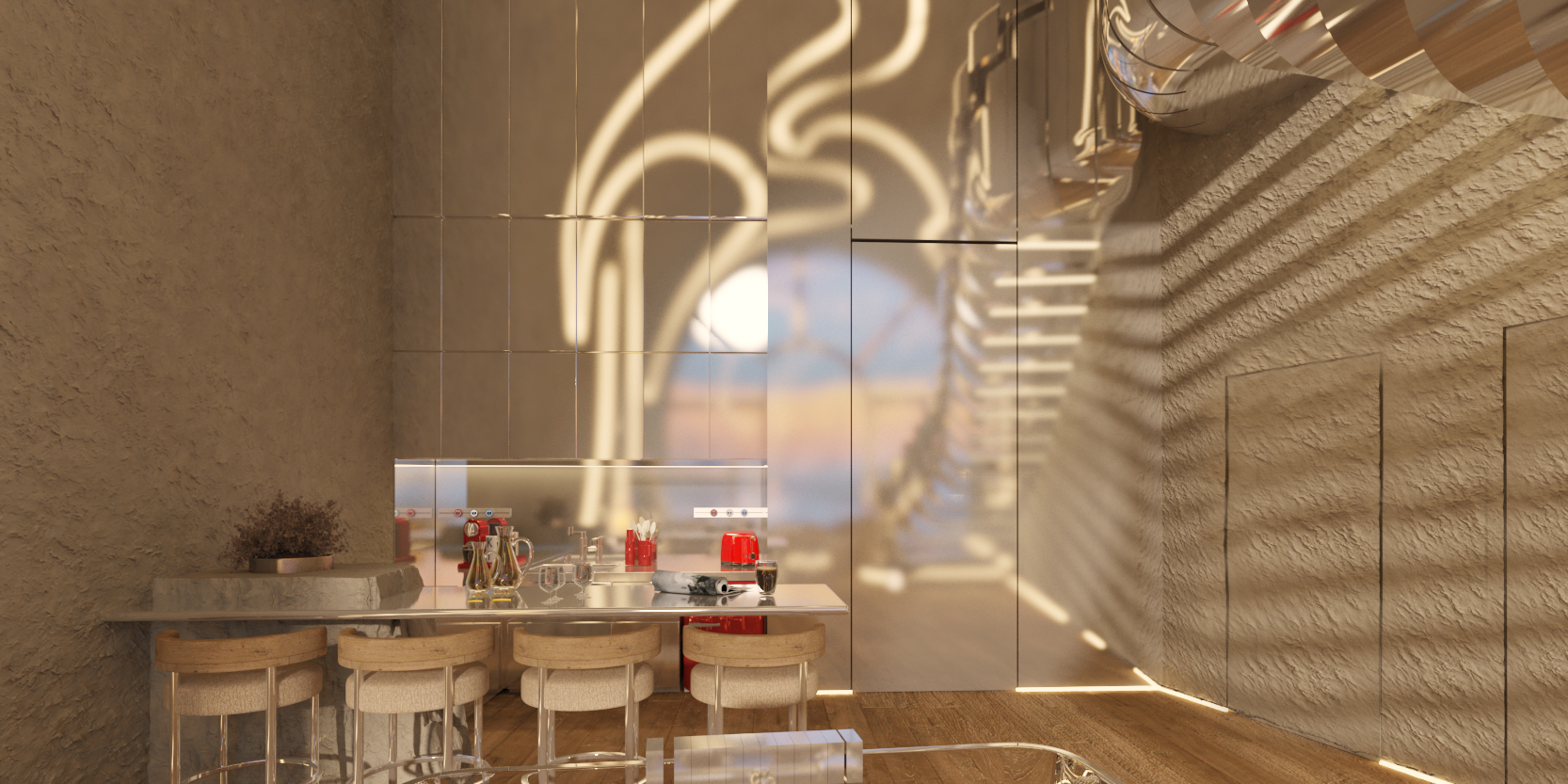
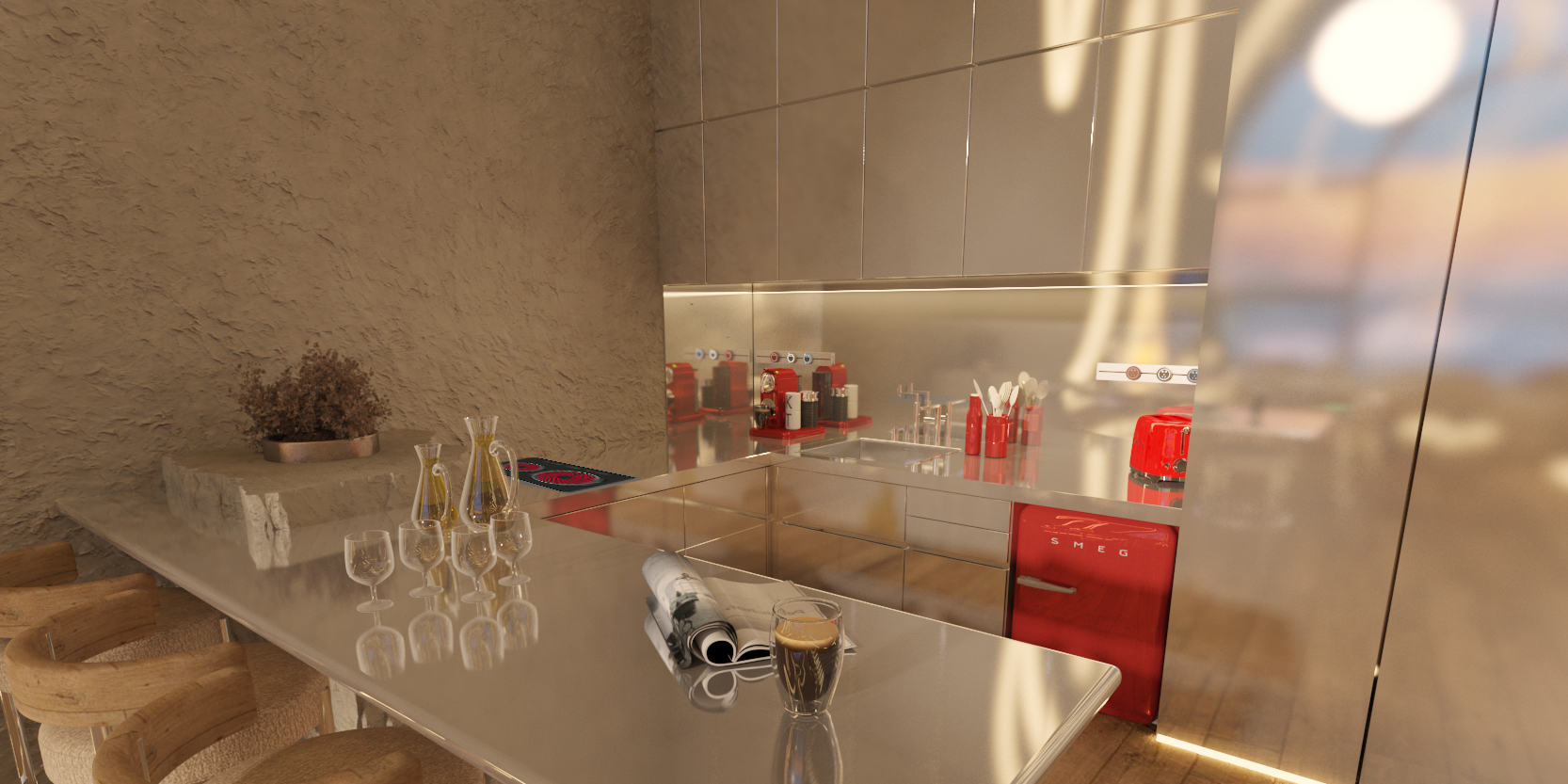
Between the living area and the staircase that climbs to the bedroom, the kitchen occupies a compact but considered position. Mirror-finished cabinetry lines the walls, a red SMEG mini-fridge anchors the palette with a deliberate pop of colour against the otherwise sand-and-gold palette, and a marble breakfast counter with bar stools faces the mirrored back wall, which reflects the arched window behind. It is a kitchen designed for two people on a mountain morning — coffee, light, the view.
The staircase is the structural and visual centrepiece of the living floor. It floats — cantilevered treads in polished steel with no visible support, each step lit from beneath, the whole assembly climbing through the cylindrical connector tube to the bedroom above. Seen from the living sofa, it reads as sculpture. The staircase also appears in the reflection of the kitchen’s mirrored wall, doubling itself across the space.
The Bedroom: The Dark Capsule
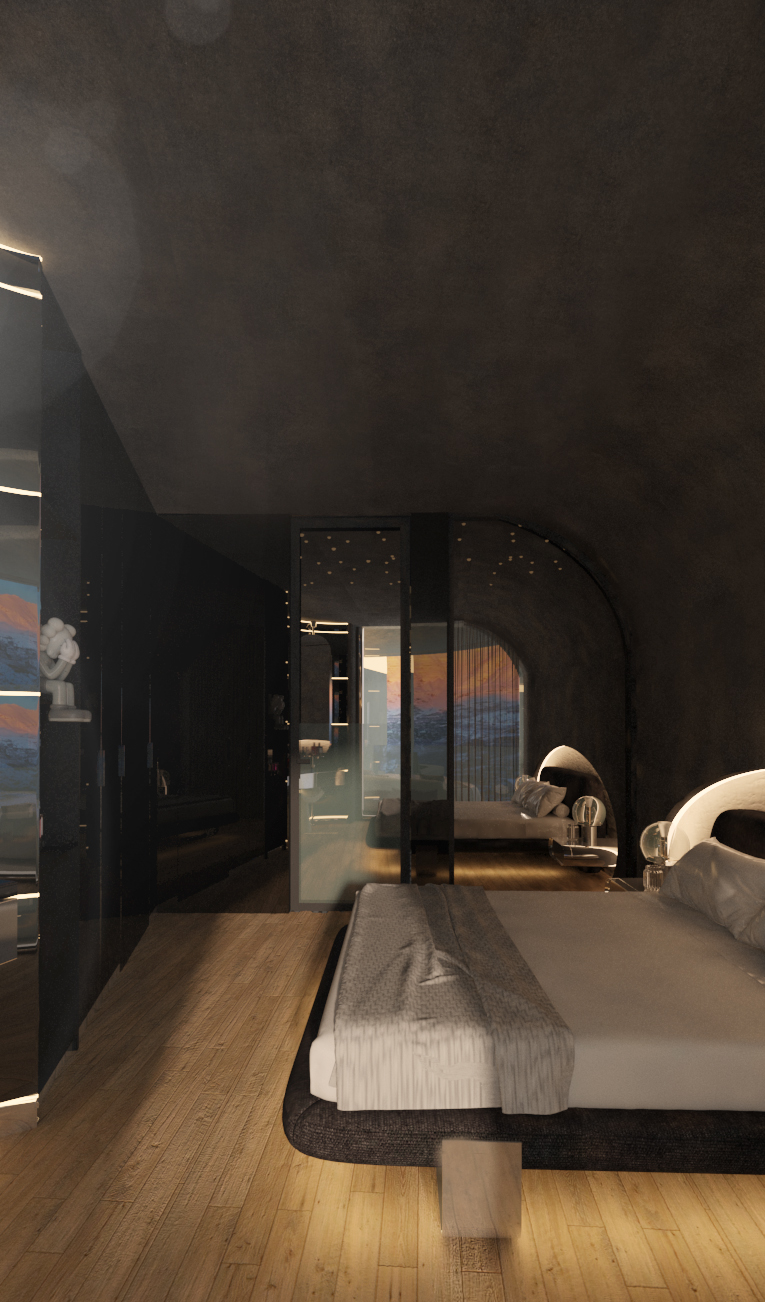
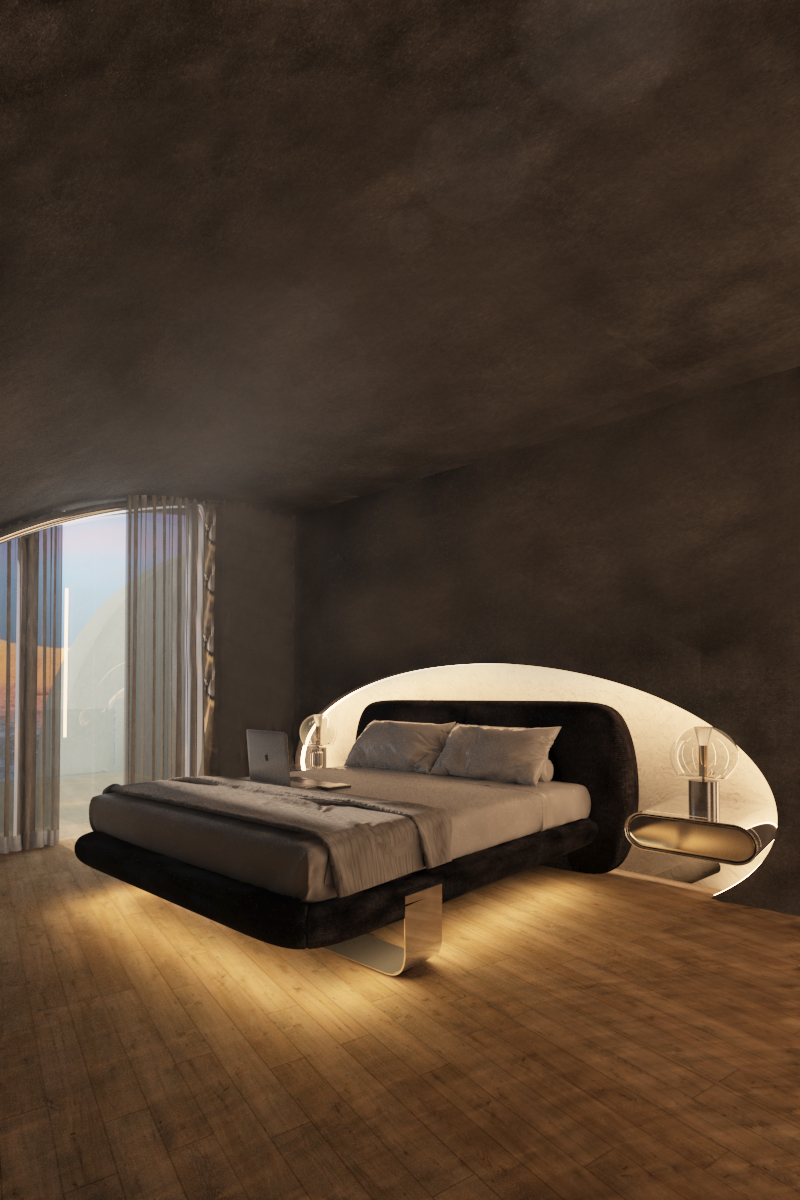
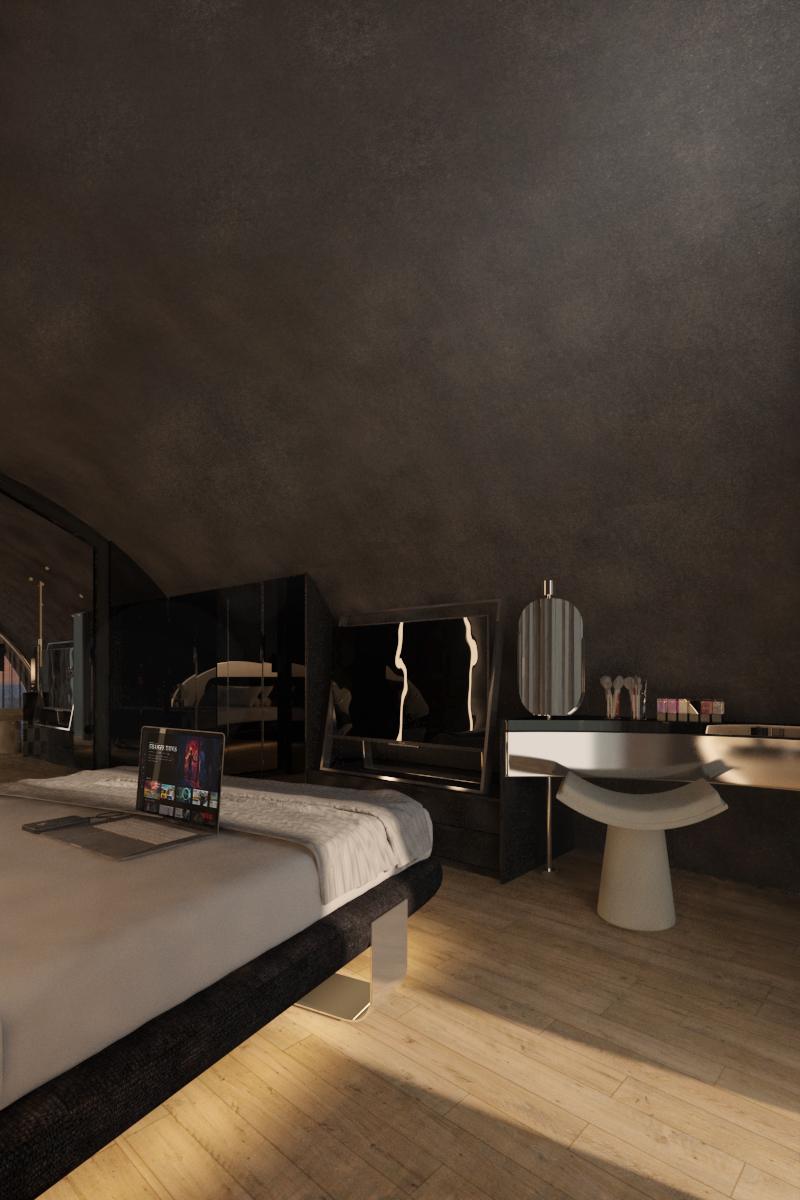
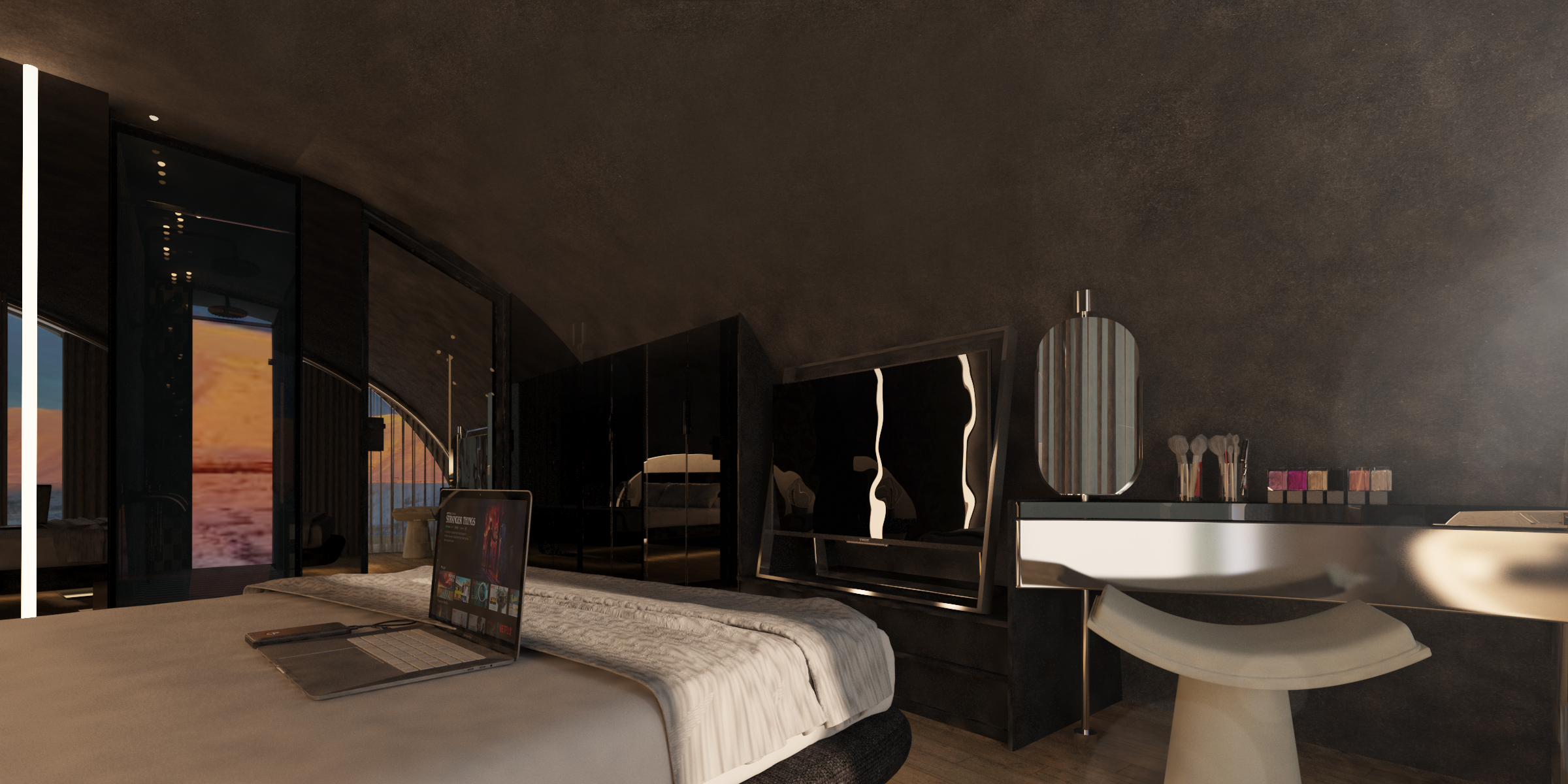
Upstairs, everything changes. The bedroom floor operates in near-total darkness — deep charcoal plaster walls and ceiling, oak wood floors warm underfoot, and almost no daylight except through the arched glass panel that frames the mountain view beyond the curtain. The darkness is not absence. It is a material decision — the same way a cinema is dark not because it cannot afford light, but because the darkness is the point.
The bed is the centrepiece — a bespoke form with a sculpted white arched headboard alcove that curves around the bedhead like a halo, backlit to cast a warm glow upward into the dark ceiling. The bed platform floats on a chrome base with ambient underlighting. Beside it, chrome oval nightstands hold globe-shaped lamps. The mountain outside, visible through the arched window, provides the only natural reference point in an otherwise sealed, dark world.
The Vanity Alcove: Ritual Space
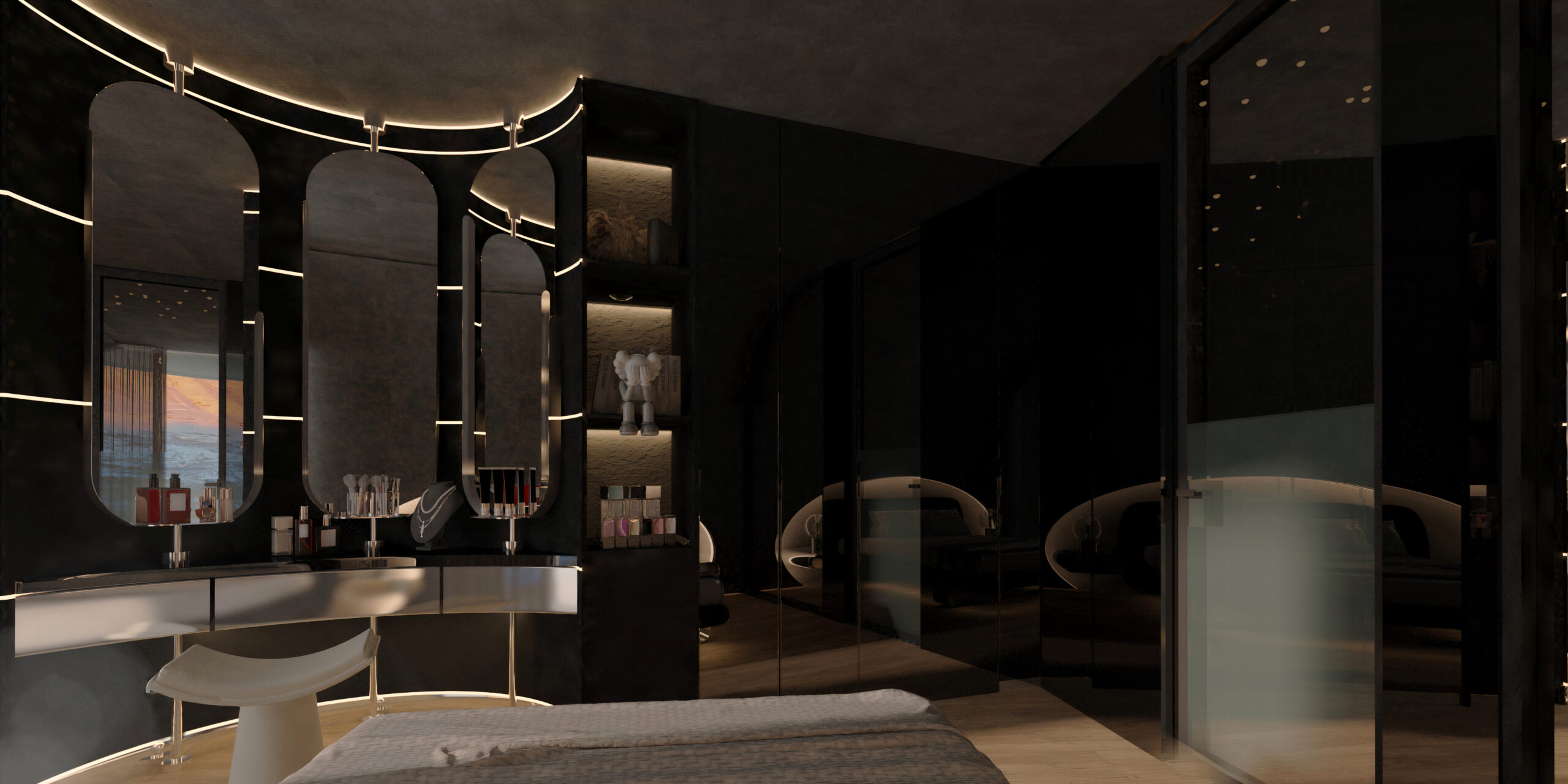
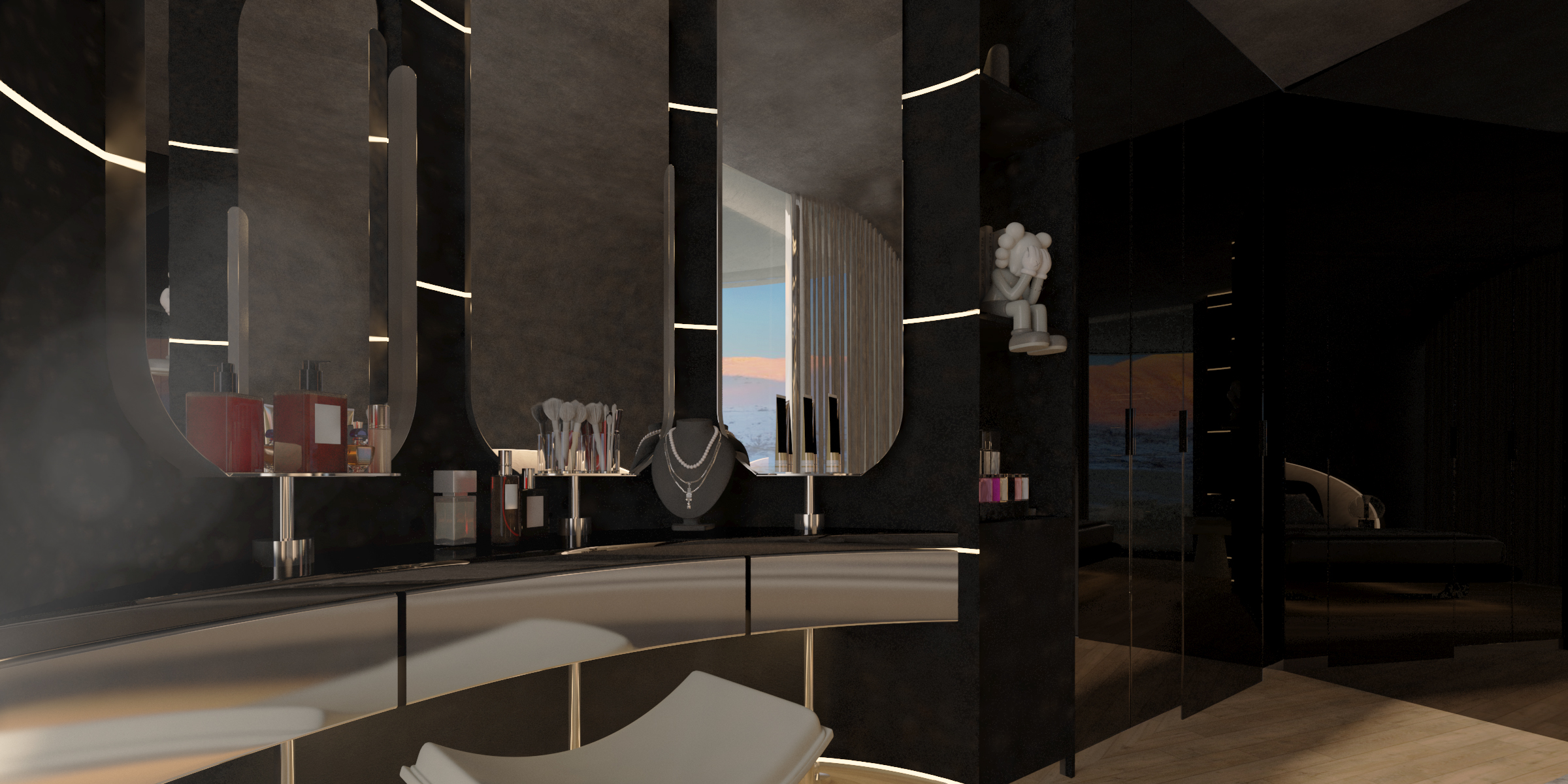
Adjacent to the bed, the vanity alcove is the most personal corner of the suite. A triple-mirror arrangement — three tall arched mirrors in rounded rectangular frames, suspended from a curved backlit gold cornice — faces a white lacquer vanity surface arranged with perfumes, brushes, and personal objects. The shelving beside it holds a curated display: a KAWS companion figure, books, personal artifacts — the only deliberate accent of cultural personality in an otherwise restrained palette.
The details in this corner — the rounded forms of the mirrors, the tulip stool, the gold trim on every edge — speak to the same language as the staircase and the neon light sculptures below. Nothing in Novantique is rectilinear where it does not have to be. The circle, the arch, the curve: these are the grammar of the project, repeated from the barrel-vault exterior all the way down to the shape of a nightstand.
The Hotel in Winter: A Different Project Entirely
One of the most deliberate choices in the design process was to render Novantique in snow. It is not a supplementary version of the project — it is an argument for it. The pods, in their ribbed silver-grey skins, disappear into a white landscape in a way that no other material choice would allow. The warm amber glow from the arched windows becomes the only reference point across the hillside. Smoke rises from the chimney flues above each pod. The reception courtyard fills with white.
Novantique in winter is not a hotel that tolerates its context. It belongs to it. The whole design — the embedded reception, the tram, the terraced pods, the hot tubs on every terrace — was conceived with this image in mind: a cluster of warm capsules in a cold mountain, each one a self-contained world, reached by a glass cabin moving silently through the dark. The snow render is not atmospheric styling. It is the truest version of the project.
Design for Generational Impact
Novantique is the kind of project that could only come from starting with an honest question: what does this specific site demand? Not what do mountain hotels usually look like — but what does this particular slope, this particular elevation change, this particular relationship between land and view require from us as designers? The elevator tram was not a clever add-on. It was the answer to a problem the land set for us, and everything else in the project — the pods, the reception, the two-floor interior world — grew from that solution outward.
That is what we mean when we say we design for generational impact. Not impact as spectacle. Impact as the trace a building leaves on the way a person moves through space — the way a morning feels inside a dark room with a view of white mountains, the way a glass cabin ascending through the trees at dusk becomes the first memory of a place you have not yet arrived in.