Why the best neocement interior design is the one you stop noticing
There is a moment in every finished space when the material stops being the point. The surface is there — underfoot, overhead, running wall to wall — but the eye doesn’t land on it. It lands on the experience. That is when a material has done its job correctly.
Neocement does that job better than almost anything we work with. We use it across F&B spaces, residential projects, and built architectural forms — and the reason we return to it is always the same: it clears the field for everything else.
It is not a new material. It has been used in interiors for decades, particularly across Southern Europe and the Middle East. But the way we use it — what we ask of it, where we place it, what we use it to say — is not about following a trend. It is about solving a specific design problem that most spaces get wrong.

What neocement is and how it works as a surface coating
Neocement is a cement-based coating applied directly over existing surfaces. It is not tile. It is not paint. It is not polished concrete, though it can resemble it closely. It is a thin, continuous skin — typically 2 to 3 millimetres — that bonds to almost any substrate and cures into a seamless, monolithic finish.
It can be applied to floors, walls, ceilings, and built forms. The same material, unbroken, can travel across an entire room — and in some cases across an entire architectural element — without a single joint or grout line. That continuity is not a stylistic choice. It is what makes neocement a concept tool rather than just a finish.
The surface can be matte or satin. Raw and industrial or refined and warm. Cool pale grey or deep sand. The pigment range is wide enough to push it in almost any direction the concept requires. What it cannot do is compete for attention. It is, by nature, a receding material — and that is precisely why we return to it.

How we decide when to use neocement in a project
When a concept brief lands on the table, the material question is never asked first. It comes last. The concept comes first — the emotional register of the space, the experience the client needs to deliver, the behaviour they want to trigger in whoever walks through the door.
By the time we arrive at neocement, the decision is usually already clear. The concept has told us what it needs. A surface with no joints, no pattern, no competing visual weight. A background that makes everything placed in front of it read more sharply.
That is the function of neocement interior design in our work: it gives the concept room to breathe.
Neocement on walls, floors, and ceilings — two F&B projects
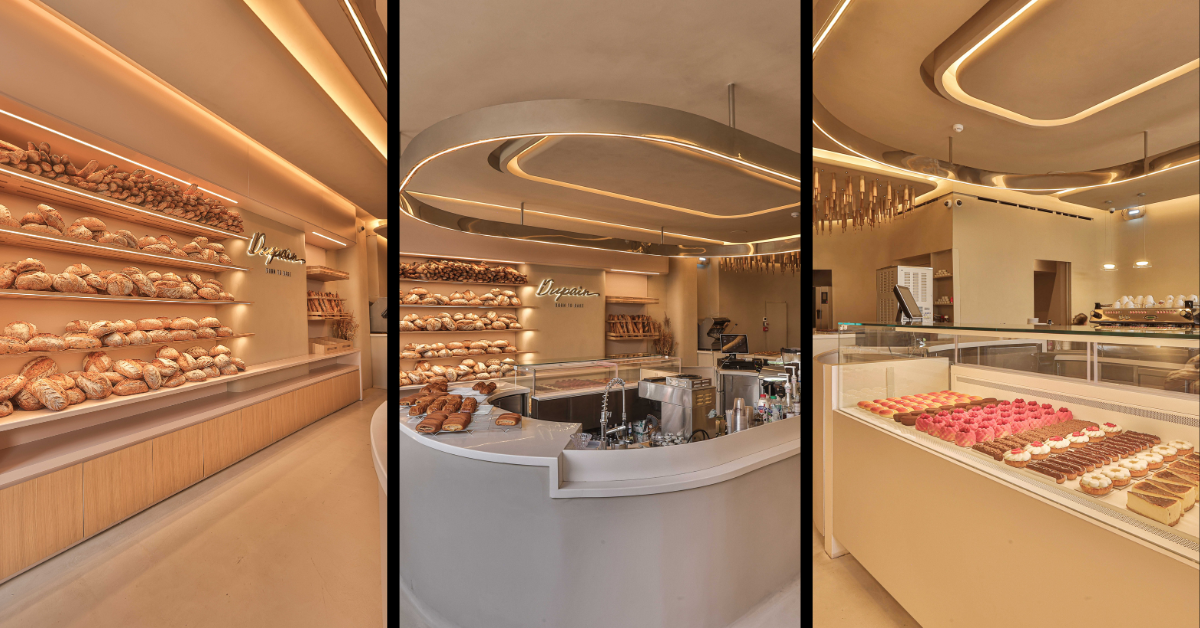
Dupain is a bakery and café concept where the brief demanded warmth without nostalgia. The risk with any F&B space built around bread, wood, and morning light is that it tips into a version of itself you have seen before — comfortable, competent, and entirely forgettable.
At Dupain, the neocement runs across the walls and ceiling throughout — a warm sand tone that wraps the entire volume continuously, with no interruption. The curved cove lighting sits within it, the Dupain wordmark is mounted against it, the shelving recedes into it. Nothing competes. The material is the reason the croissants and the timber and the handwritten script all read so clearly — because the background refuses to participate in the foreground.
What makes the Dupain application distinctive is the ceiling. Neocement on walls is common enough. Neocement overhead — wrapping down from wall to ceiling without break, holding the amber glow of the cove lighting and distributing it evenly across the room — is a different proposition entirely. It gives the space its envelope. Morning light comes in through the glazing and the neocement catches it, warms it, holds it. By midday the room has shifted. That behaviour is not incidental. A space built around the ritual of early morning coffee needs to feel alive to time, not frozen in a single mood. The neocement made that possible.
Roff is a coffee shop by day and a cocktail bar by night — a concept built entirely around the idea that one space can hold two completely different emotional registers without contradiction. That kind of brief puts enormous pressure on every surface decision. Nothing can read as belonging exclusively to one mode.
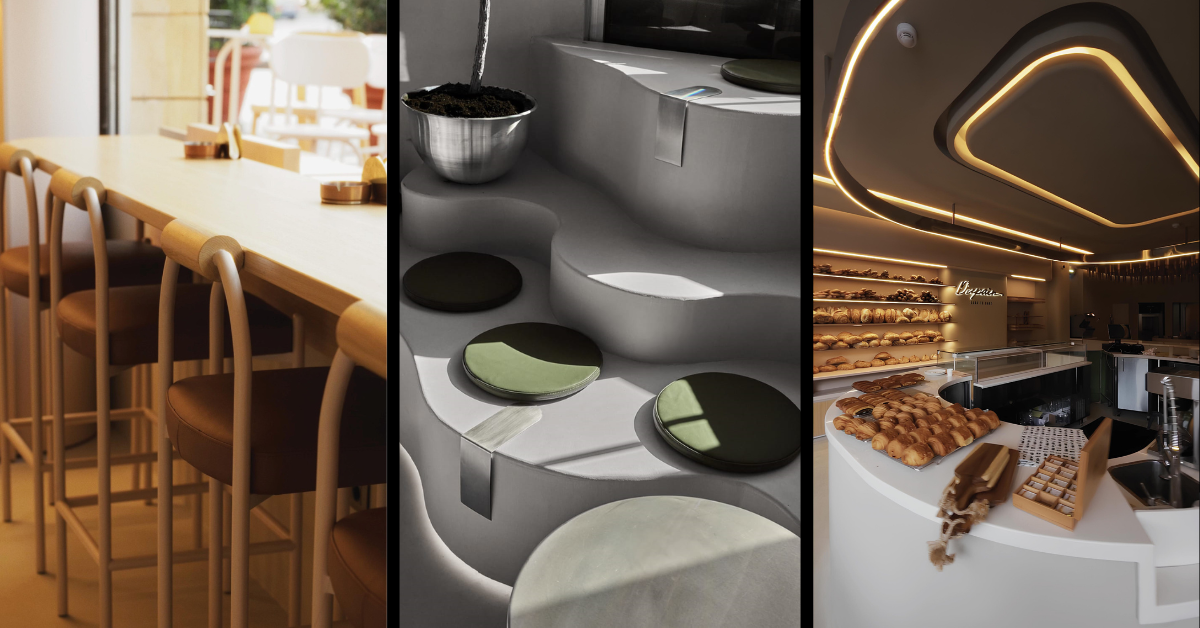
At Roff, neocement doesn’t just cover the surfaces — it builds them. The walls, the floor, and the entire tiered seating structure that defines the window zone are all formed from the same material, in the same pale cool grey, continuous and unbroken. The seating is not furniture placed on a neocement floor. The seating is neocement — organic, wave-form volumes that emerge from the ground plane as if the space grew them. There is no visual interruption between what you sit on and what surrounds you.
In daylight, this reads as sculpture. The material is quiet enough that the light does all the work — raking across the curved forms, casting sharp shadows, changing the character of the room hour by hour. The exposed concrete ceiling above creates a deliberate tension: raw above, refined below, the neocement sitting between the two as the element that makes sense of both.
By night, under directed spot lighting, the same surfaces hold differently. The texture activates. What felt soft and ambient in the morning becomes more deliberate, more present. A space with two identities needed a surface that belonged to neither one specifically — and to both completely. The neocement at Roff is exactly that.

Neocement maintenance and durability in commercial spaces
The most consistent question about neocement is maintenance. Can it stain? Yes. Does it require sealing? Yes. Is it appropriate for a high-traffic commercial floor?
It depends entirely on how it is specified and finished.
In every commercial environment we use neocement, we seal it — two to three coats of a high-quality topcoat matched to the surface finish. Properly sealed and properly maintained, it performs well under demanding conditions. It is not indestructible. Neither is timber or honed stone, and neither of those is removed from the palette for that reason.
The more useful question is not whether neocement can handle the conditions. It is whether the conditions deserve neocement. Not every space does. When the concept calls for a seamless, continuous surface that recedes and lets the experience take the foreground, there is almost nothing better. When the concept calls for pattern, dominant texture, or a material with its own strong visual personality, we will reach for something else.
Material selection is a concept decision. That is the only frame that consistently produces the right answer.
Why neocement works as a concept material, not just a finish
Every material we specify is asked the same question before it enters a project: what does this material do to the experience of the space? Not what does it look like in a sample. What does it do to the person standing inside the finished room?
Neocement’s answer is consistent: it clears the field. It removes visual competition. It gives the concept — the lighting, the furniture, the spatial sequence, the human movement — the best possible conditions to perform.
That is not a minor contribution. Most spaces fail not because the hero elements are wrong, but because the background is too loud. The surface competes with the concept instead of serving it.
When the material disappears, the experience takes over. That is the outcome every brief is really asking for.