
Player One Entertainment is Lebanon’s first dedicated next-generation gaming and entertainment concept. It is not an arcade. It is not a gaming café. It is a fully designed immersive experience — a space where VR simulators, motion gaming rigs, laser rooms, Floor is Lava rooms, and physical play zones are brought together under a single identity and built into an environment that feels like it was pulled directly out of a game world. You do not go to Player One to sit in front of a screen. You go to feel what it is like when the screen becomes the room around you.
The concept currently spans four locations across Lebanon — Le Mall, Bayada, Revive Club, and WTFun — each one designed by Lartquitecte to fit its setting while remaining unmistakably Player One. Le Mall and Bayada are pure Player One venues, built and branded as standalone destinations from the ground up. Revive Club and WTFun take a different form: Player One lives inside them, a fully realized brand world built into an existing host — a gym at Revive Club, a teen-focused playground at WTFun — rather than a location of its own. And this is only the beginning: more locations are already in design, each one set to push the concept into new territory as Player One continues to expand across the country. The brand has a language that is hard to miss: electric blue, fractured geometric panels, floating cube ceiling installations, neon-lit eye rooms, Floor is Lava rooms, and scrolling LED signage running the brand’s mantras on loop. Play On. Level Up. Game Bigger. Go Big. Whatever location you walk into, you know immediately where you are.
What makes Player One worth talking about — beyond the technology and the machines — is the design. Most entertainment venues treat the interior as a container: a room that holds the equipment. Player One treats the interior as part of the experience itself. The walls, the ceiling, the floor, the lighting, the signage: all of it is designed to put you inside the game before you have even picked up a controller. Each location does this differently, according to its own context and crowd, but the commitment to that idea runs through all of them.
Le Mall
The Le Mall location opens with a facade that earns a second look from anyone passing through. Aluminum composite panels fractured into a low-polygon geometric skin — the same visual language used in 3D game environments — glow with integrated blue neon from within every faceted edge. Floor-to-ceiling tempered glass panels reveal what is happening inside before you even commit to entering. The storefront is already part of the experience.
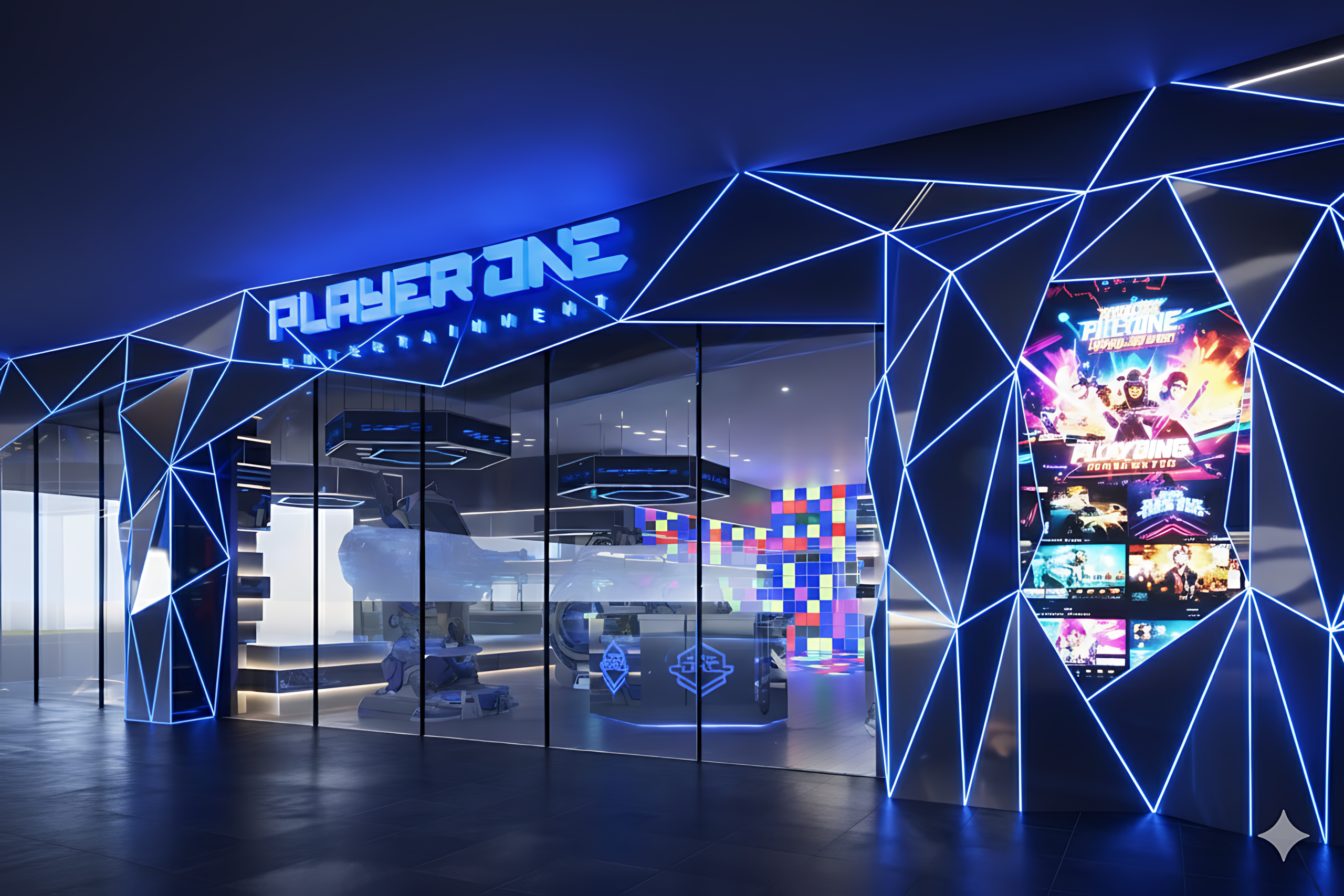
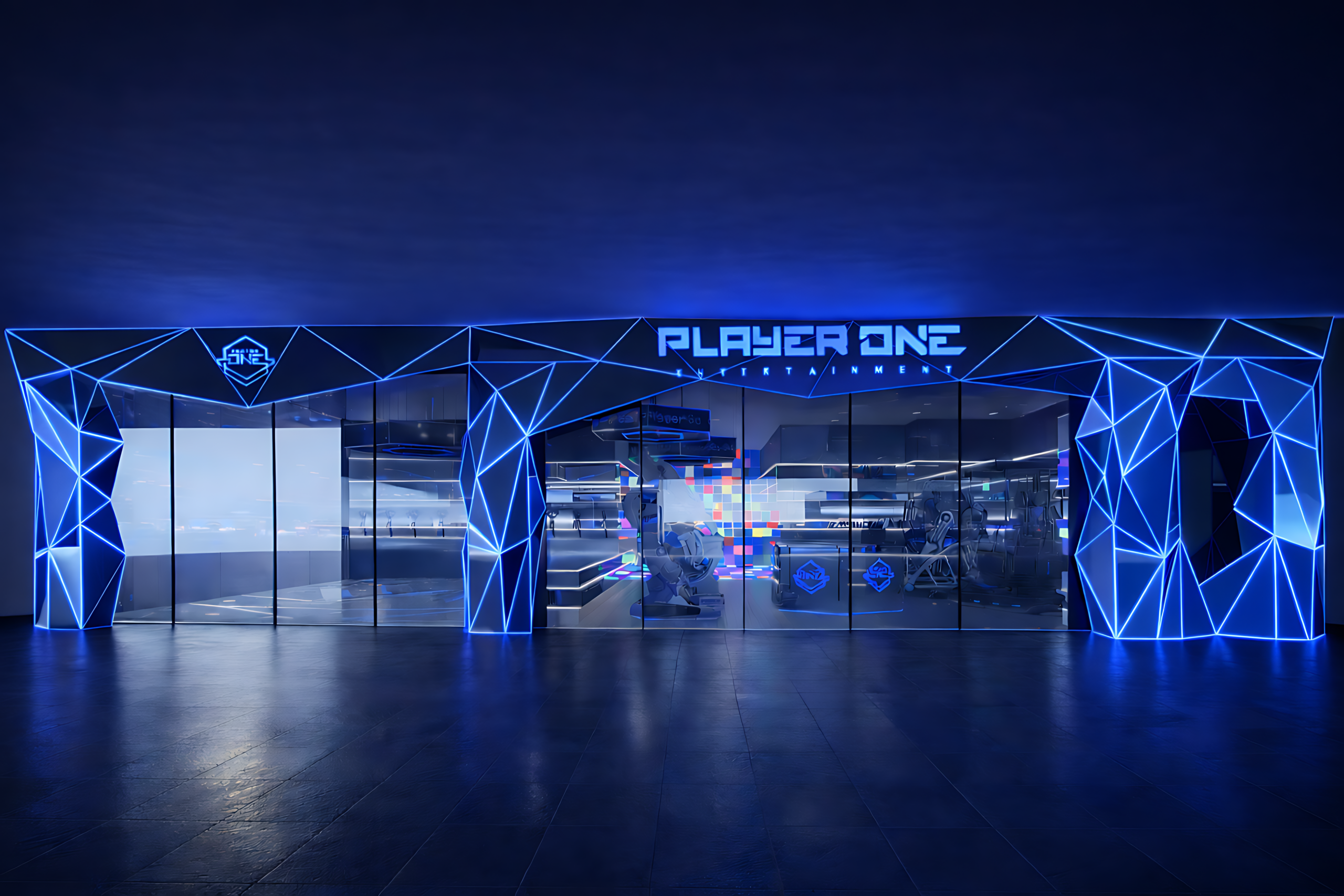
A CNC-cut geometric line system of recessed LED strips maps across the facade like circuit board traces. A flush-mounted LED screen on the exterior runs gameplay content in real time. The facade does not simply identify the brand — it performs it.
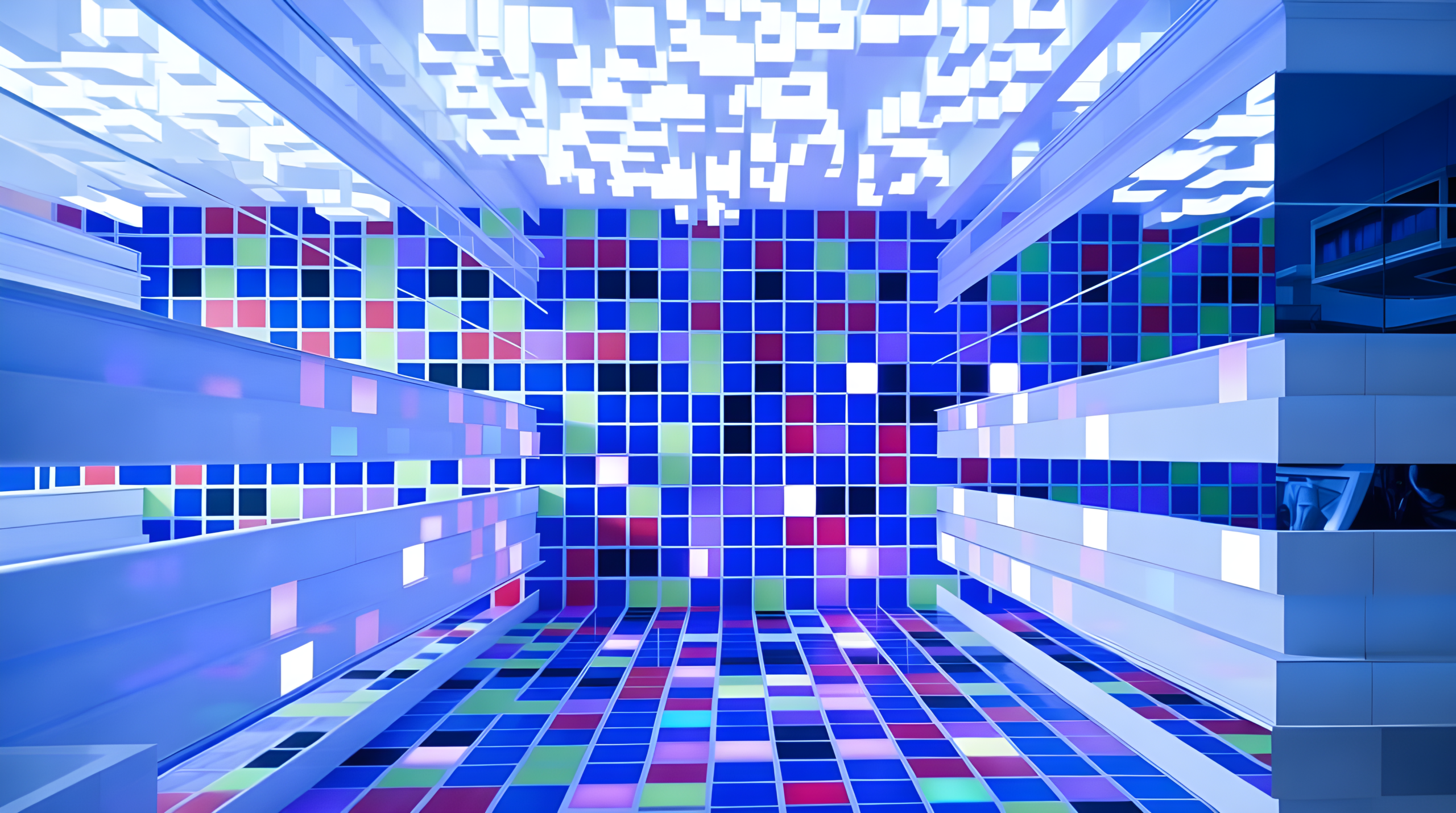
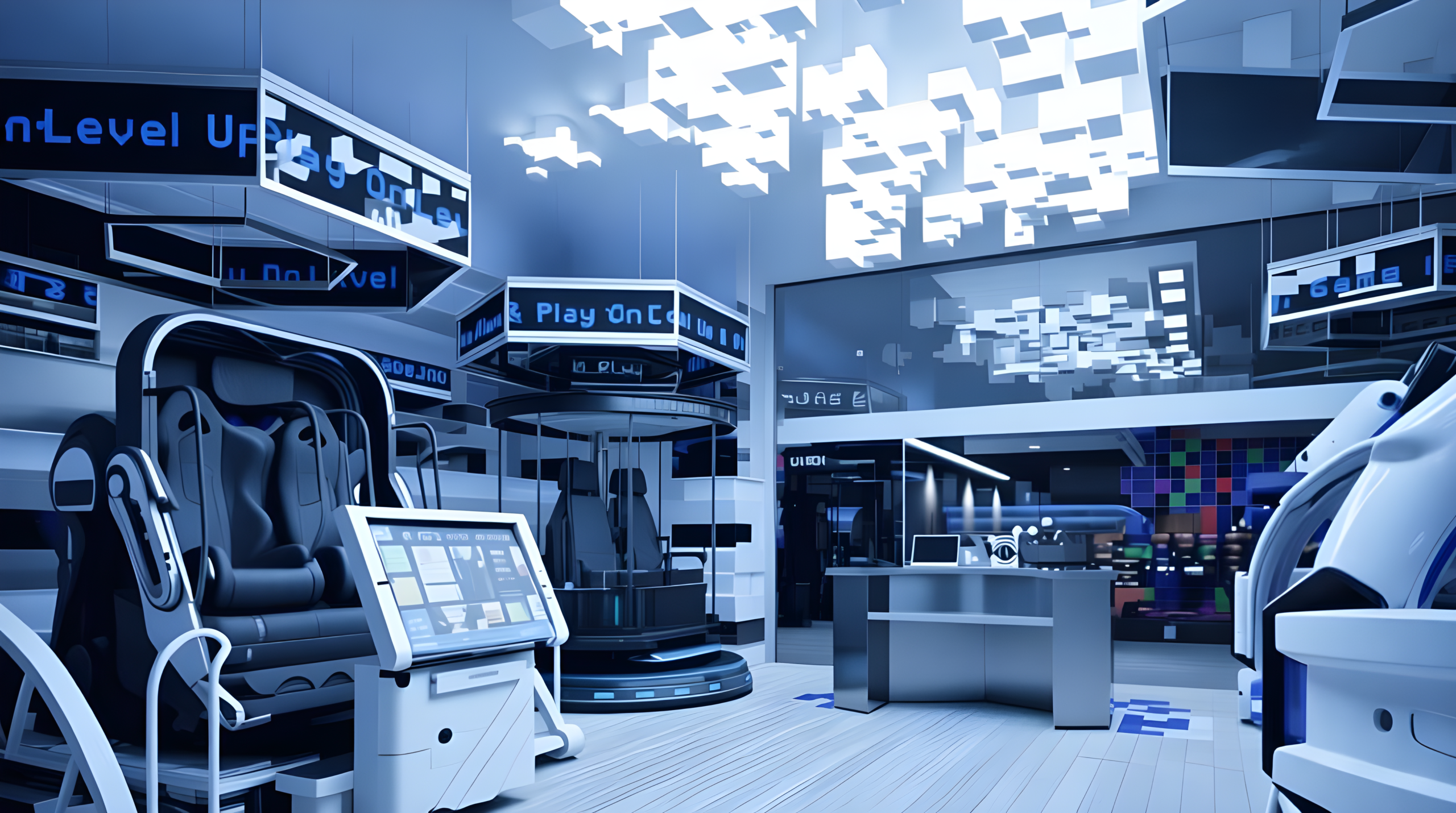
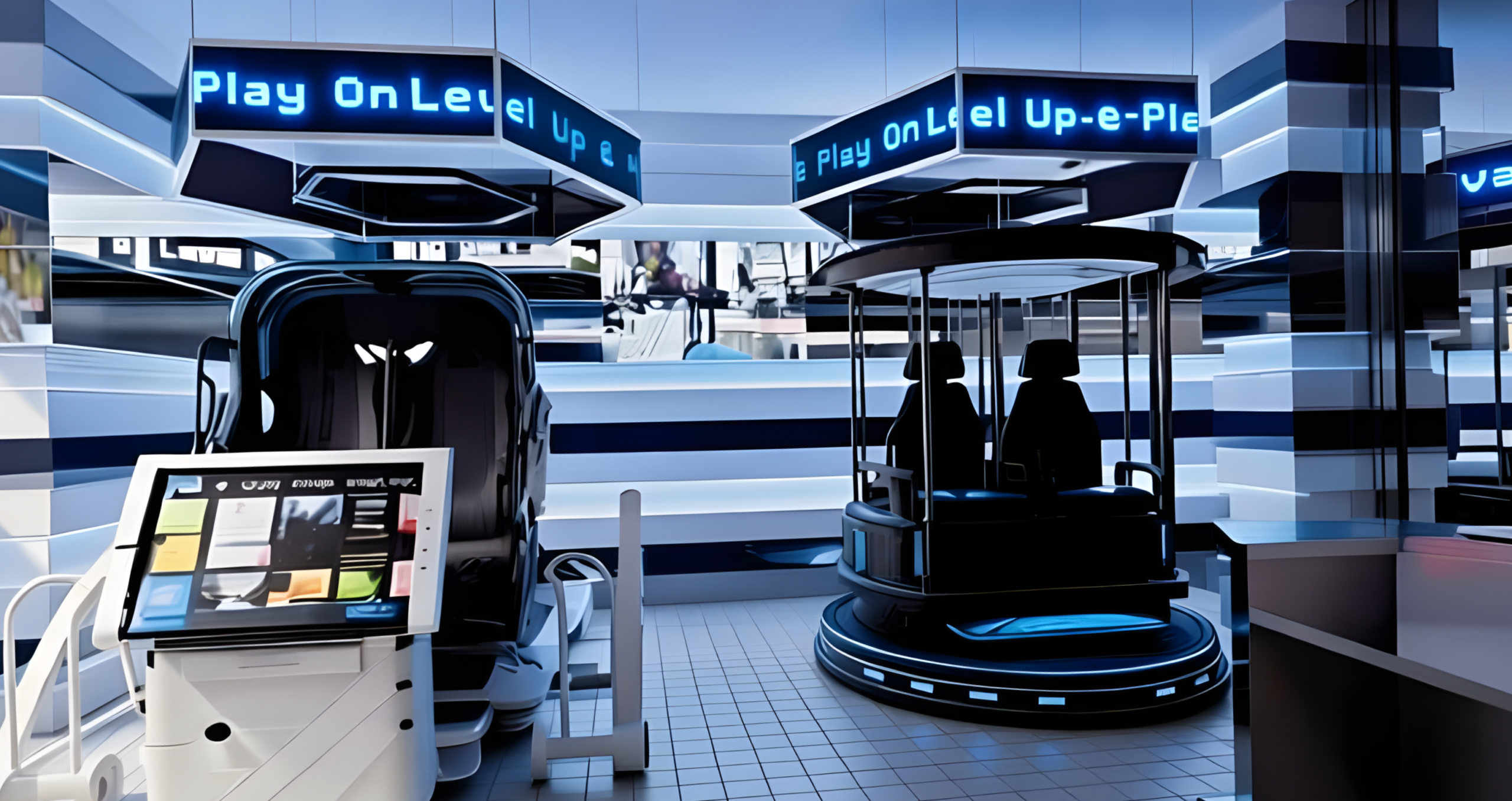
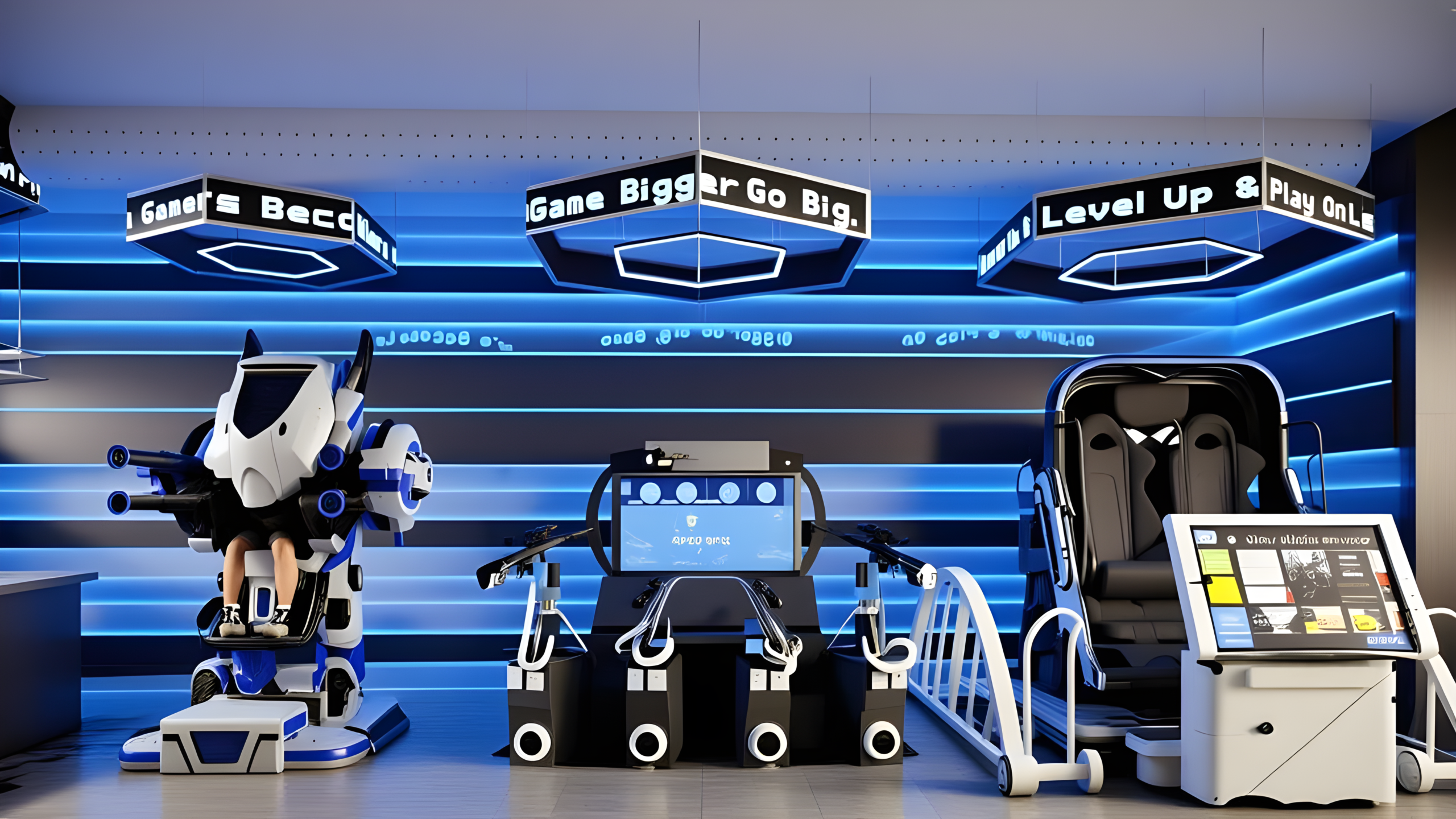
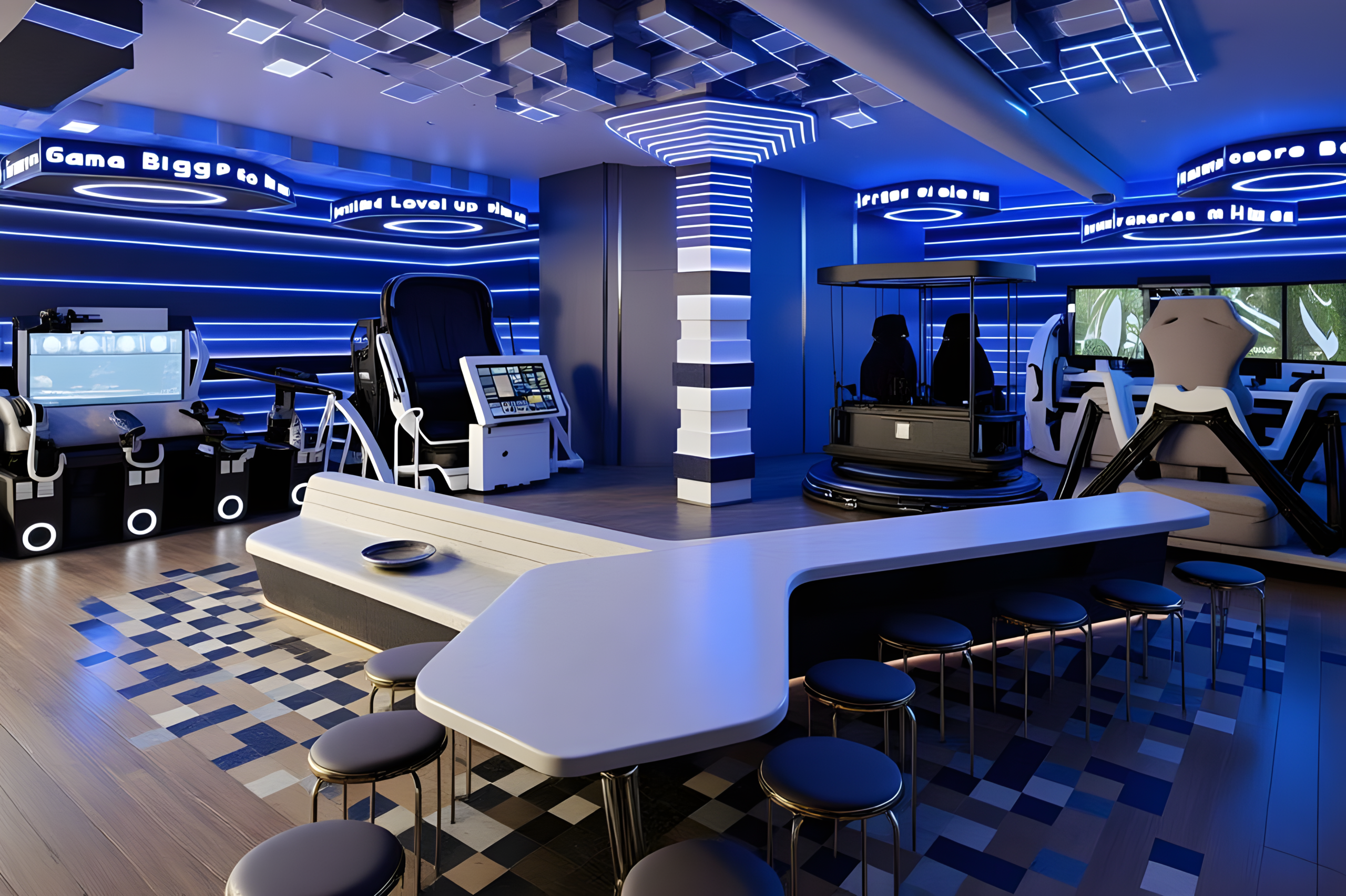
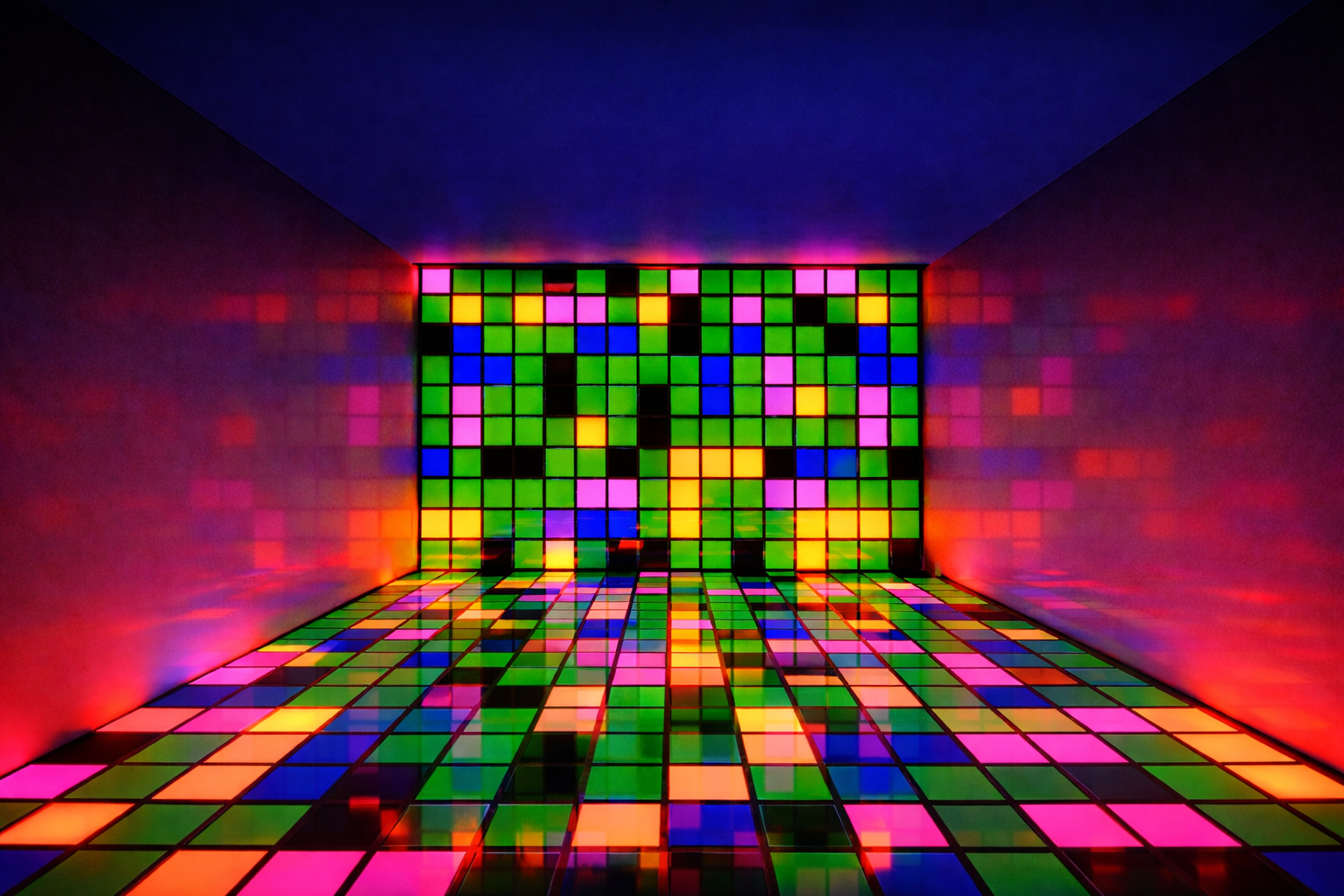
Inside, the fun starts immediately. VR motion simulators and egg-shaped gaming pods sit alongside a Floor is Lava installation, its panels lighting up underfoot in blocks of blue and white as players cross. Overhead, hundreds of illuminated white cube light boxes hang at different depths — a fragmented ceiling that feels like a digital skyline frozen mid-collapse. Scrolling from hexagonal sign units suspended throughout the space are the phrases of the brand, cycling in a monospace font that gives the room the quality of a terminal mid-computation. The central service counter glows with the Player One logo in neon, a landmark in the middle of all the action. The whole space hums with the anticipation of something about to happen.
Bayada
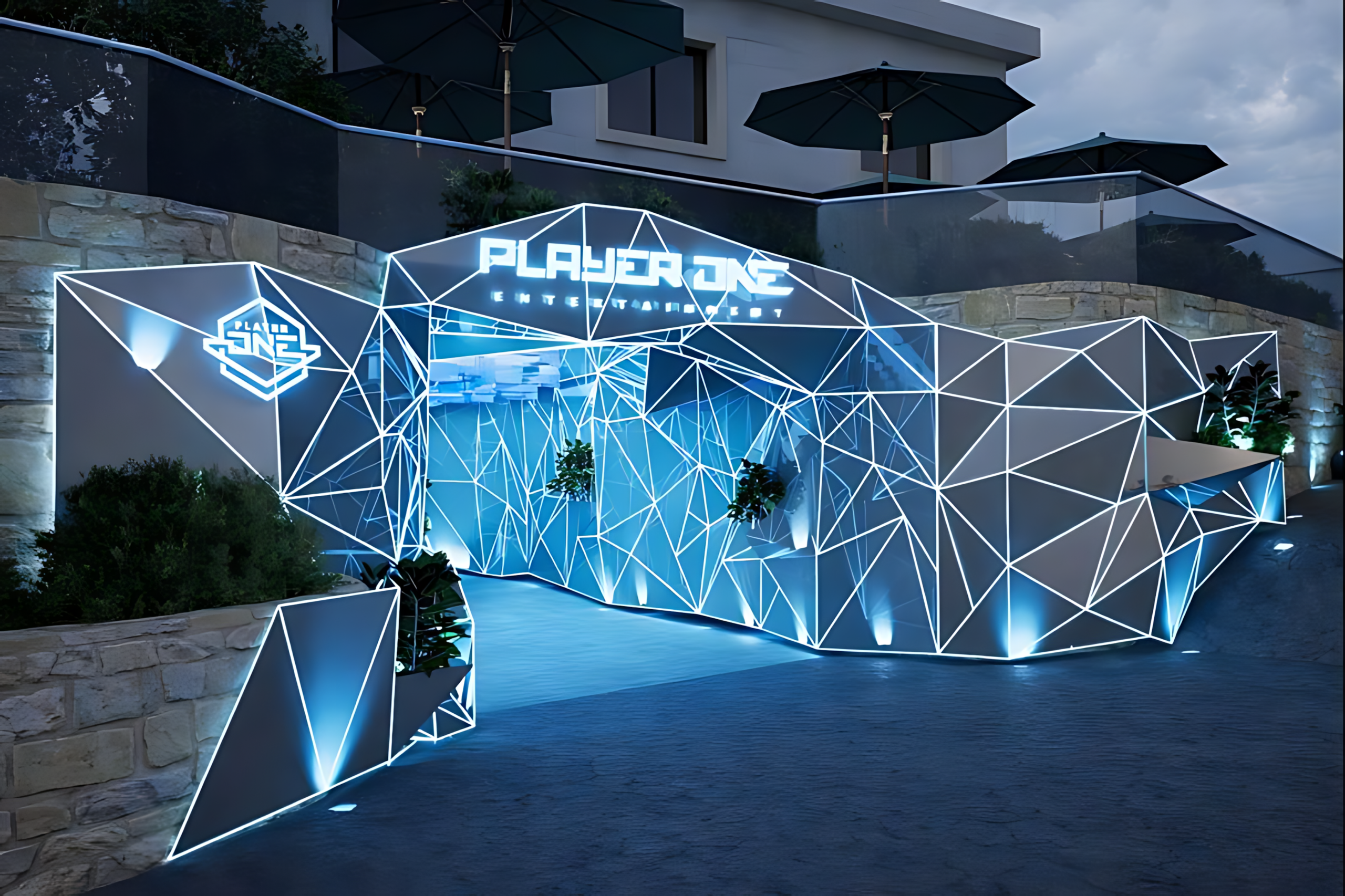
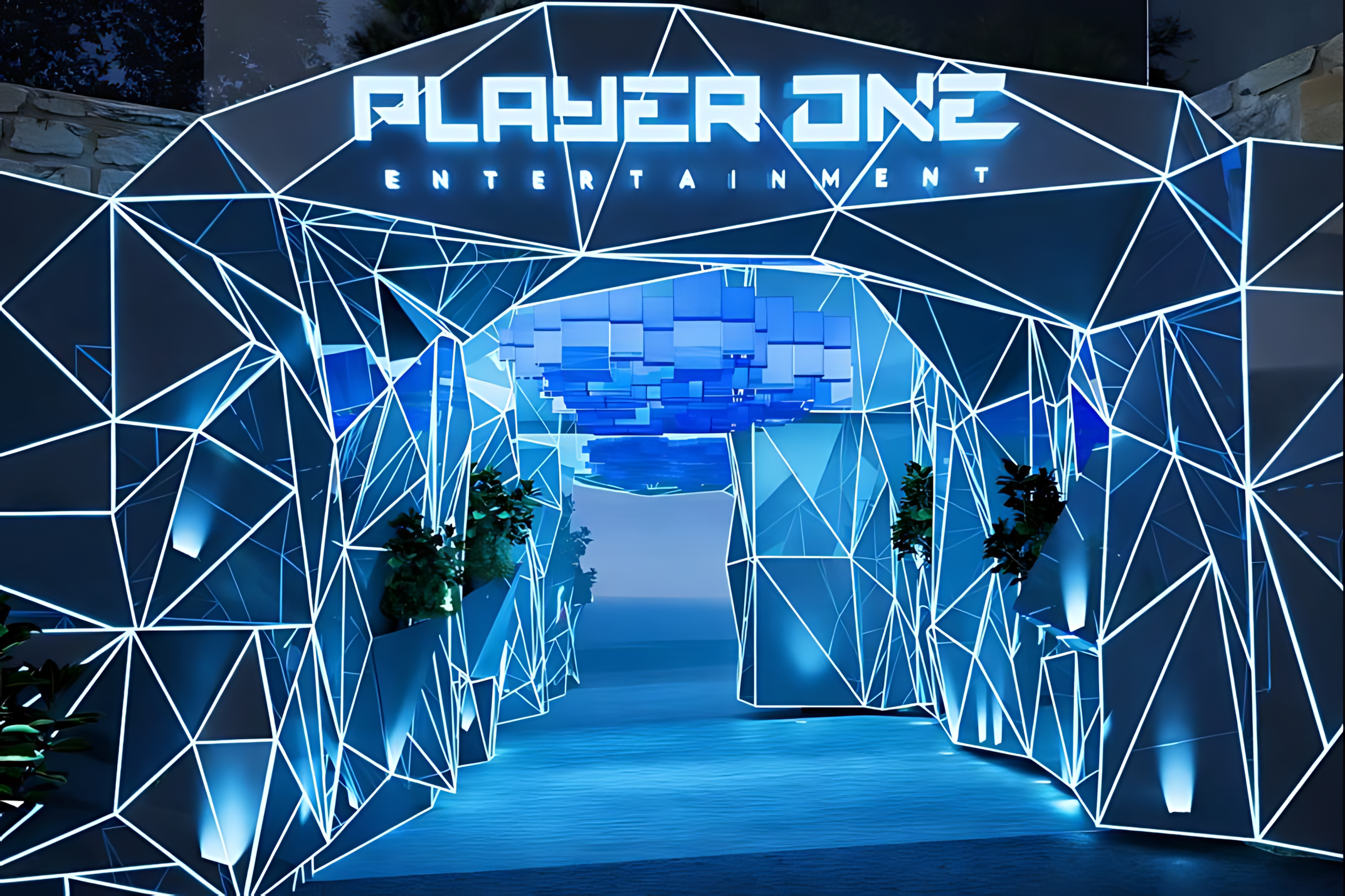
Bayada is where the Player One concept meets the open air, and the result is one of the most distinctive entrances in the portfolio. A freestanding geometric archway — fractured panels, LED-edged, the brand name glowing above the passage — stands between stone walls and outdoor terracing, flanked by built-in planters. It feels like a portal that was dropped into the middle of a courtyard and decided to stay.
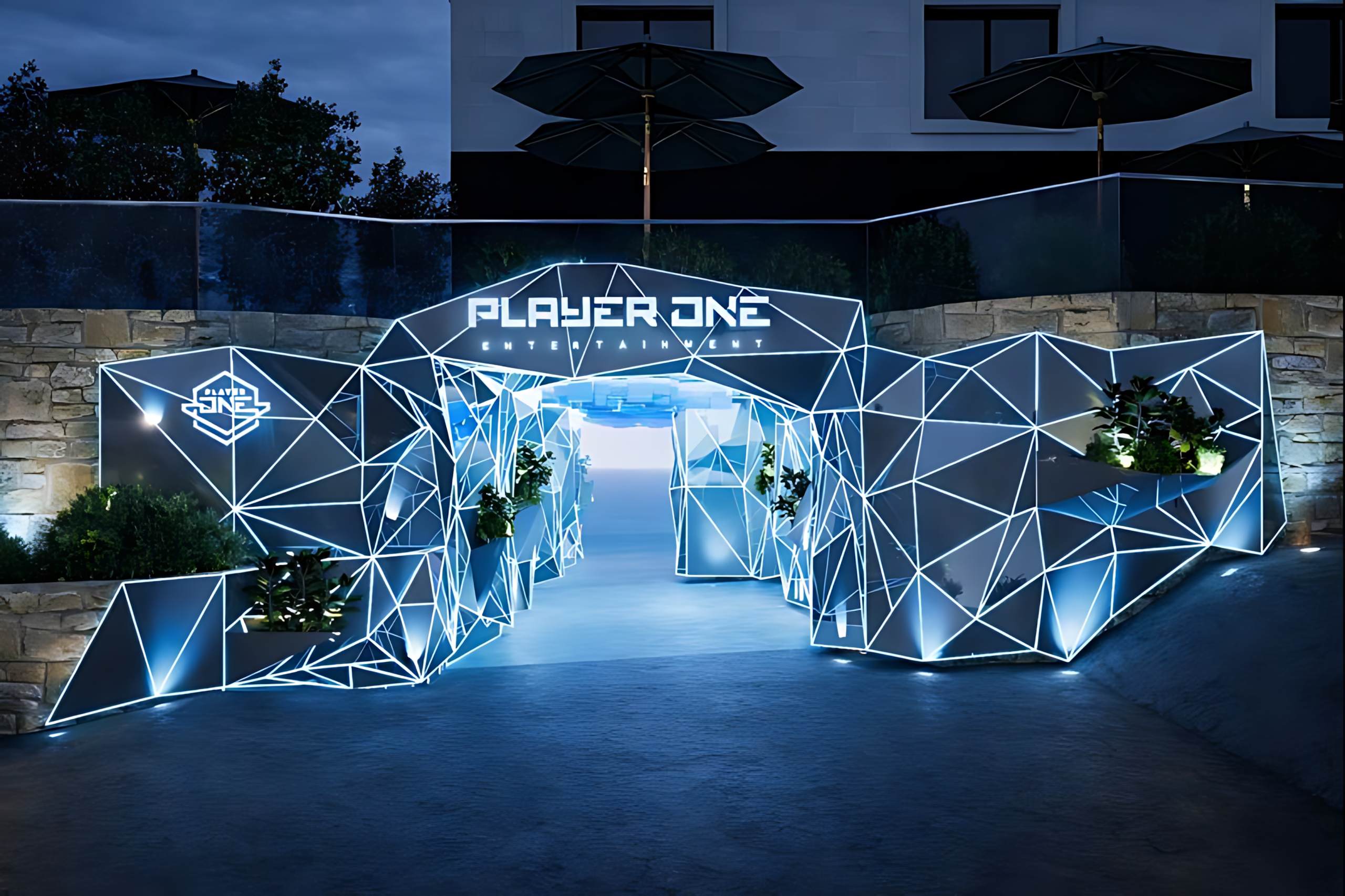
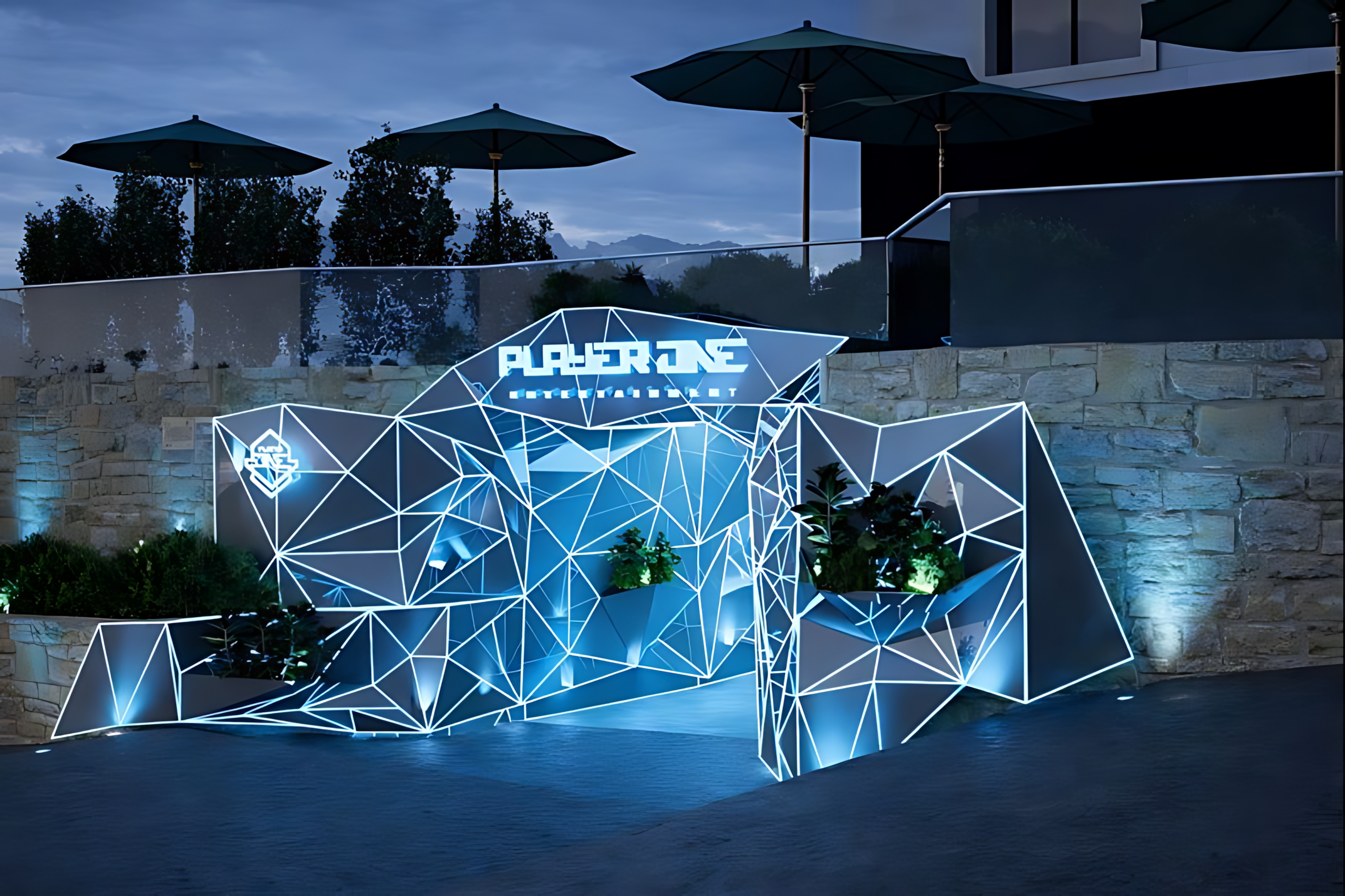
Walking through it is genuinely fun. There is a moment — stone paving behind you, blue light ahead, the arch framing exactly what comes next — that does something very simple and very effective: it makes you want to go in. The outdoor setting gives this location something the indoor versions cannot replicate: the contrast of the familiar world giving way to something entirely designed.
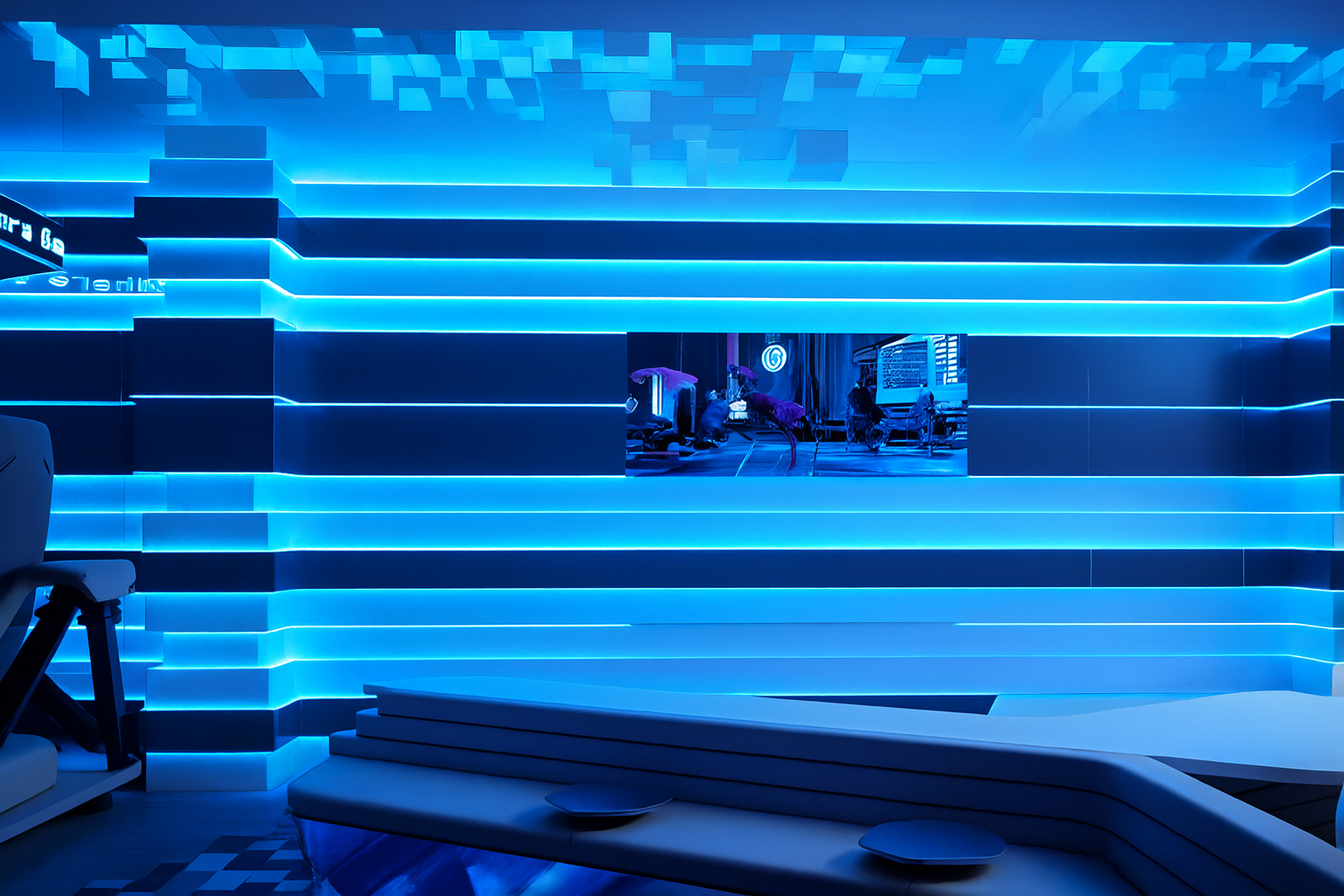
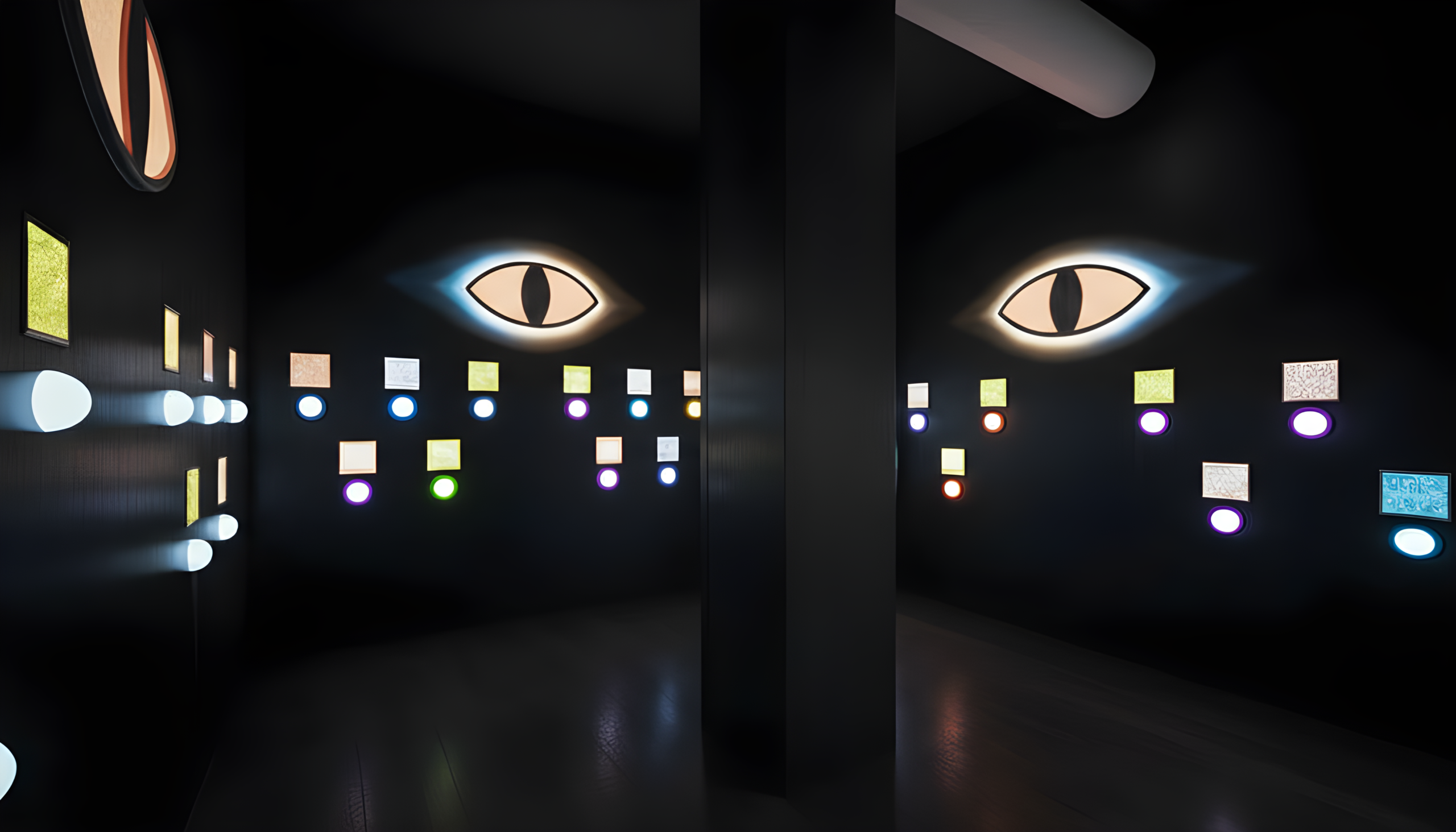
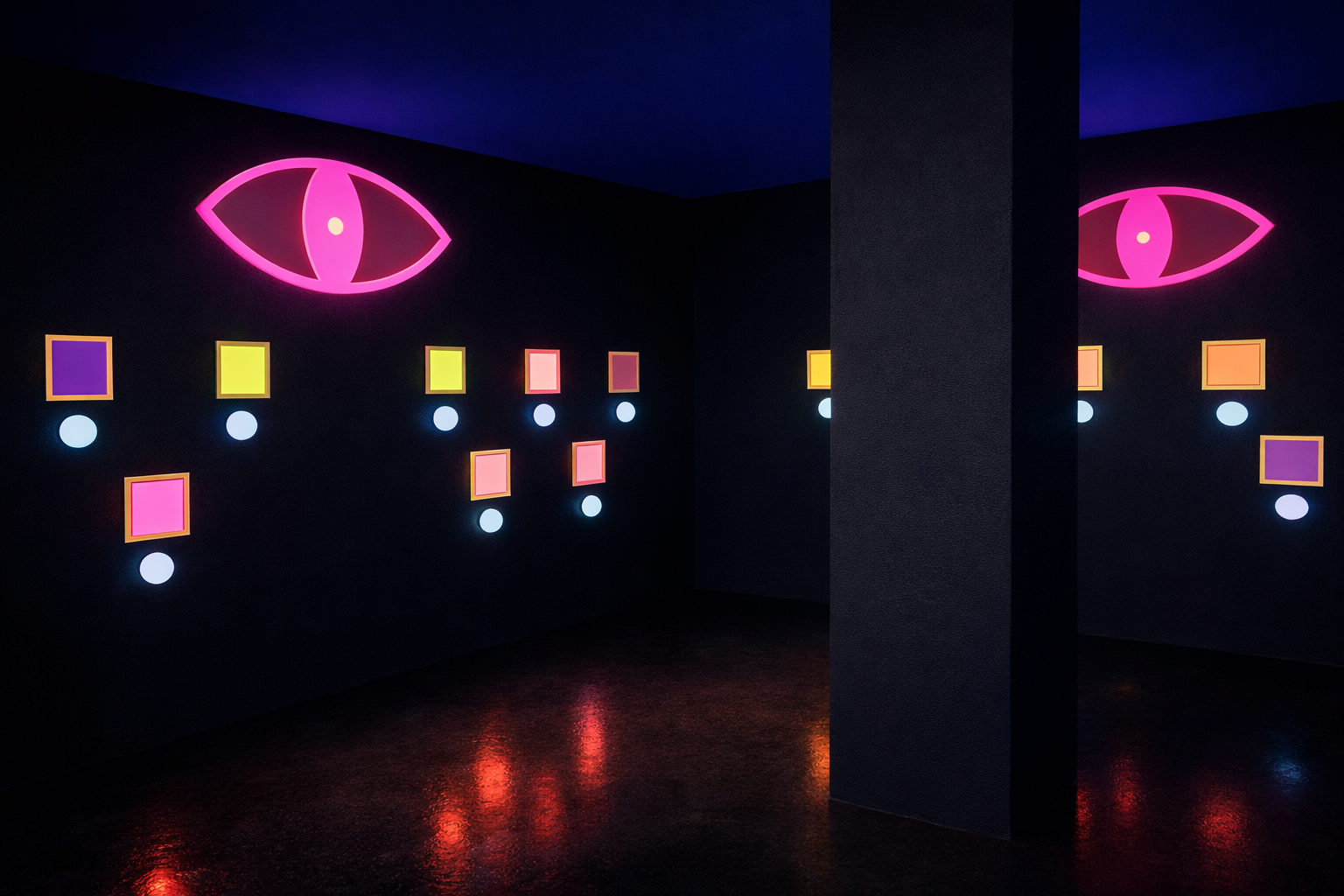
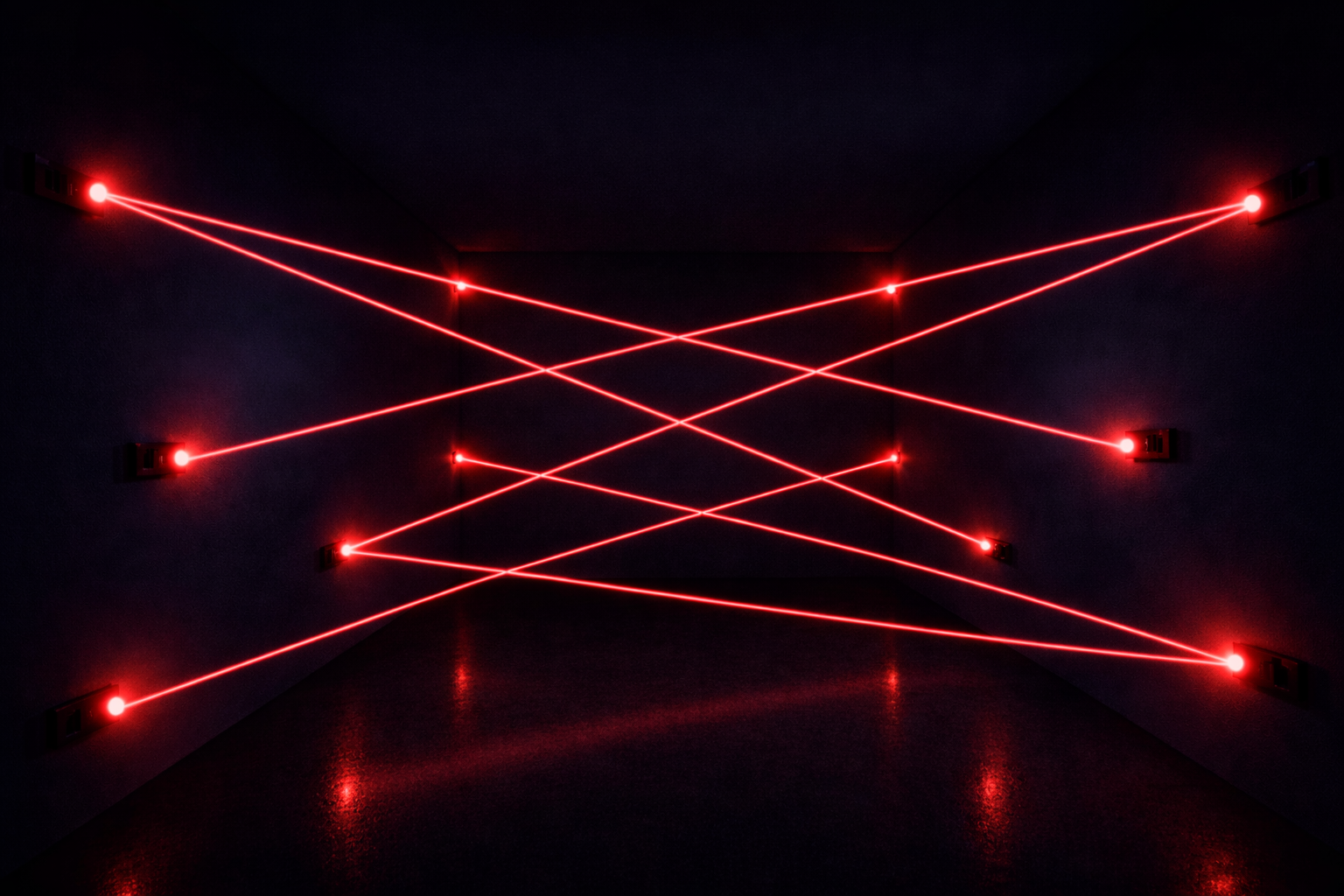
The interior delivers on that promise. Horizontal LED wall striping, a lounge-bar counter, a Floor is Lava room, and a dedicated Squidgame room where neon-lit eye motifs and floating colour panels pulse from the walls. That room deserves its own mention: pure darkness, two enormous glowing eyes staring from the wall, coloured squares of light arranged below them like scattered confetti. It is theatrical and slightly unsettling in the best way — the kind of room you walk into, stop, and immediately want to play. Alongside it, a red laser grid fills a separate room with intersecting beams that visitors can move through. At Bayada, the fun has an edge to it.
Revive Club
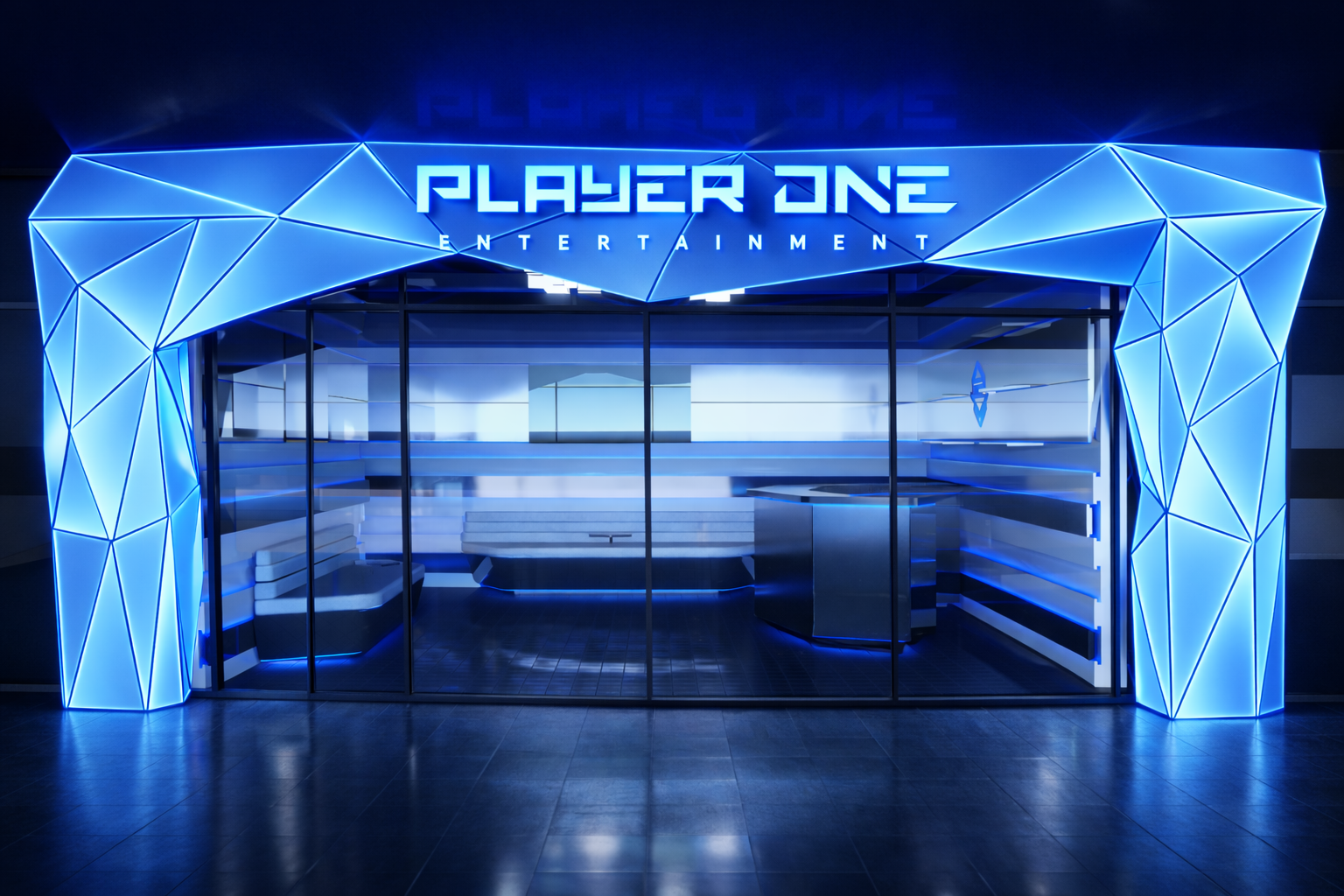
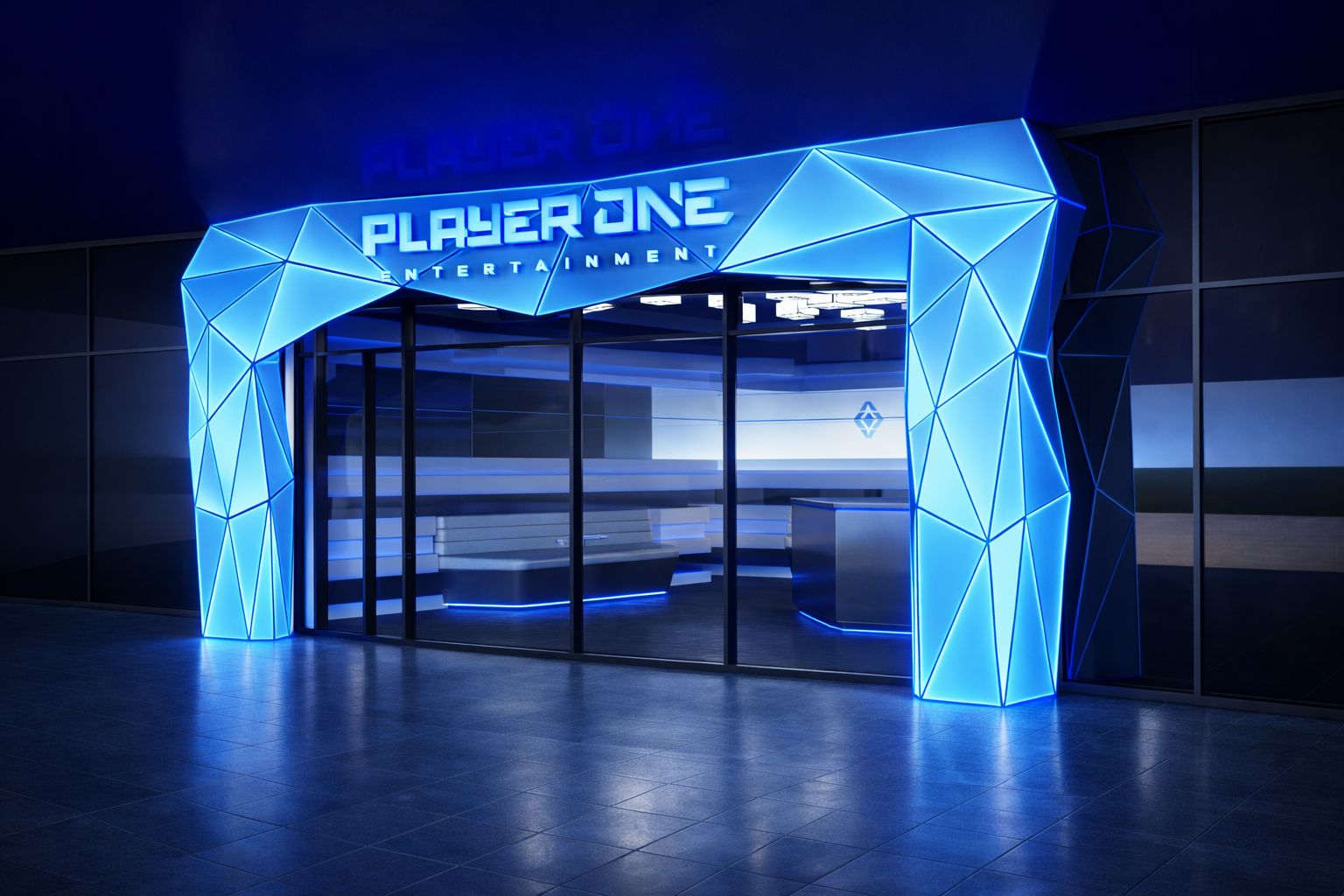
The Player One at Revive Club lives inside a gym — not a standalone venue, but a fully branded world built into an existing fitness space — and the design reflects that host environment. The entrance is a compact geometric arch — the same fractured-panel system, the same electric blue, but scaled and finished to match a membership space where aesthetic expectations run high. Full-height glass with minimal aluminum framing. Clean lines. The Player One wordmark backlit clearly above.
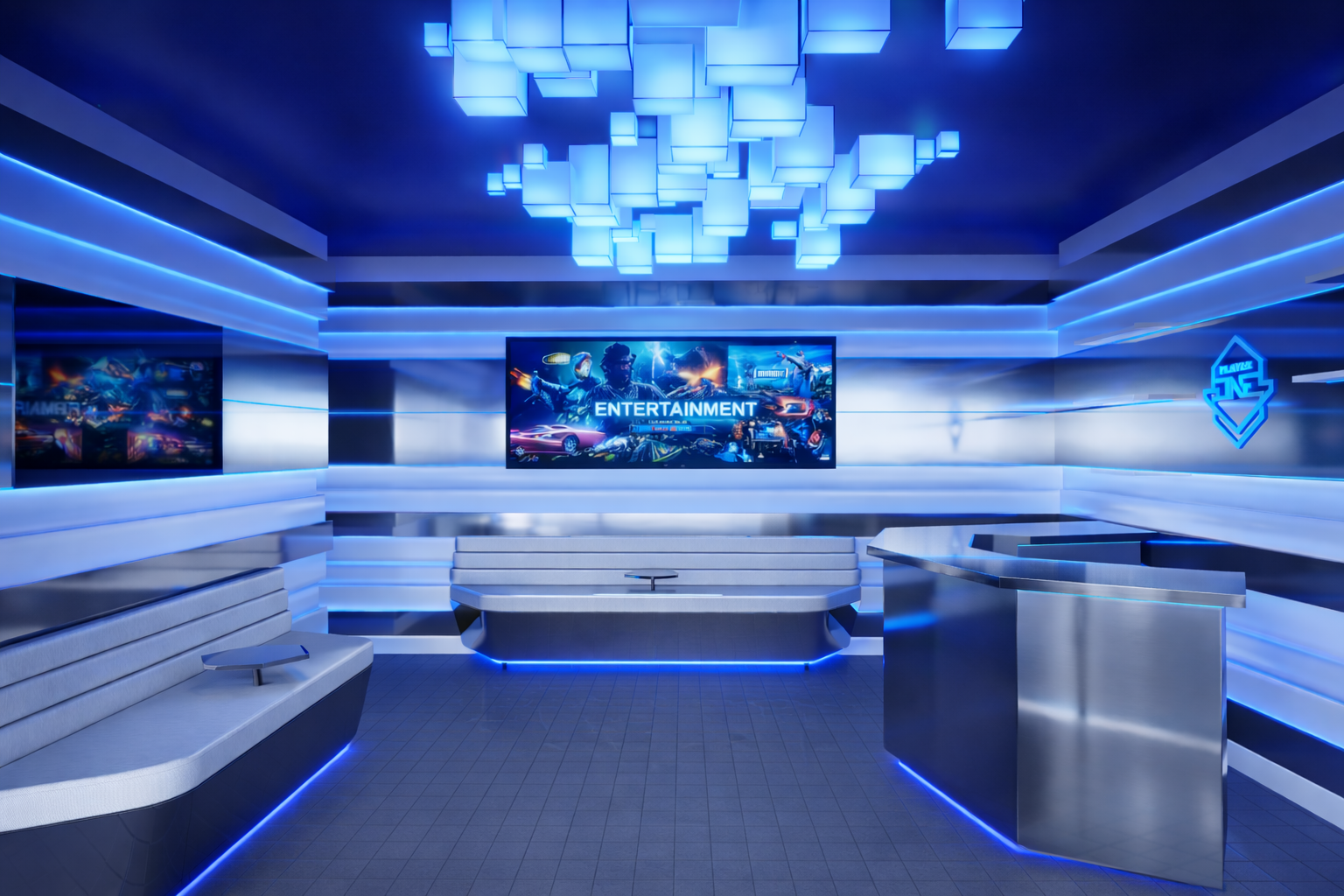
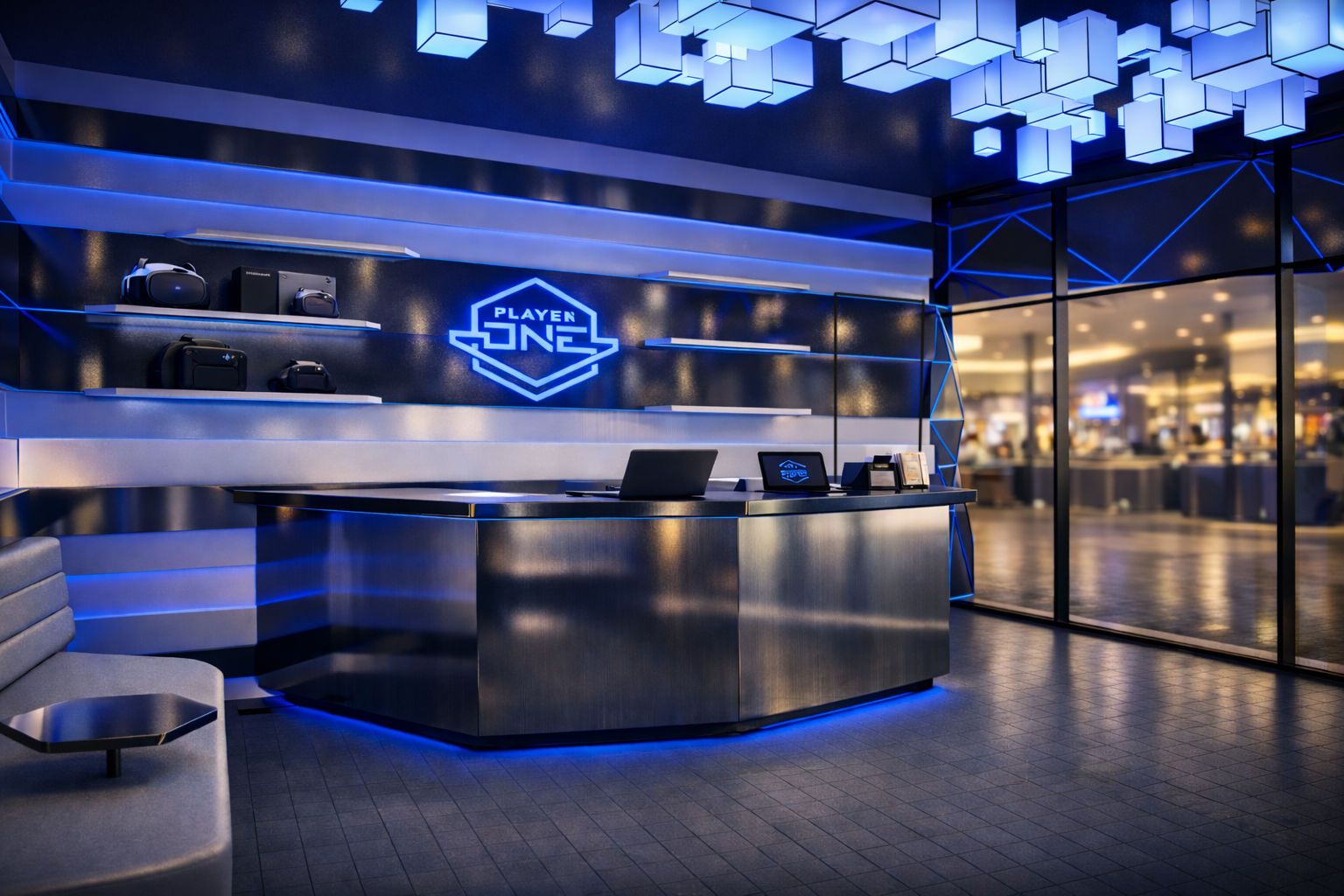
Inside, the space is intimate but no less considered. The reception counter is brushed stainless steel with under-counter LED uplighting, VR headsets displayed on open shelving above it, and the Player One neon badge on the back wall. The pixel-cube ceiling installation anchors the room. Lounge seating is built into perimeter walls that run in LED-striped horizontal bands, glowing softly in the low light.
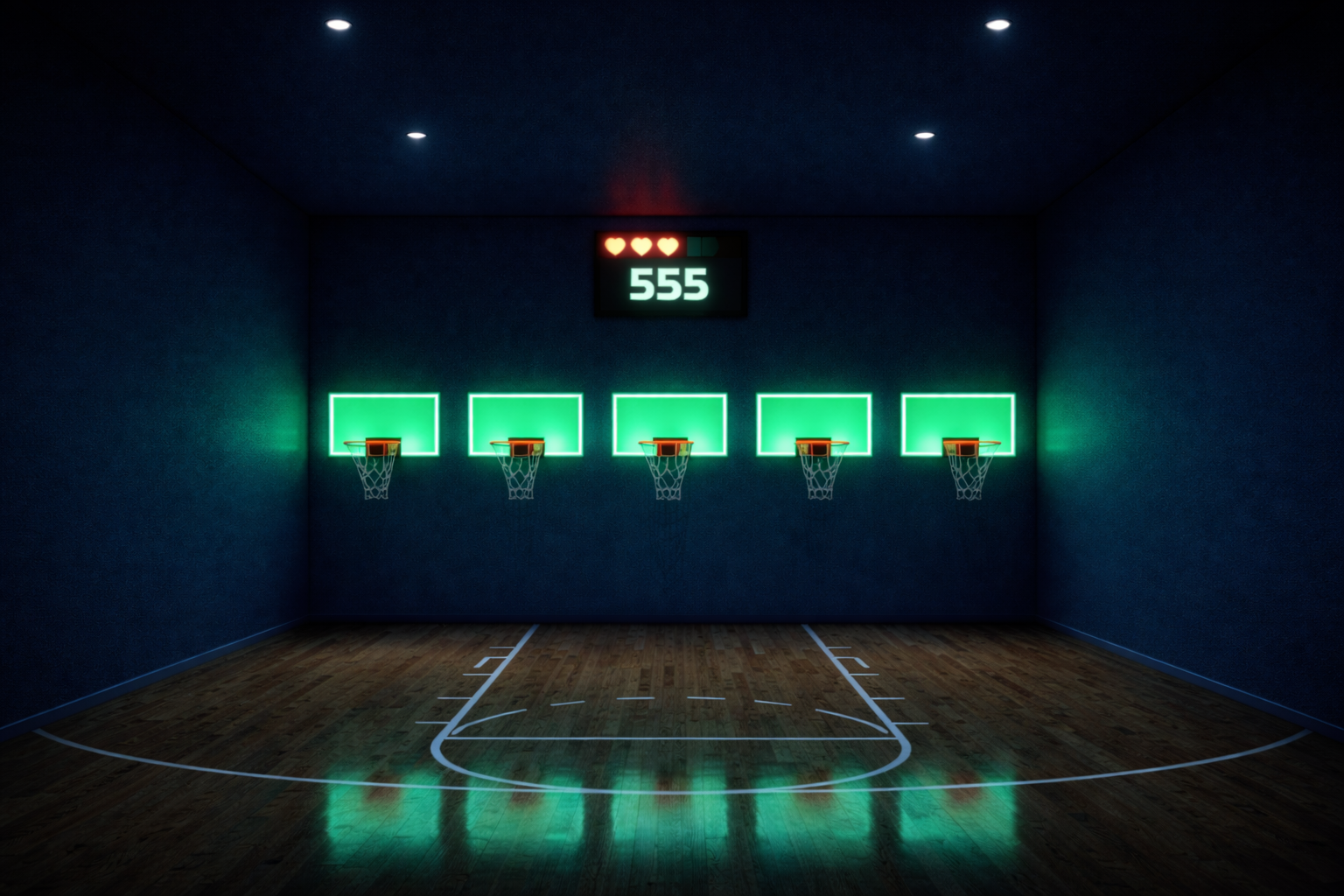
The Squidgame room here takes the eye motif and renders it in hot pink neon against black — sharper, more charged, calibrated to a crowd that comes to have a specific kind of fun. And then there is the basketball court: five illuminated hoops lining the wall, a live scoreboard above, a hardwood floor below. It is one of the more joyful details across all four locations — a physical game built into a space designed around digital ones, executed with the same level of care.
WTFun
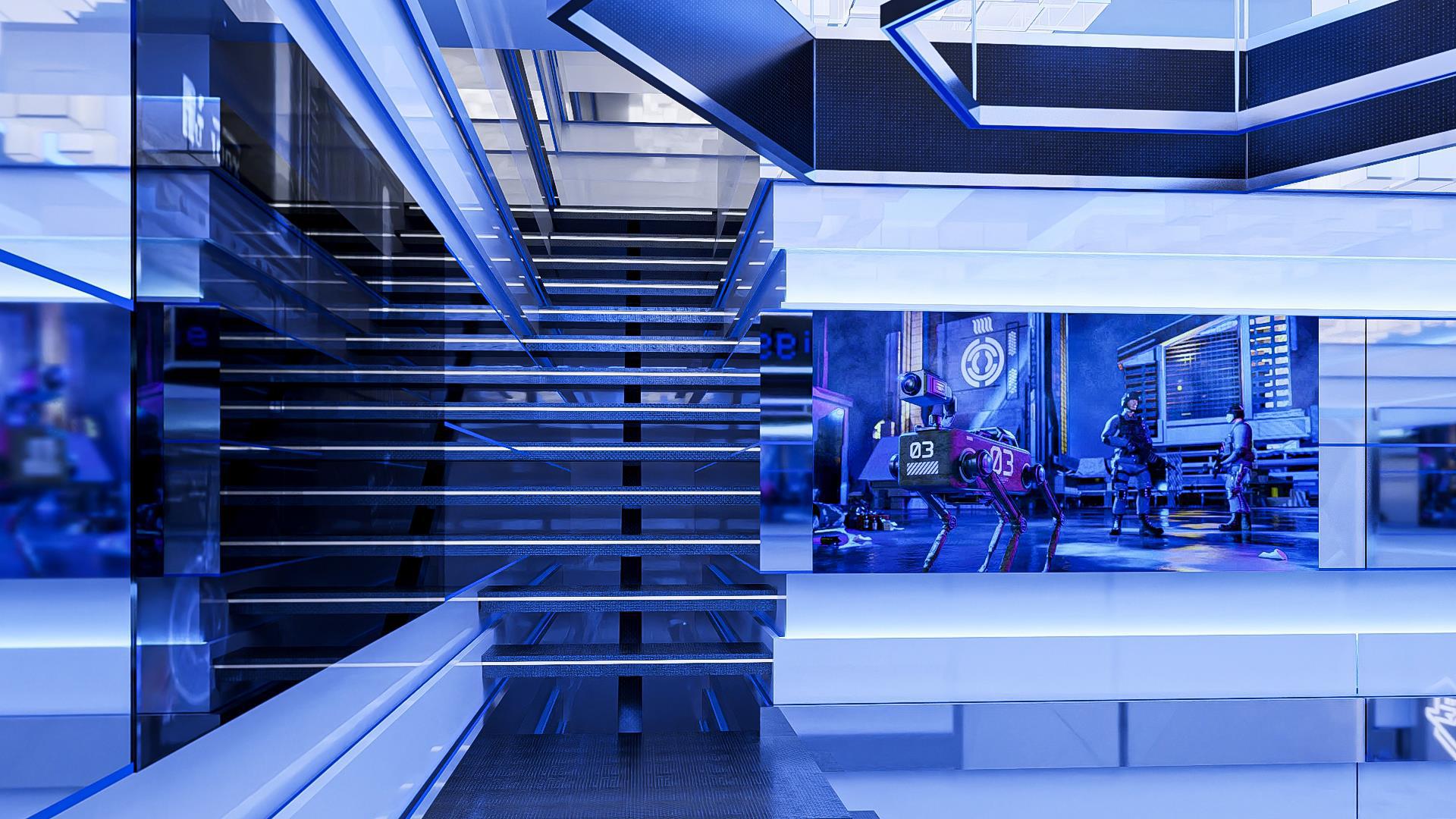
At WTFun, a playground built for teens, Player One occupies a double-height space rather than the venue itself, and the design makes full use of the volume. A glass-and-steel staircase — each step edge-lit — connects the levels, with LED mirror panels lining the walls and large-format gaming screens embedded within them. The Player One logo is rendered at oversized scale on the floor, readable from the level above. Scrolling sign units run the brand copy overhead on loop. The space communicates energy without ever feeling empty.
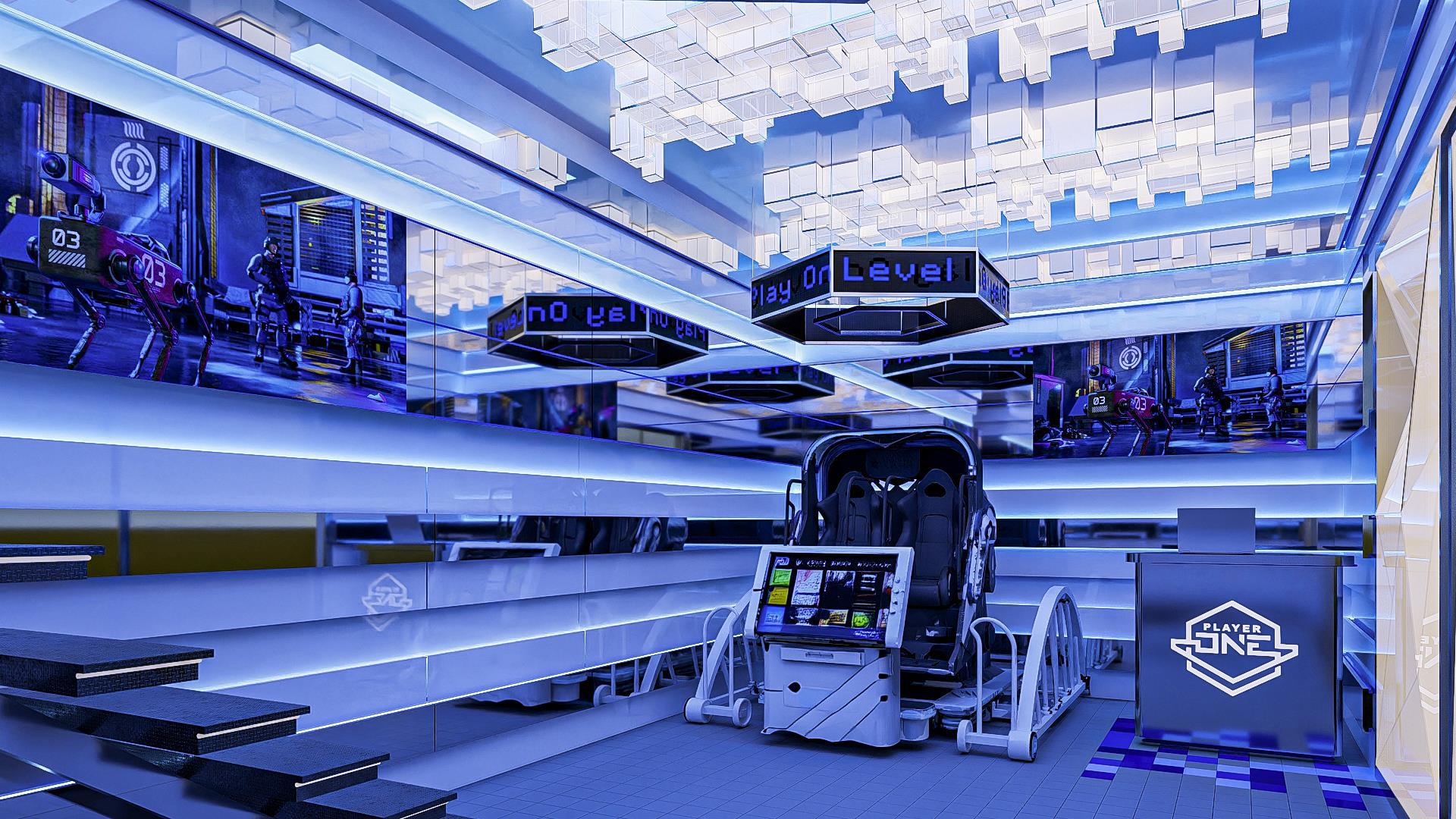
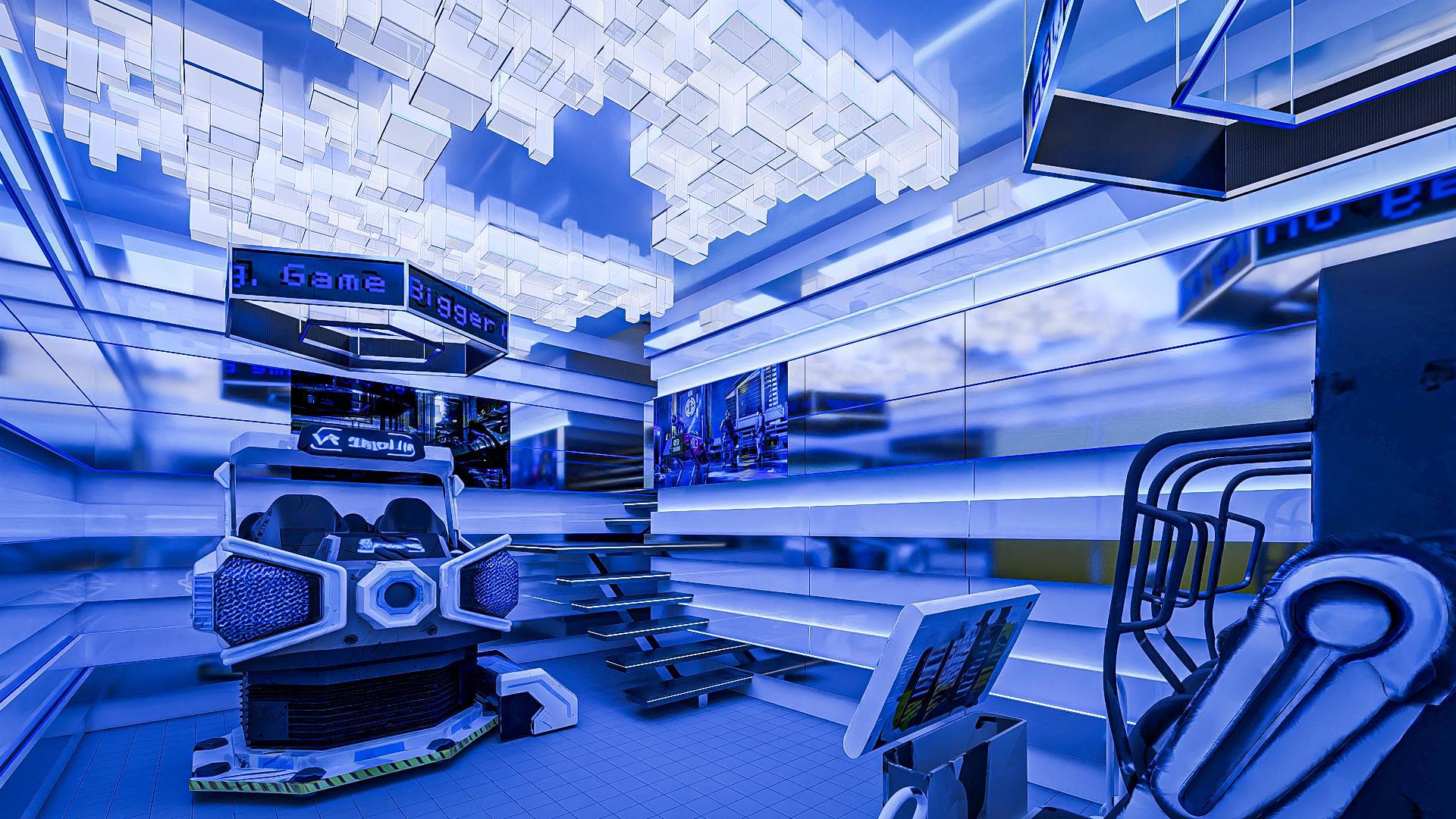
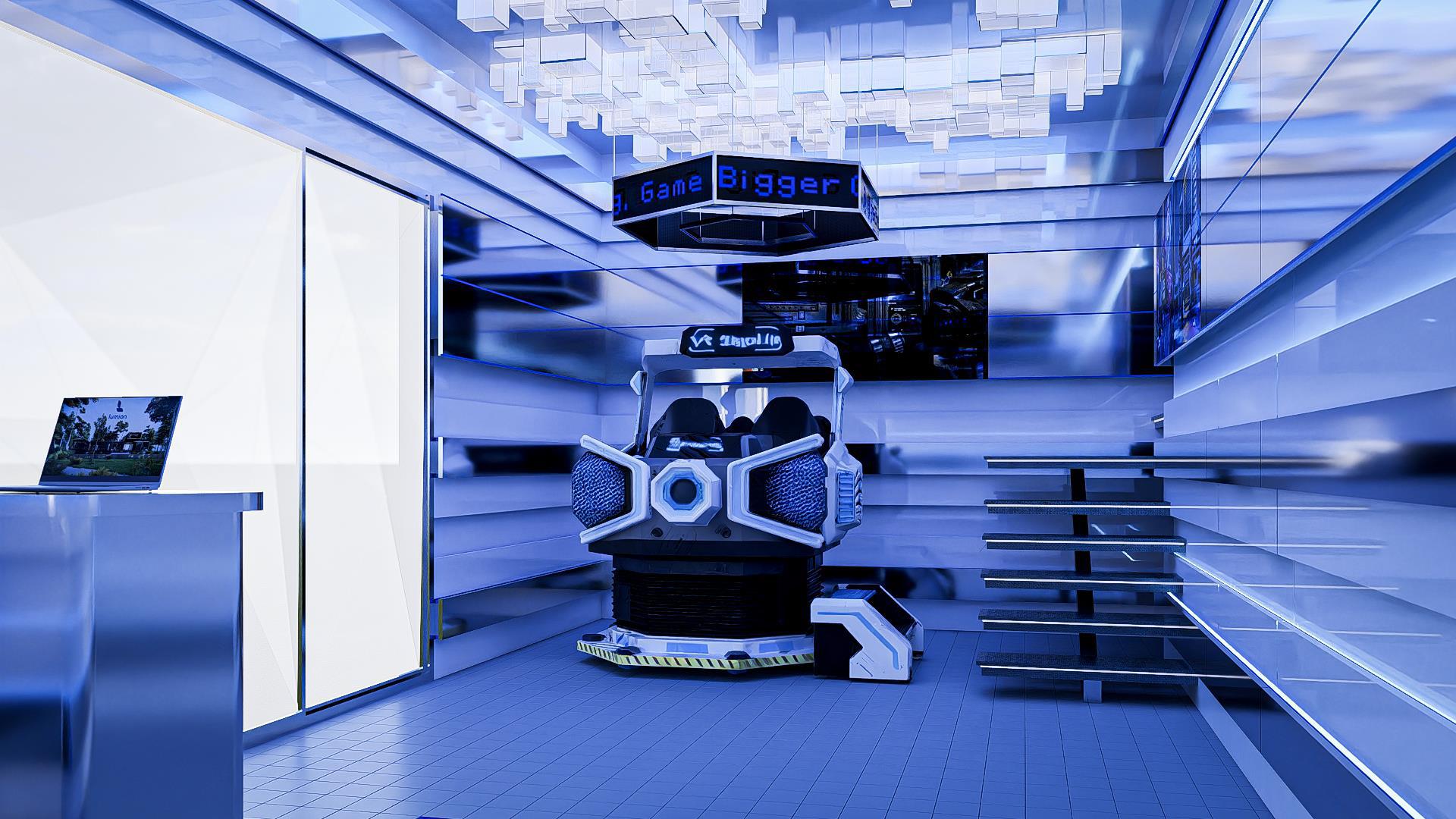
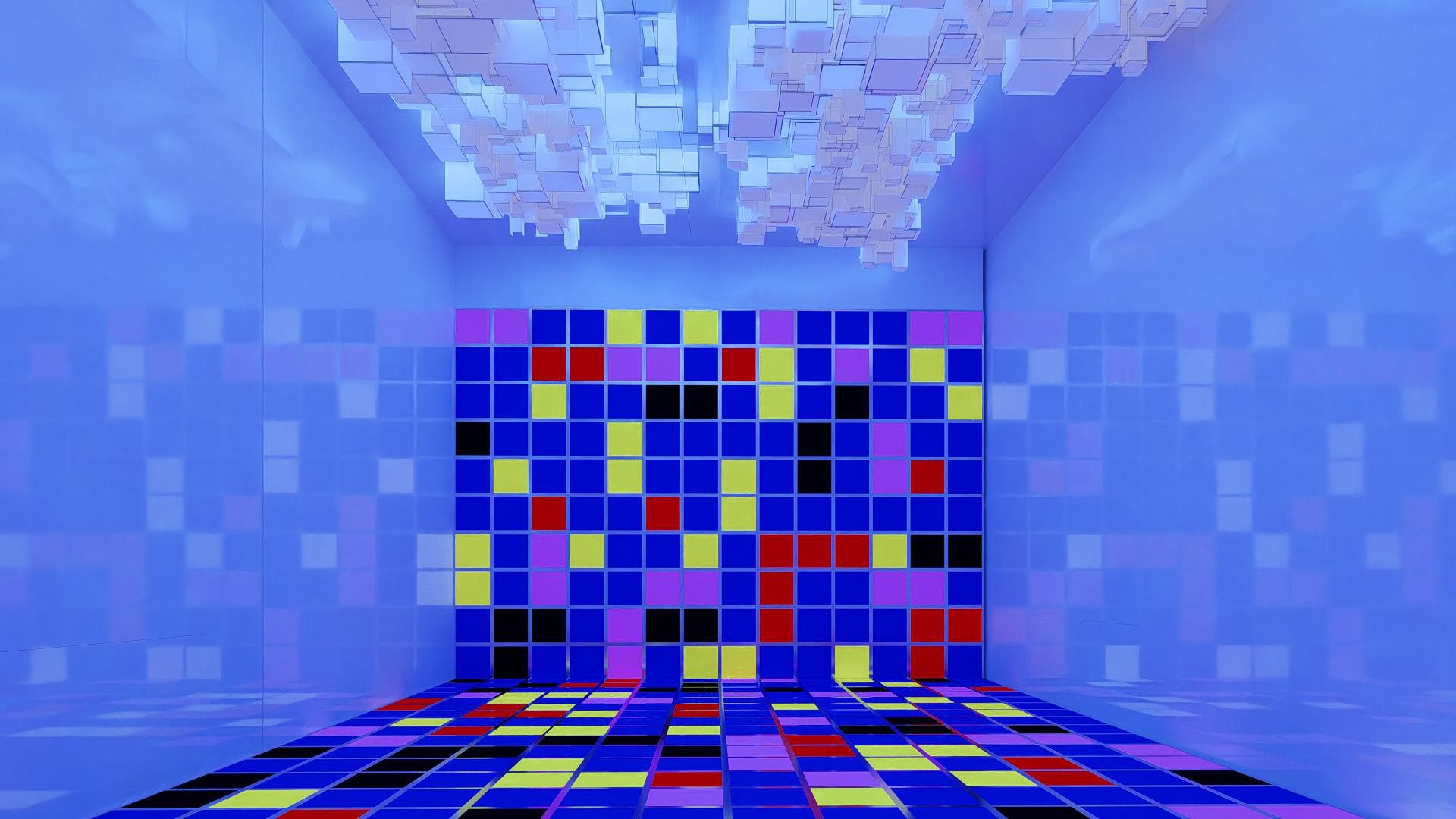
WTFun’s take on the Floor is Lava room runs a different palette to the other locations — vivid blue, yellow, red, and pink lighting up the panels underfoot, bright and poppy rather than dark and atmospheric. It matches the WTFun environment, which runs at a higher frequency. VR motion simulators sit on the lower floor, and the full-wall mirror panels multiply everything: the machines, the light, the movement, the people. It all bounces back and fills the room with an energy that is hard to locate precisely but very easy to feel.
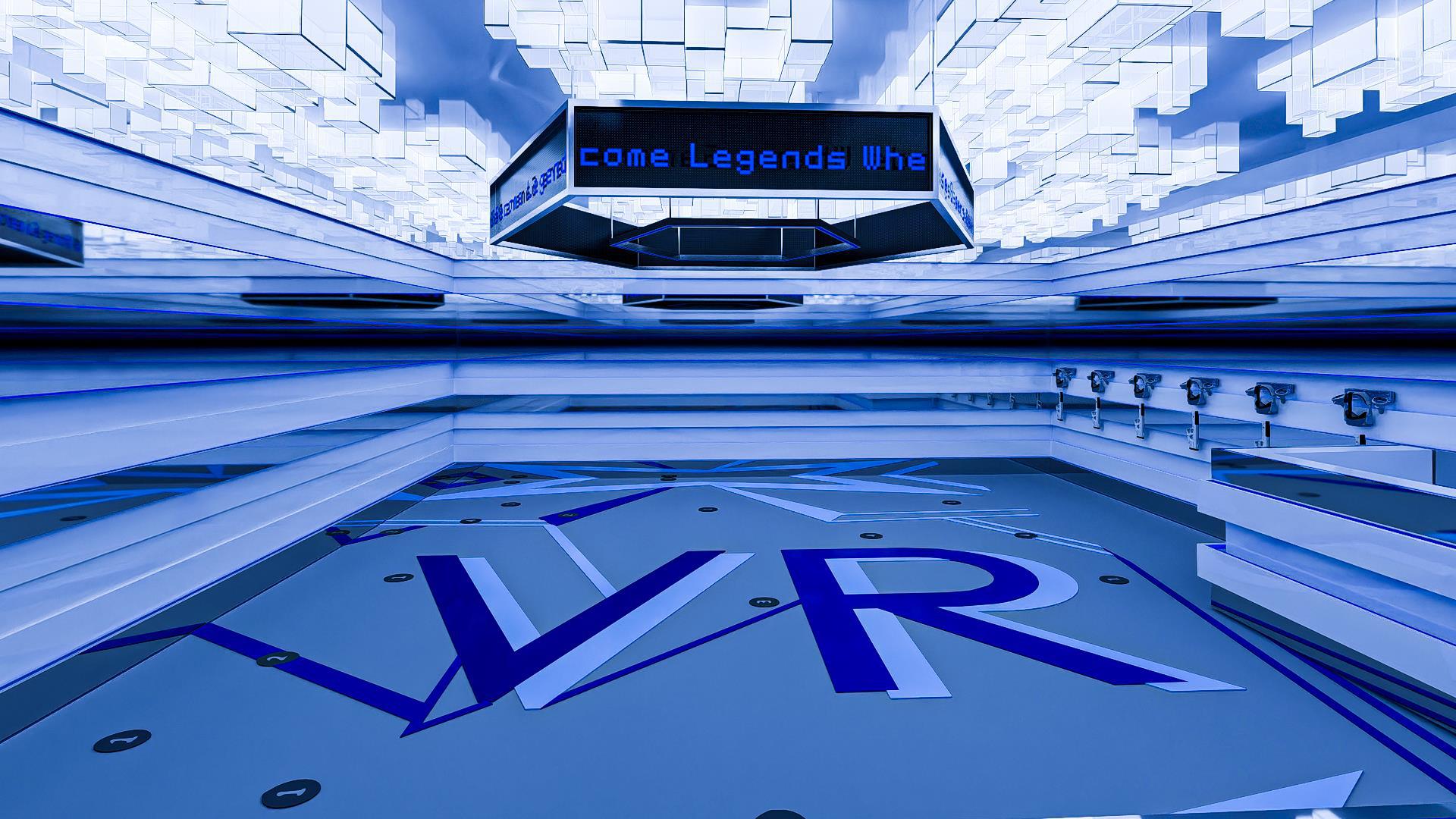
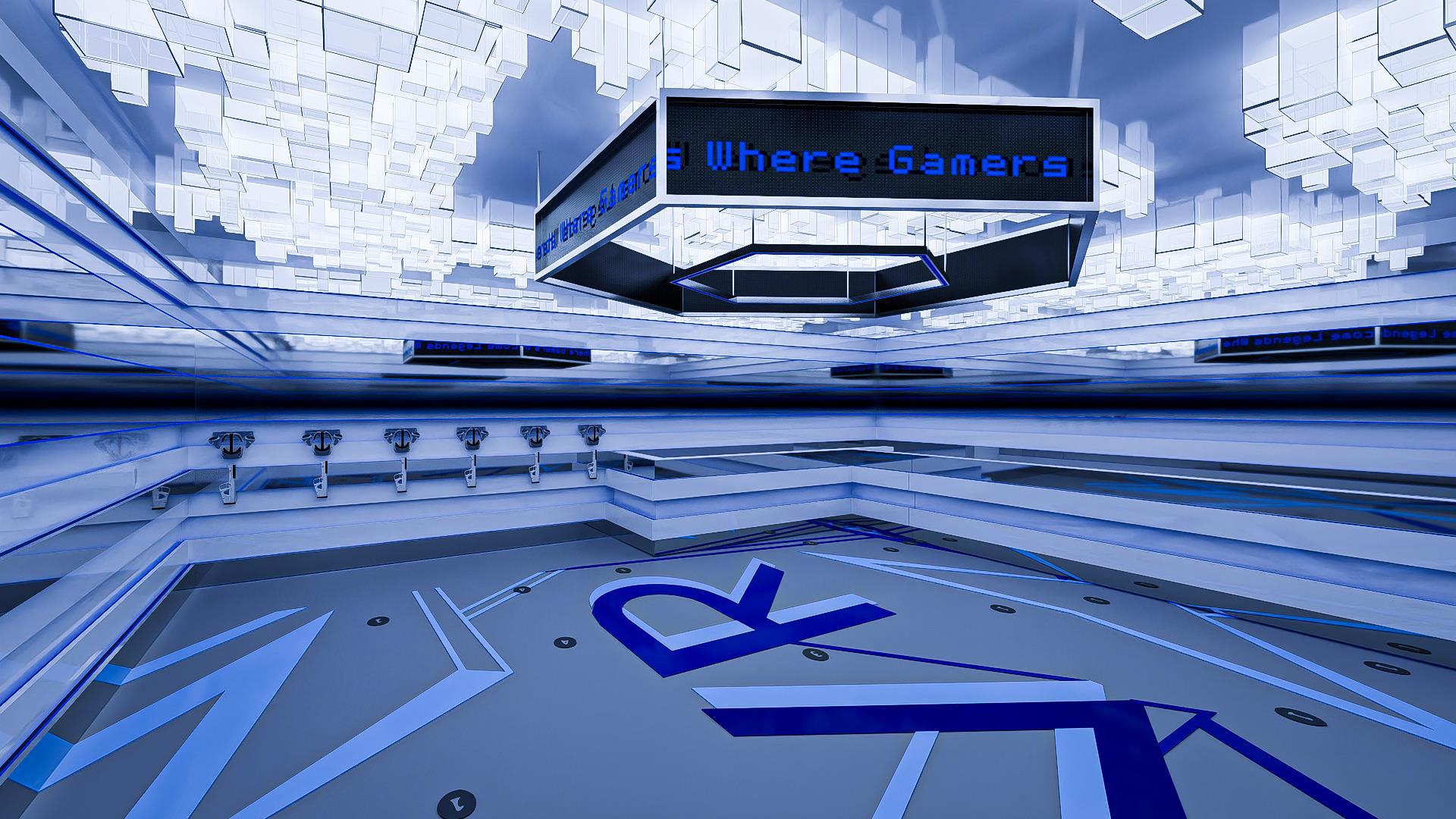
A fully immersive VR room where play becomes reality. The scrolling sign text at WTFun reads: Come Legends Where Gamers Become Legends. As a line it is slightly absurd and completely earnest — which is exactly the right register for a space asking people to take their fun seriously.
One Concept, Growing
What the Player One rollout demonstrates is that a strong entertainment concept does not need to be identical across every location to be coherent. The geometric facade system adapts. The interior vocabulary recombines. The colour and light language holds. But each space has its own character — Bayada’s portal drama, Revive Club’s club-coded precision, WTFun’s high-energy volume, Le Mall’s neon-lit buzz — because each one was designed for its context, not simply dropped into it.
The design takes gaming seriously as a source of visual and spatial language. The pixel, the neon, the low-polygon geometry, the scrolling terminal text: these are not decoration applied to a generic box. They are the concept, built into the walls and the floor and the ceiling. The result is four spaces where the fun is not incidental. It is structural.
And four is only the current count. Player One is an expanding concept, with additional locations already in the design pipeline — each one an opportunity to push the language further while keeping the identity intact. Lebanon is going to see a lot more of Player One.