
One land. Many doors. The same courtyard.
There is a version of the family compound that solves privacy by building a wall. Hamad Villas solves it by building a door — several of them, actually, each opening onto the same stretch of cobblestone in the Bekaa. The brief was never “luxury villas.” It was a family that wanted to stay on their land without living on top of each other. What we built is the answer to that: a cluster of private homes, none of them facing the road, all of them facing one another.
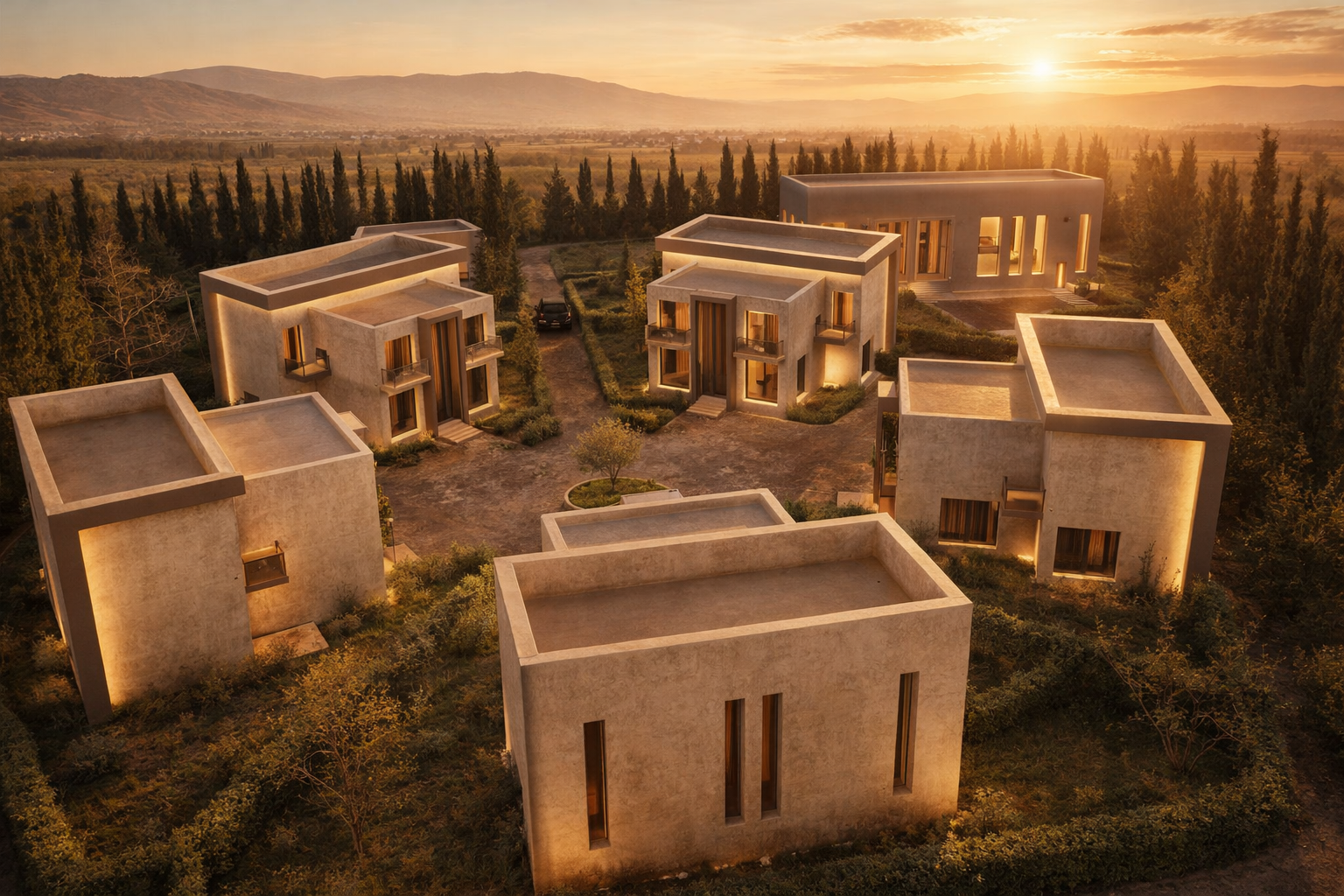
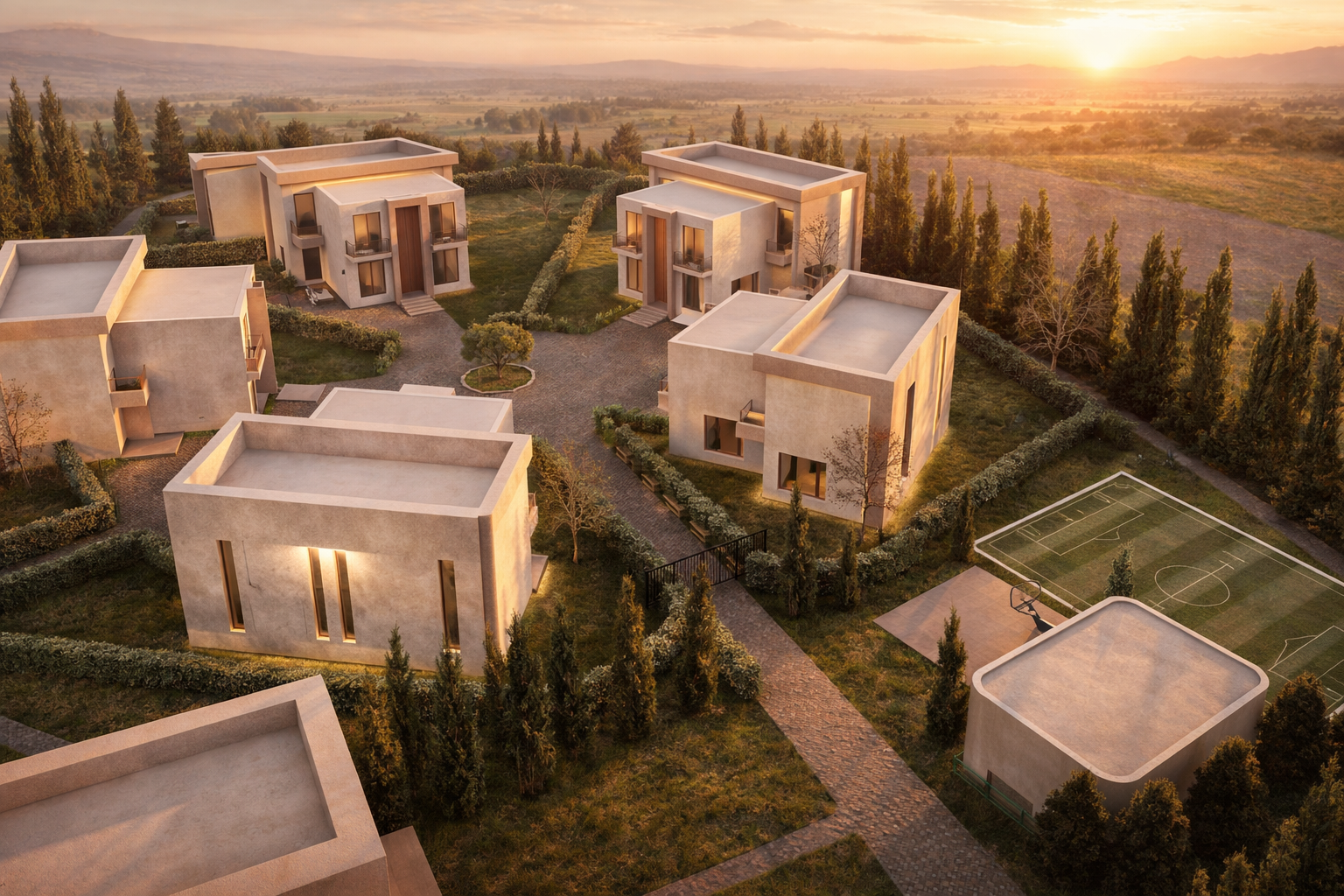
The site sits low against the Bekaa’s open horizon — flat farmland running out to a line of hills, cypress trees planted in the kind of straight rows that only a valley this old grows. We kept the massing low and boxed, roofs cut flat and deep, so the villas read as a row of concrete forms set into the field rather than a development dropped on top of it. Sunset does most of the work here; the render doesn’t need dramatizing, the light already does it.
The Courtyard Does the Talking
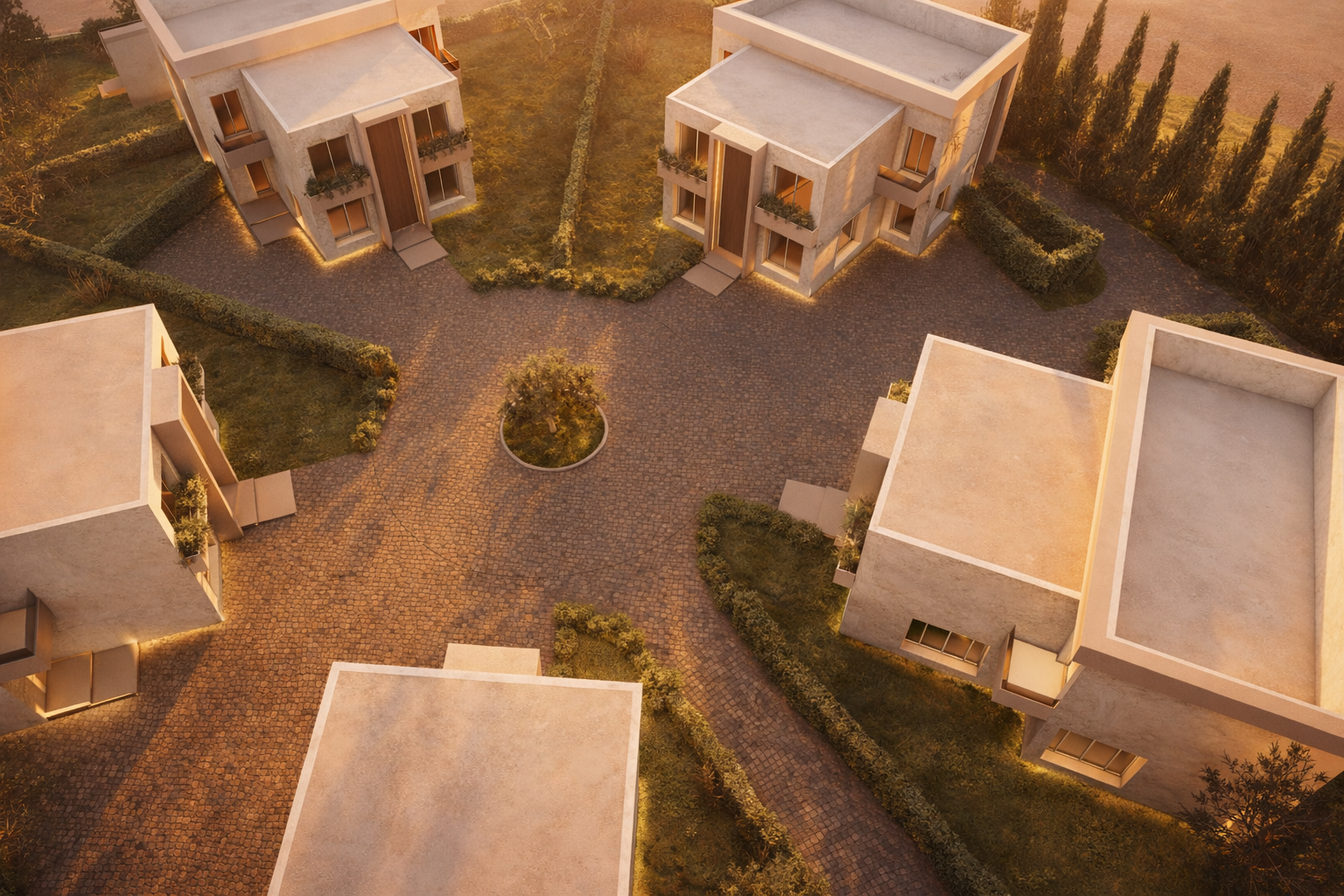
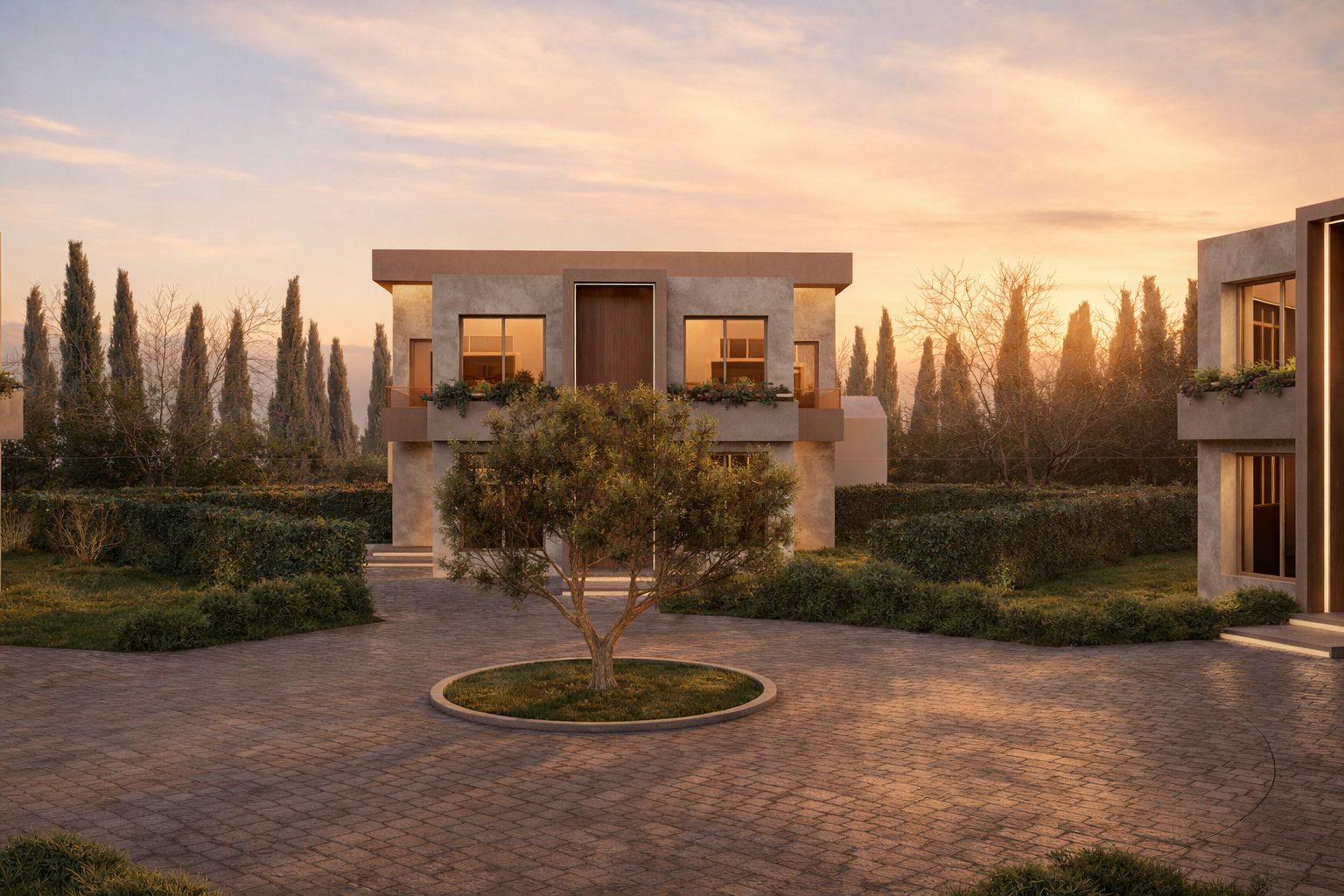
No fences separate one villa’s garden from the next. Instead, every front door opens onto the same shared spine — a cobblestone courtyard, hedges doing the boundary work that walls usually do, and one olive tree planted dead-center where the paths cross. It’s a small move with an old logic: in a family compound, the empty space in the middle matters more than the buildings around it. That’s where the kids will actually play, where someone leaves a car overnight, where two houses end up talking to each other without either of them meaning to.
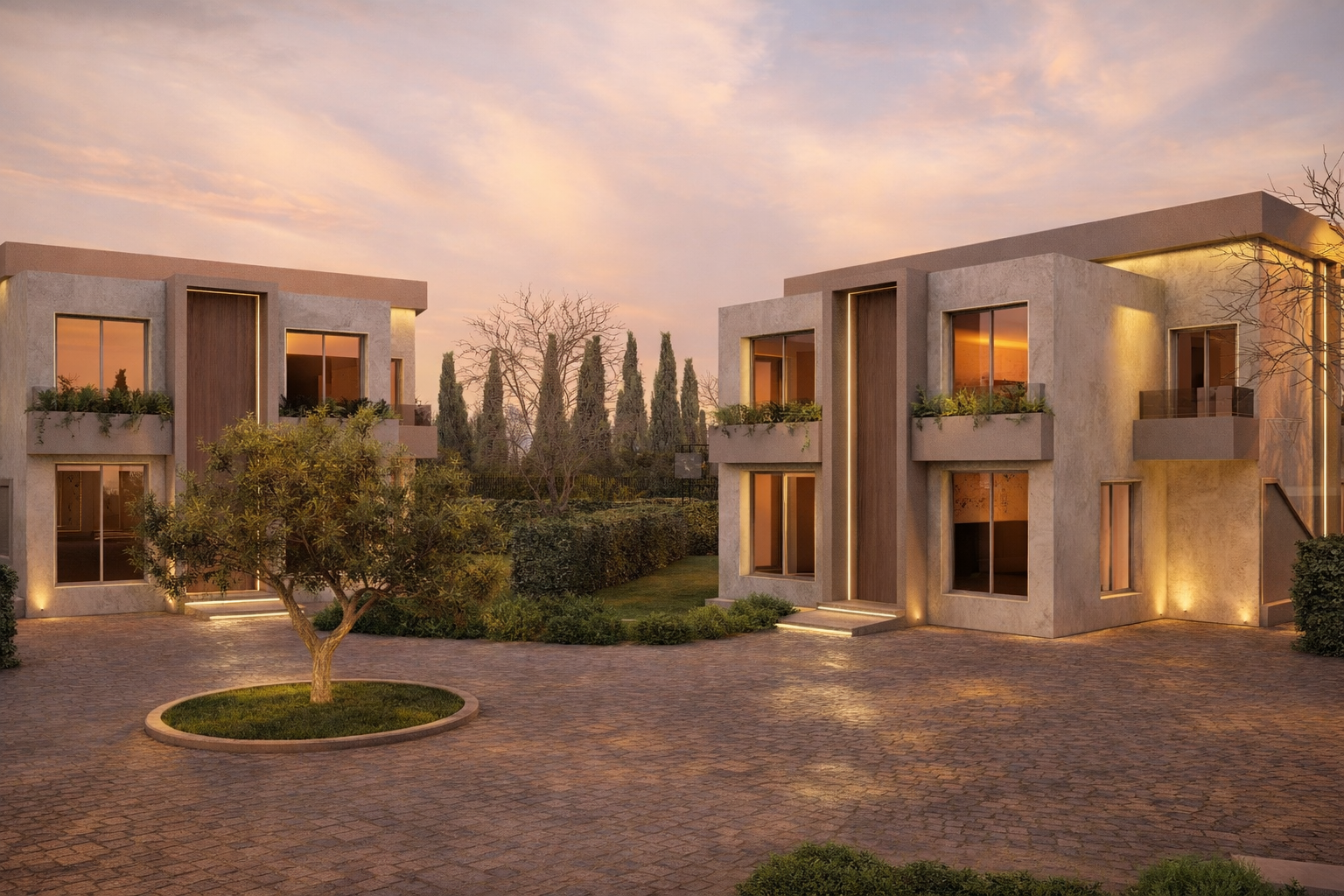
Seen straight down, the courtyard reads almost like a piazza scaled for six households instead of a town — paths radiating out from the tree, each branch ending at somebody’s front step. Seen from villa level, at dusk, it’s simpler than that: two houses facing each other across ten meters of stone, close enough to wave, far enough to still knock.
No Two Villas Sit the Same Way
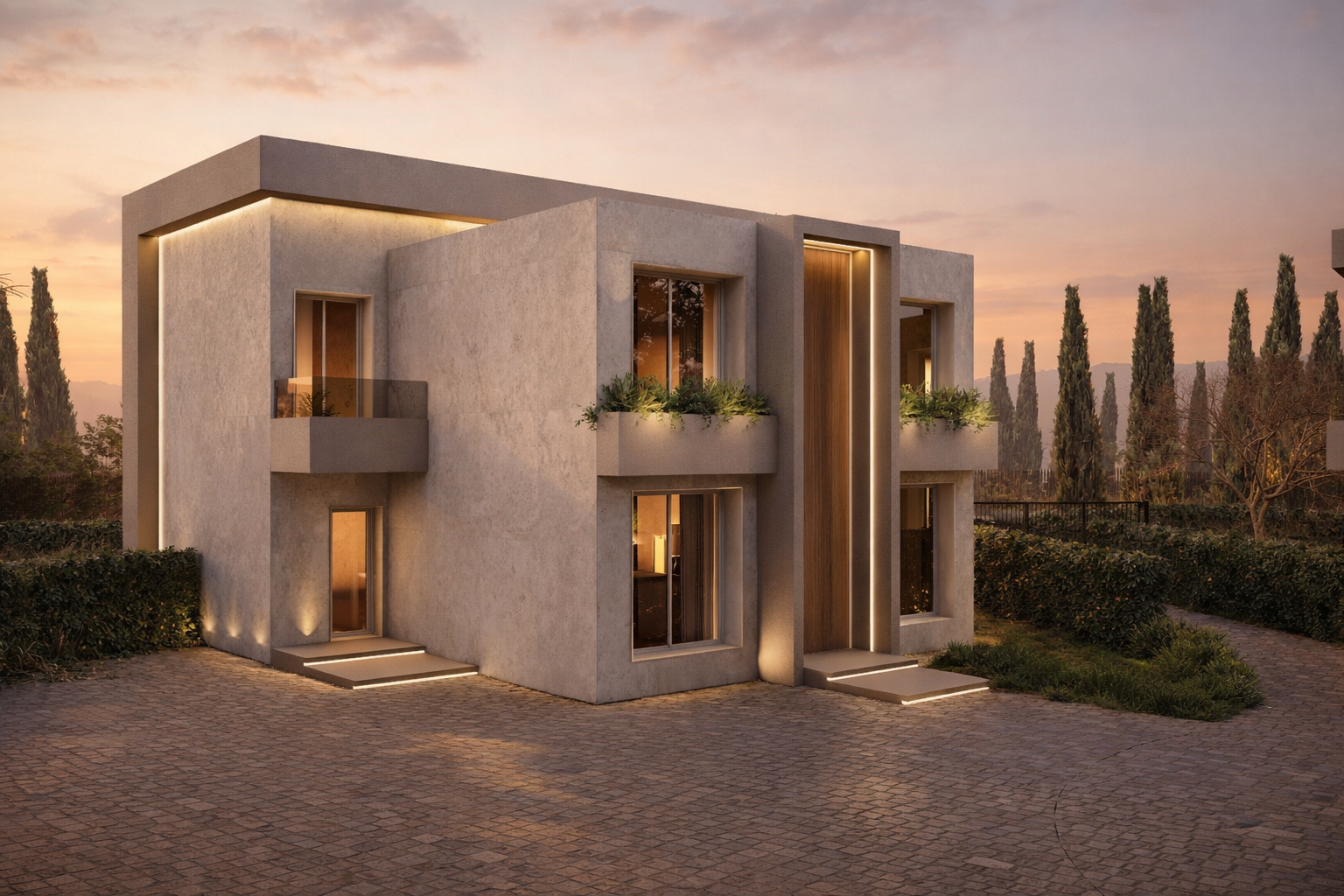
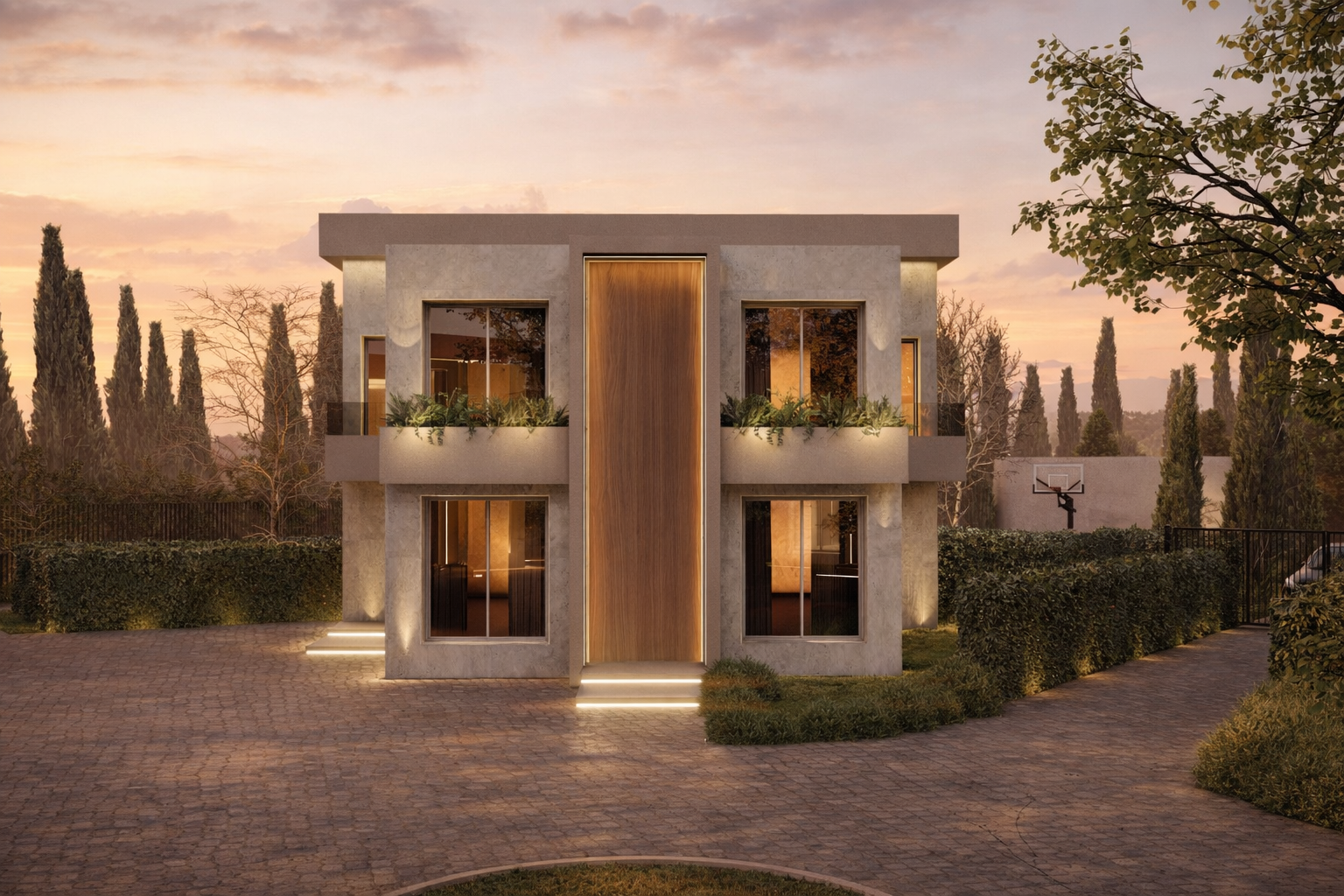
Each villa repeats the same material language — sand-toned render, a full-height wood door lit by a hairline strip, deep-set windows, a cantilevered balcony holding a strip of planting — but no two are massed identically. Some split into two staggered boxes with a shadow gap between them; others sit as a single symmetrical block, door dead-center, a window mirrored on either side. It reads less like a catalogue of unit types and more like six answers to the same question, each family getting a slightly different one.
The wood door is the constant. Every villa gets one — full height, grain running vertical, lit from a recessed channel rather than a fixture. No two are lit quite the same way, but each is the first thing that’s warm when the sun’s gone down. Ask Mohamad and he’ll put it simpler: “كل باب رجع لأهله” — every door, home to someone.
The Dewaneye: A Room With No Small Talk
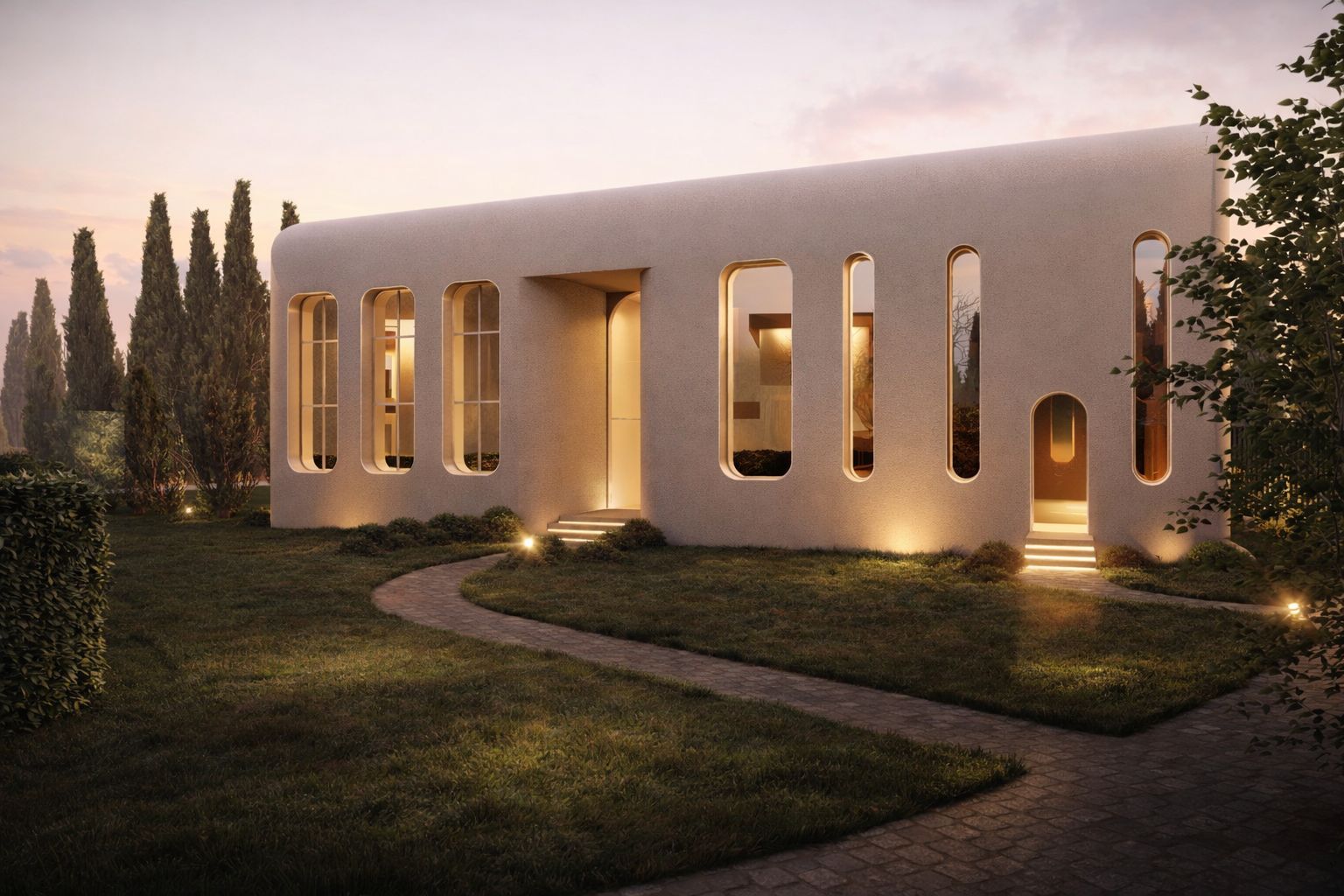
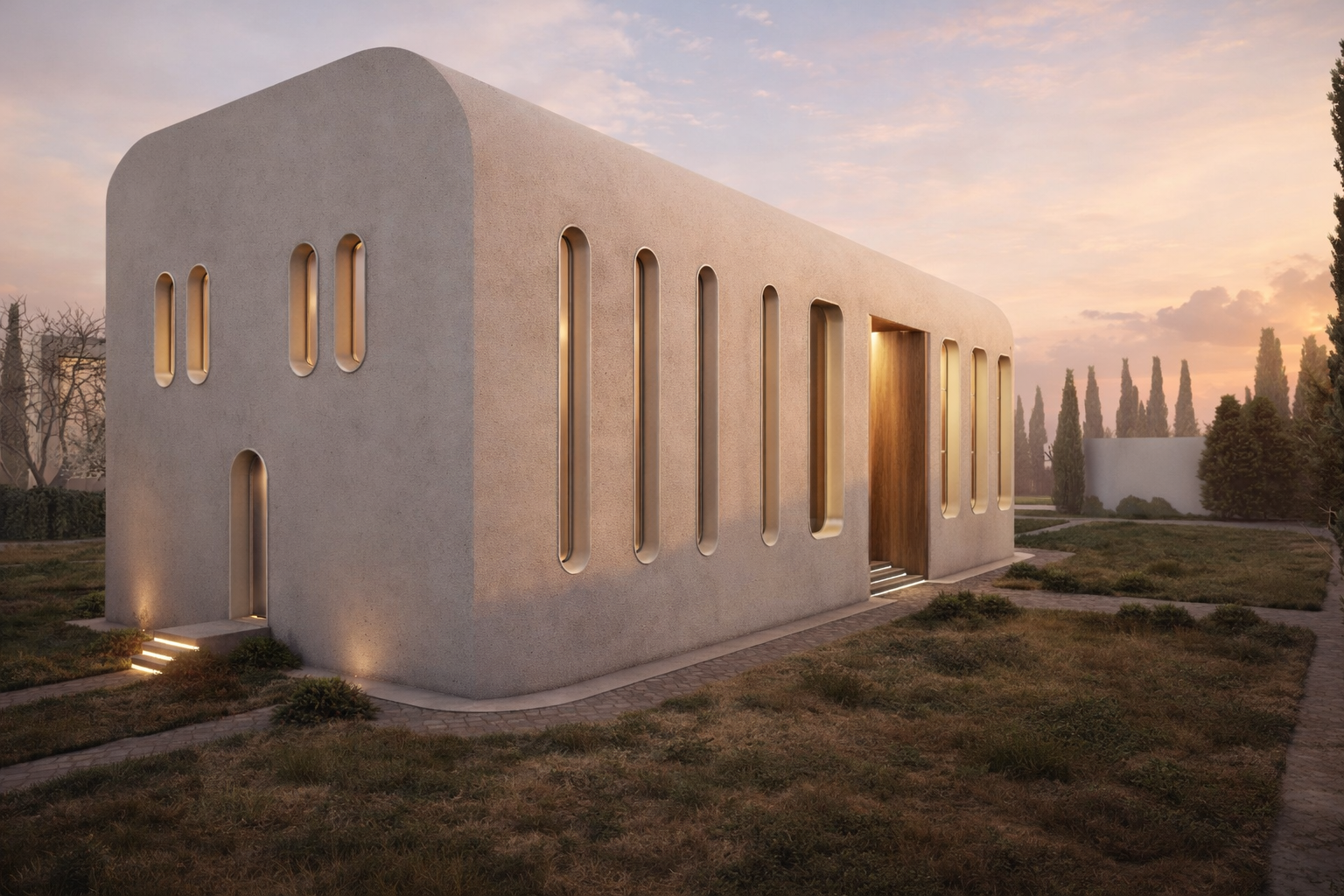
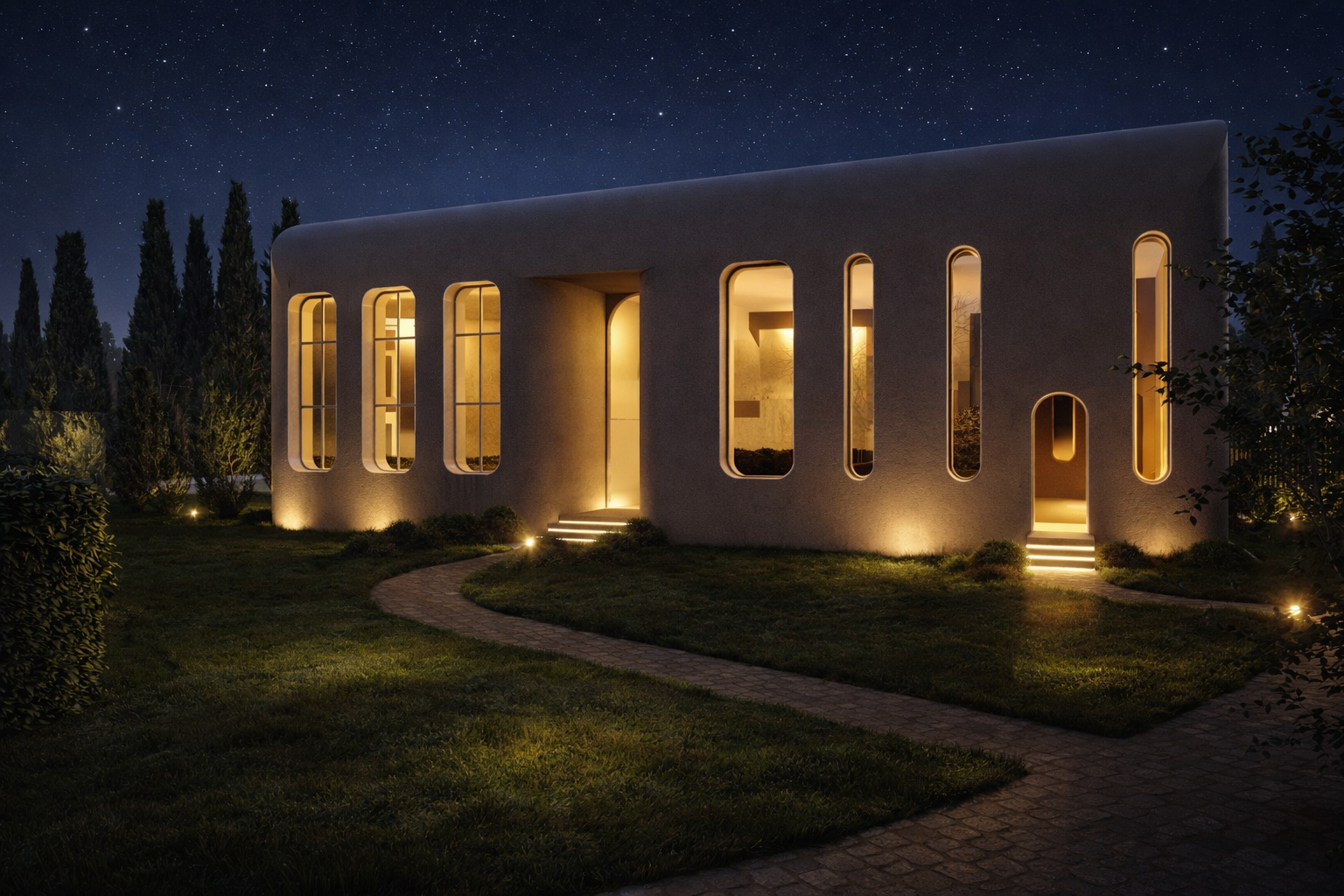
A family compound needs somewhere to gather that isn’t anyone’s living room. That’s the dewaneye — a reception hall of its own, set apart from the villas, built for the kind of sitting that goes on for hours. The form is a single curved volume, corners rounded off rather than cut, with a run of tall arched window-slits cast in warm light and two doors — one grand, one modest — set into the long white wall. It’s the most sculptural piece on the land, and deliberately the least private.
We rendered it across a full day because a room like this doesn’t have one mood. At dusk it’s a soft outline against a fading sky. At golden hour, from the back, its arched cuts glow gold against the render’s rough stucco. At night, the same building goes quiet and lit — windows like lanterns cut into a dark wall, the kind of glow that tells you, from across the courtyard, that someone’s still up.
Water, Held Still
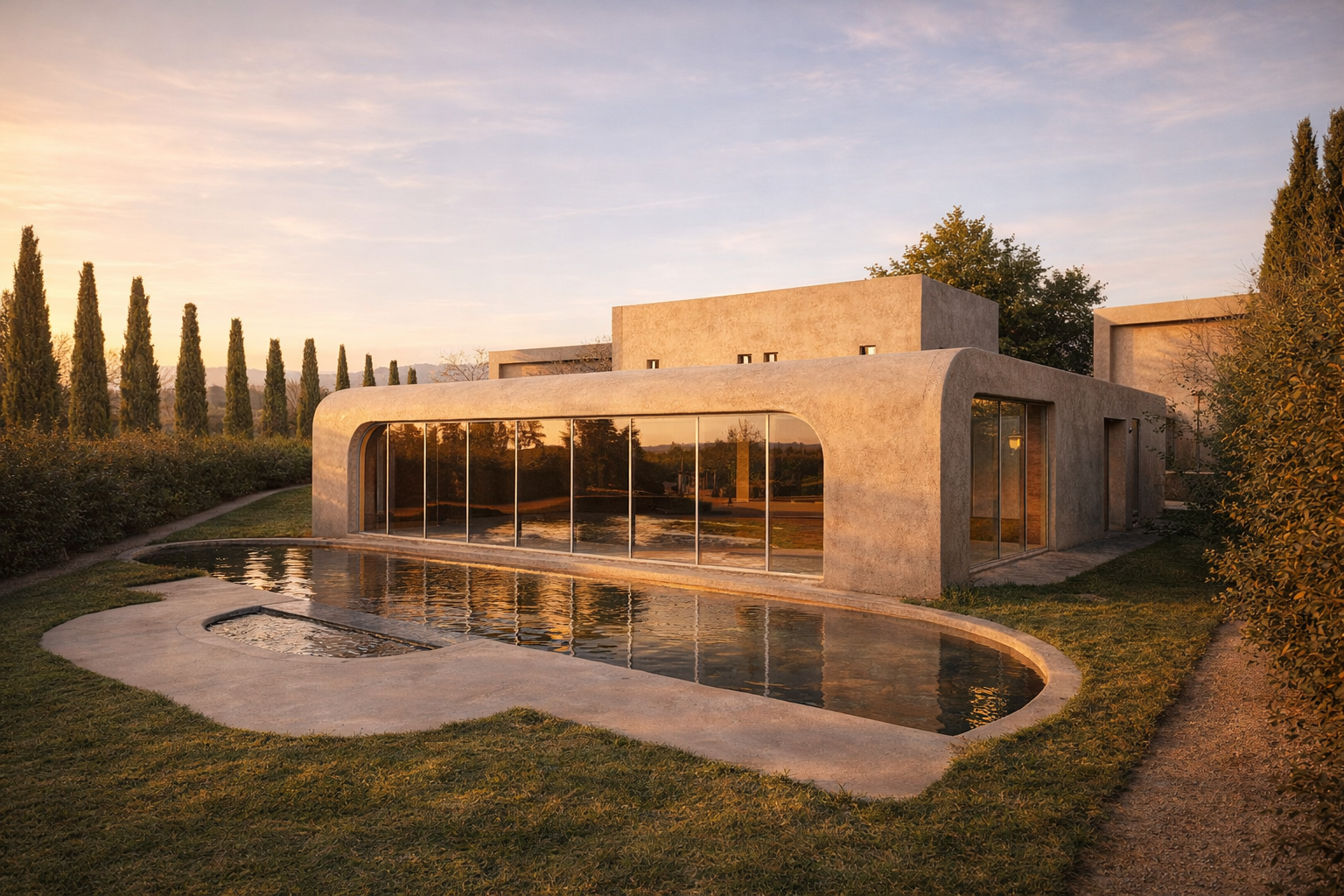
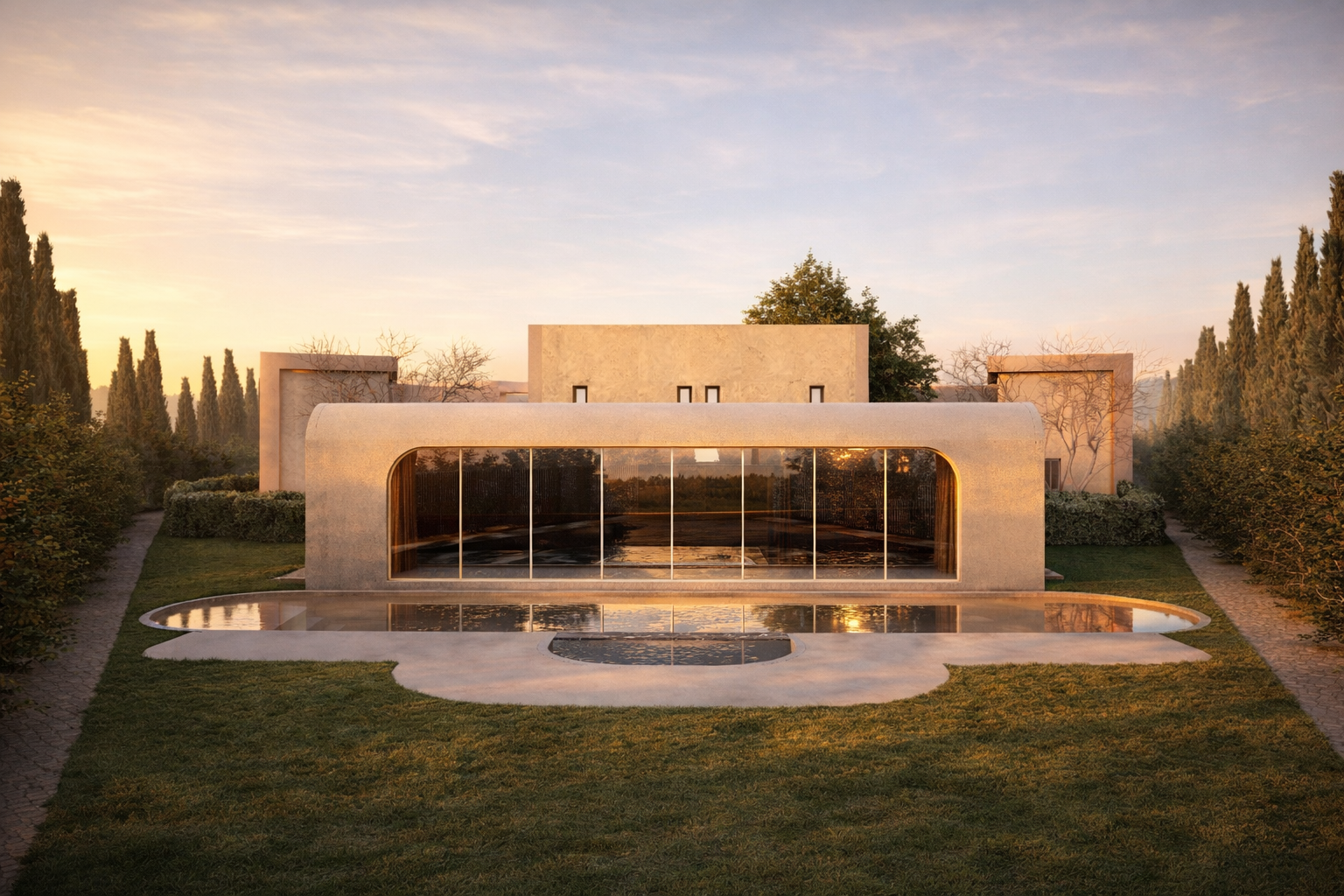
Set apart from the villas and the dewaneye both, a glass pavilion holds a curved pool that wraps the building rather than sitting in front of it — one long arm of water plus a smaller circular basin, poured concrete instead of tile, edges soft rather than squared. Floor-to-ceiling glass runs the length of the pavilion, so from inside, the valley and the pool blur into the same reflection. It’s a gym and a pool house in one — the one building on the land built for solitude rather than gathering.
The Roofs Carry Their Own Light
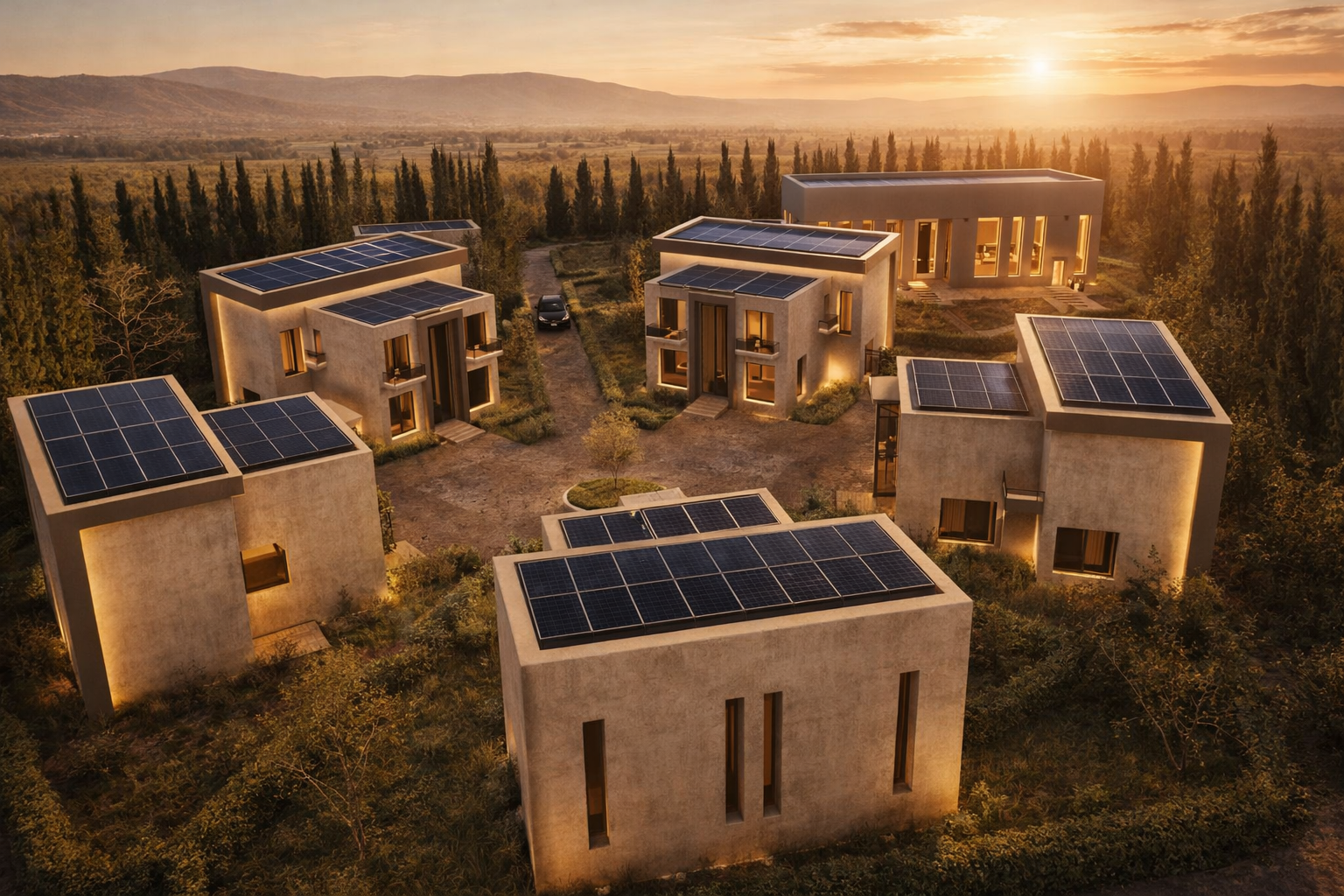
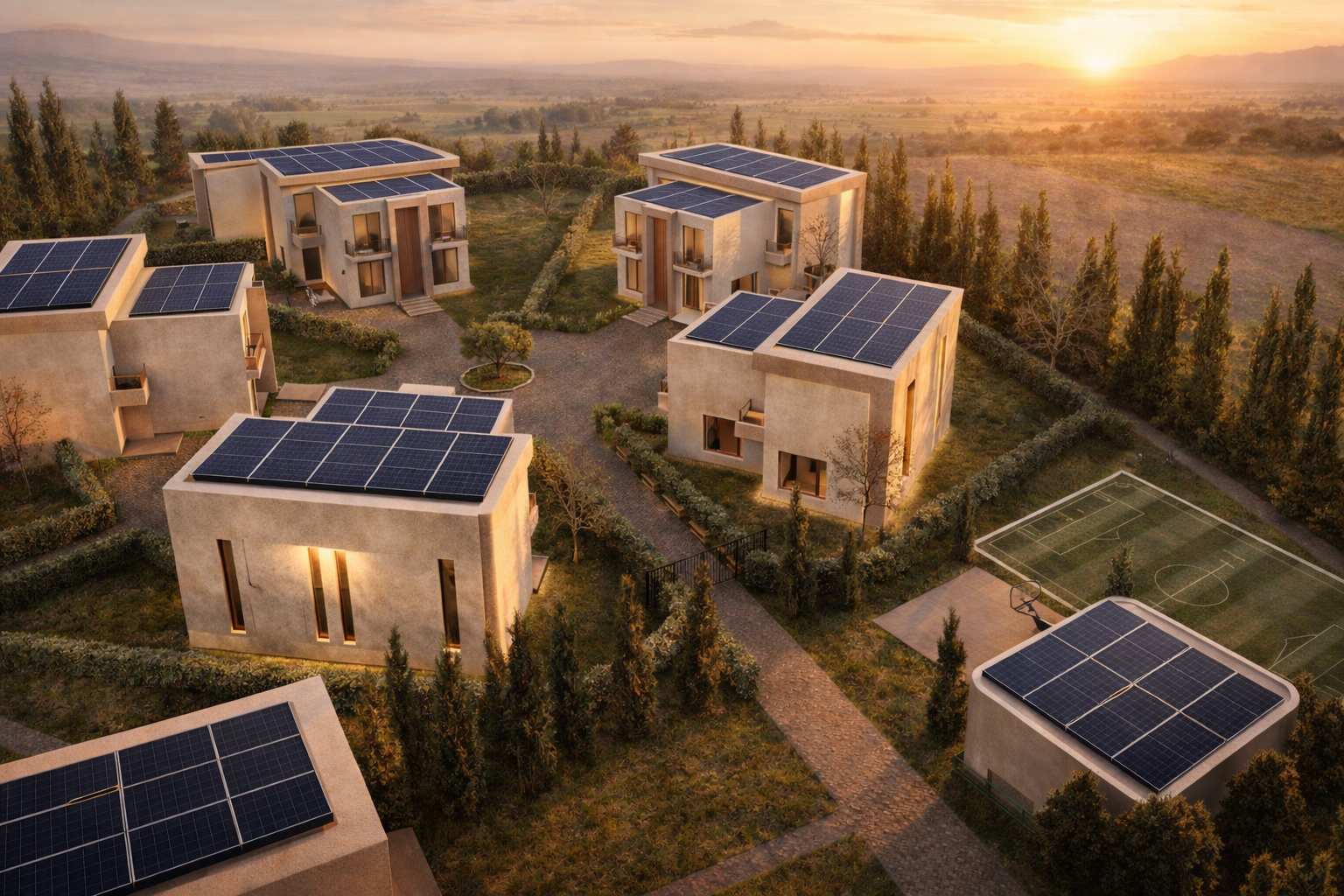
Every roof on the compound is fitted for solar. Not as a footnote, and not as a selling point — in the Bekaa, a family building six houses on one plot has already thought about what happens when the grid doesn’t show up. The panels sit flush and dark against the same flat roofs that, in the earlier renders, read as pure concrete. Same buildings, same light, one detail added — and the whole compound stops depending on anyone else to keep its lights on.
Put the two states side by side and the compound doesn’t look any less considered without the panels — it looks like a project that decided its roofs should do something, instead of just sitting there being roofs.
One Family, Several Front Doors
Hamad Villas isn’t a compound because it has a gate. It’s a compound because the distance between one door and the next was designed on purpose — close enough to see who’s home, far enough that everyone still has a home of their own. The olive tree in the middle of it isn’t decoration. On land a family has already lived on, it’s the one thing that was probably there before we were.