
Most venues give you one experience. You arrive, you sit, you leave. The space performs around you and then it’s over. At the Apex was built on a different idea — that where you are in a building changes everything about how you experience it, and that the most memorable destinations are not rooms you walk into but journeys you move through.
The concept is simple enough to say in one sentence. On the ground, a pool club. At the top, a restaurant. And between the two, a sequence of architecture that makes the name feel not chosen but inevitable.
That simplicity is deceptive. Getting two entirely different experiences to coexist inside one building — to feel distinct from each other without contradicting each other, to serve different moods without feeling like different projects — is one of the harder things you can ask a design to do. At the Apex does it by making the relationship between the two levels the concept itself. The pool is not just a pool. The restaurant is not just a restaurant. They are two ends of the same story, and the building is the telling of it.
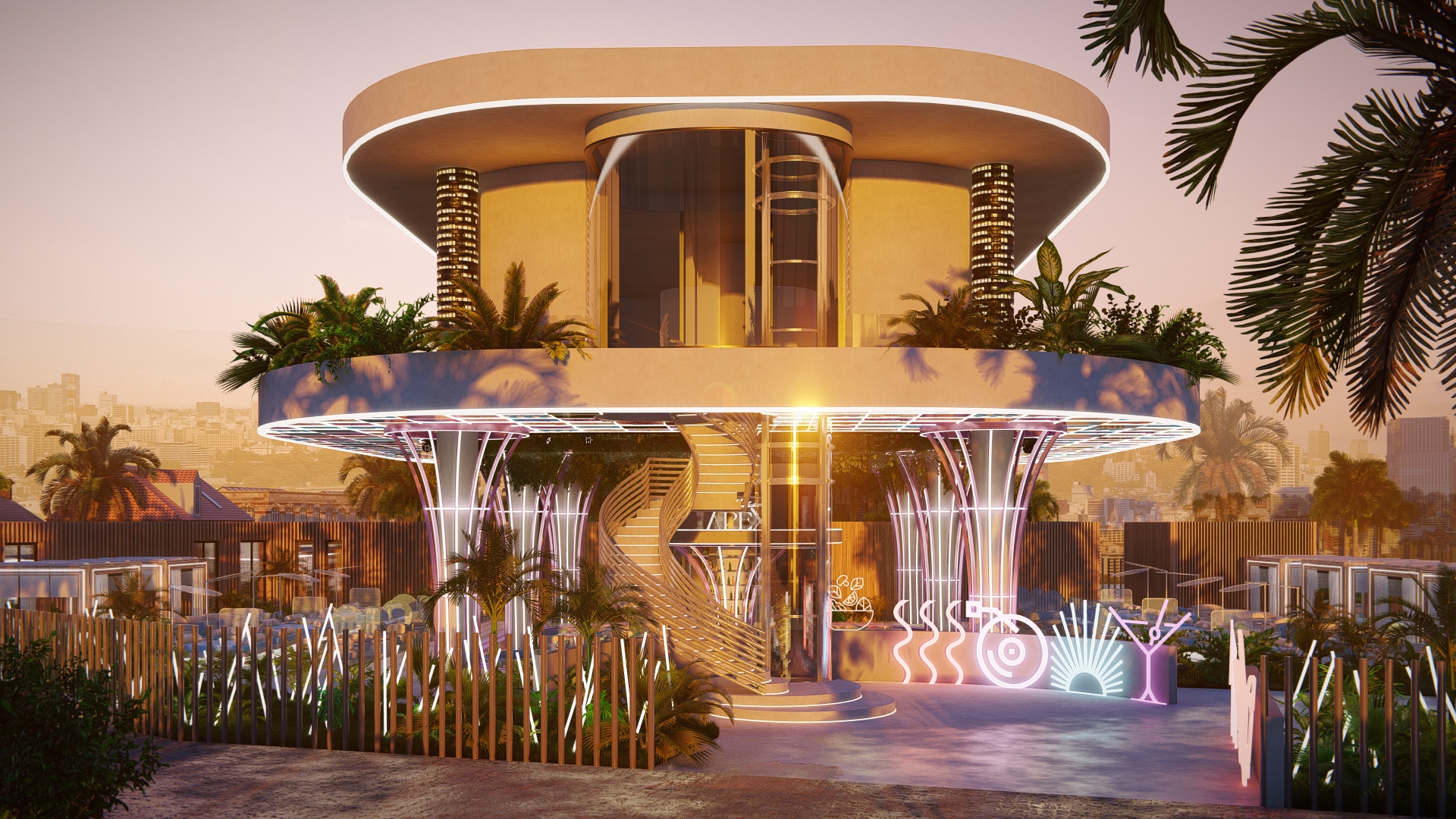
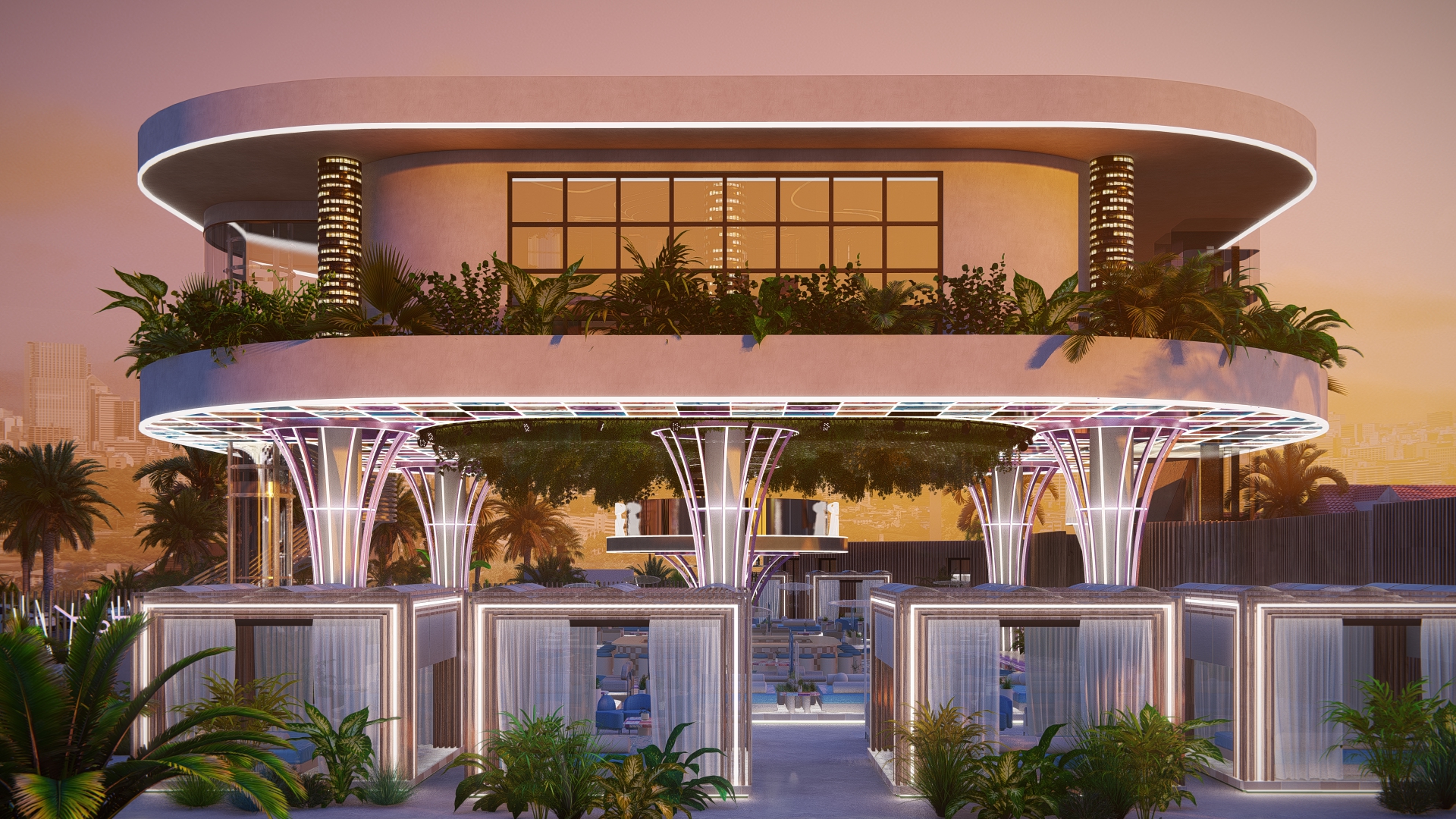
The Ground: Where the Evening Starts
The pool club at the base of At the Apex is designed for the long, open hours of the day — for the kind of afternoon that doesn’t need a reason to keep going, and the kind of early evening that doesn’t want to end. It is warm, open, unhurried, and entirely social.
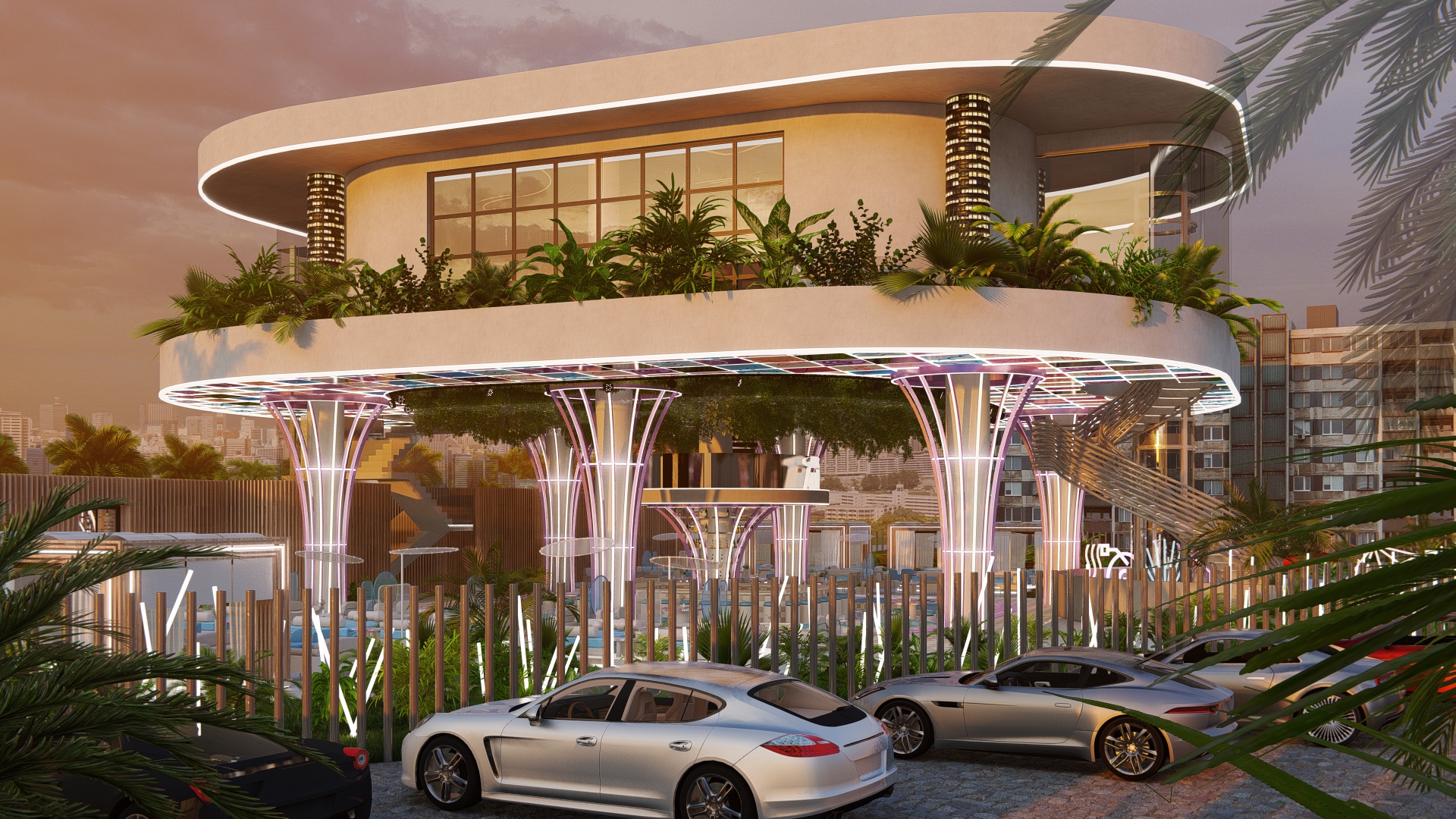
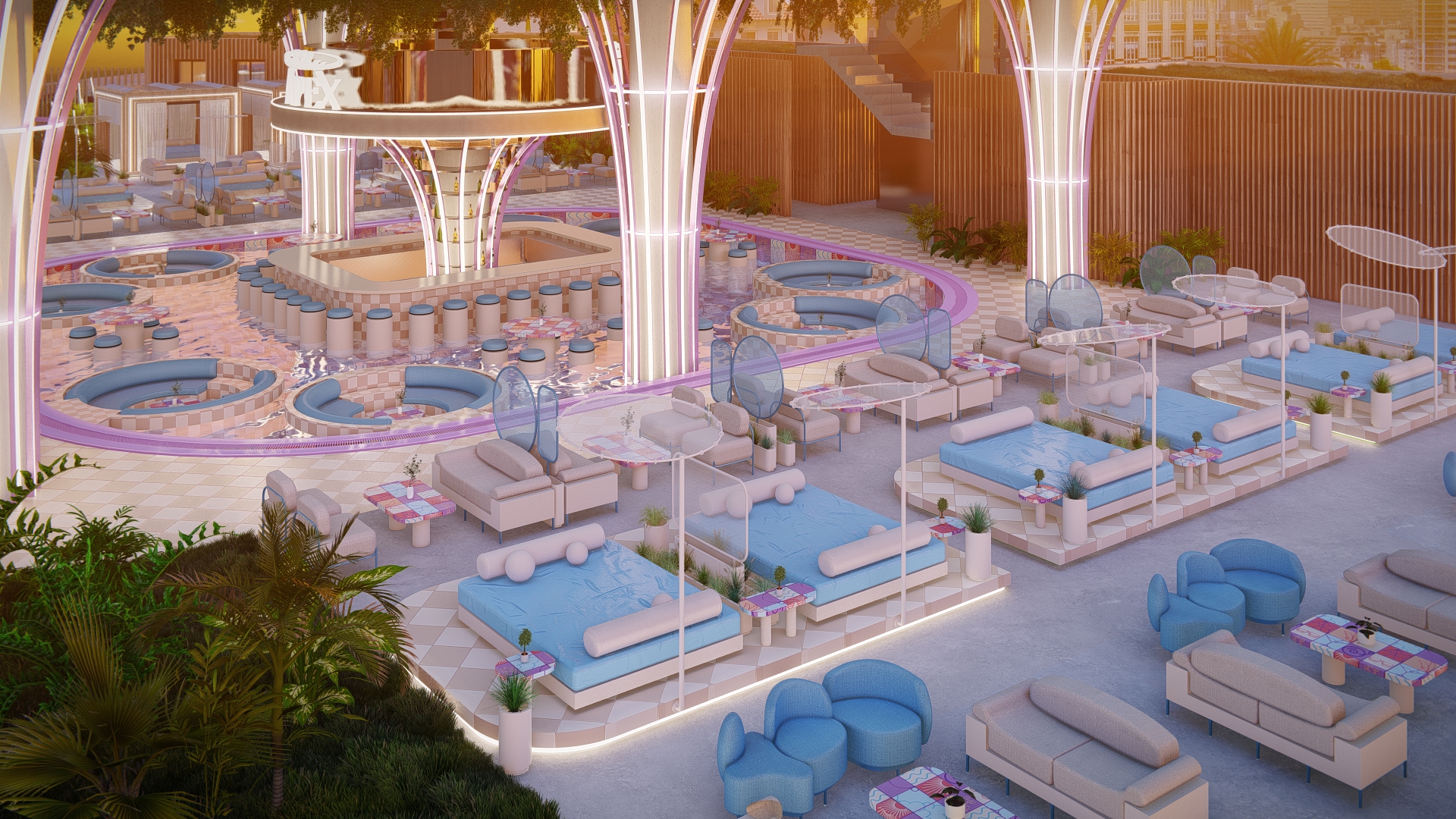
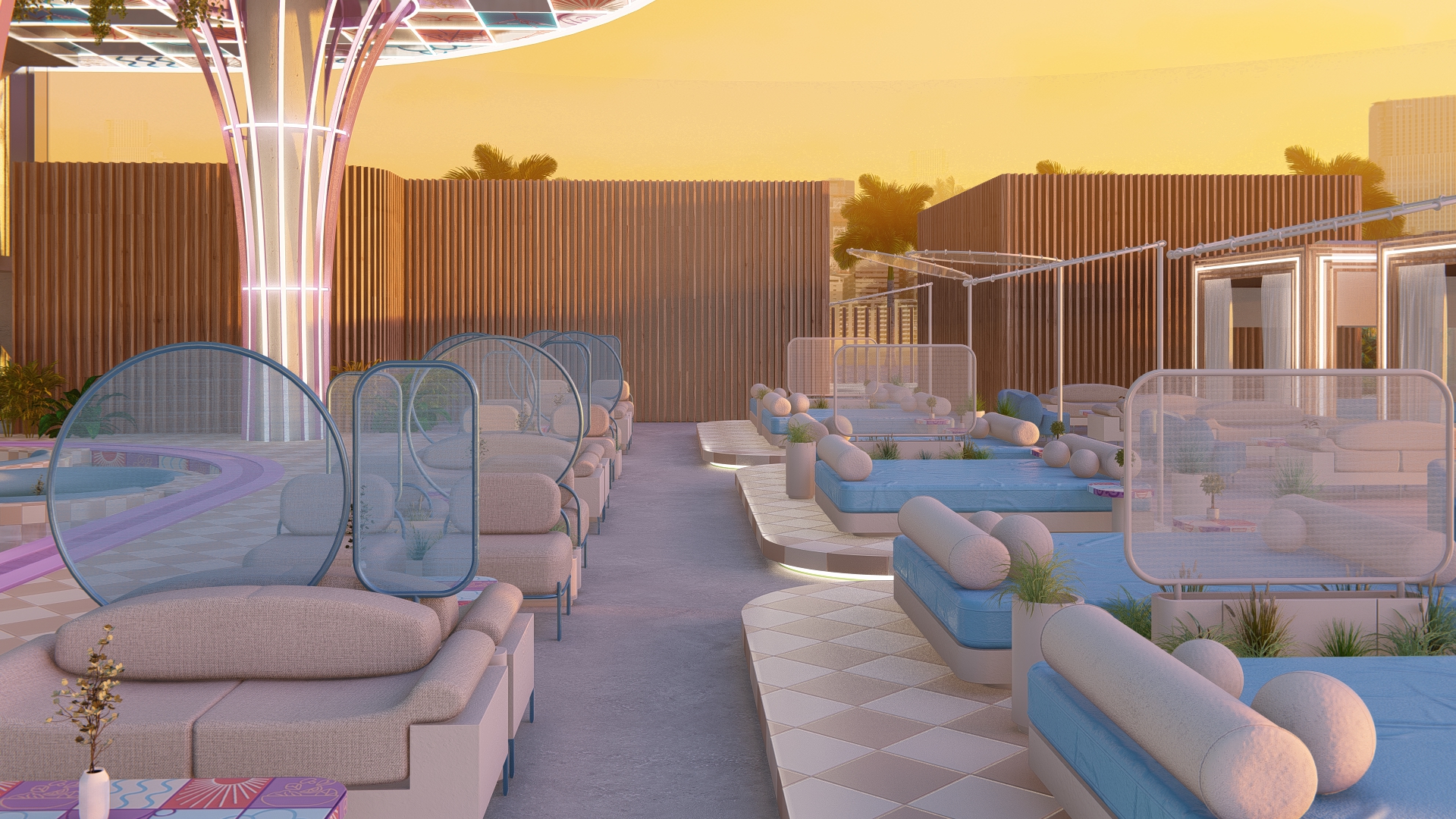
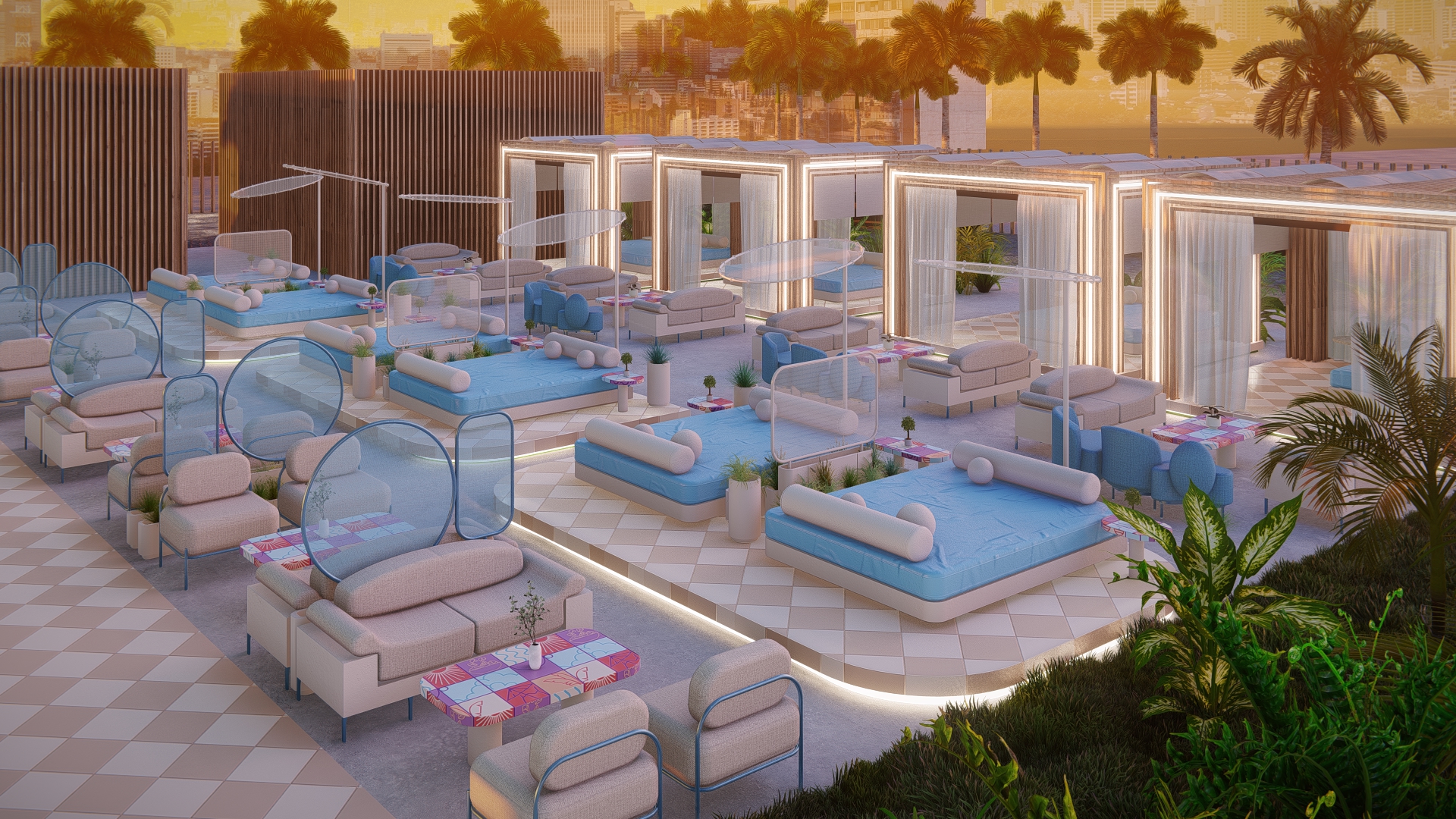
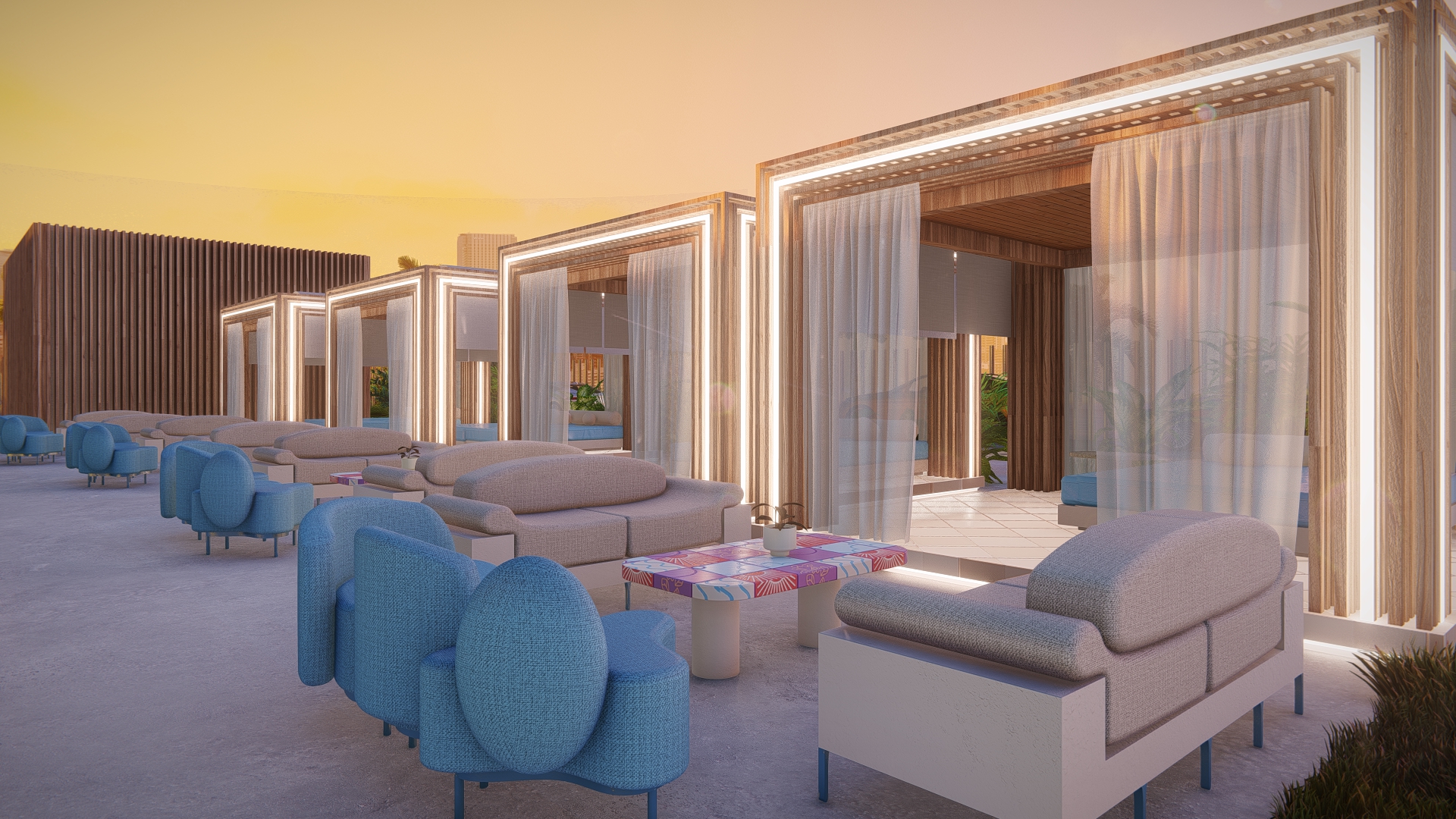
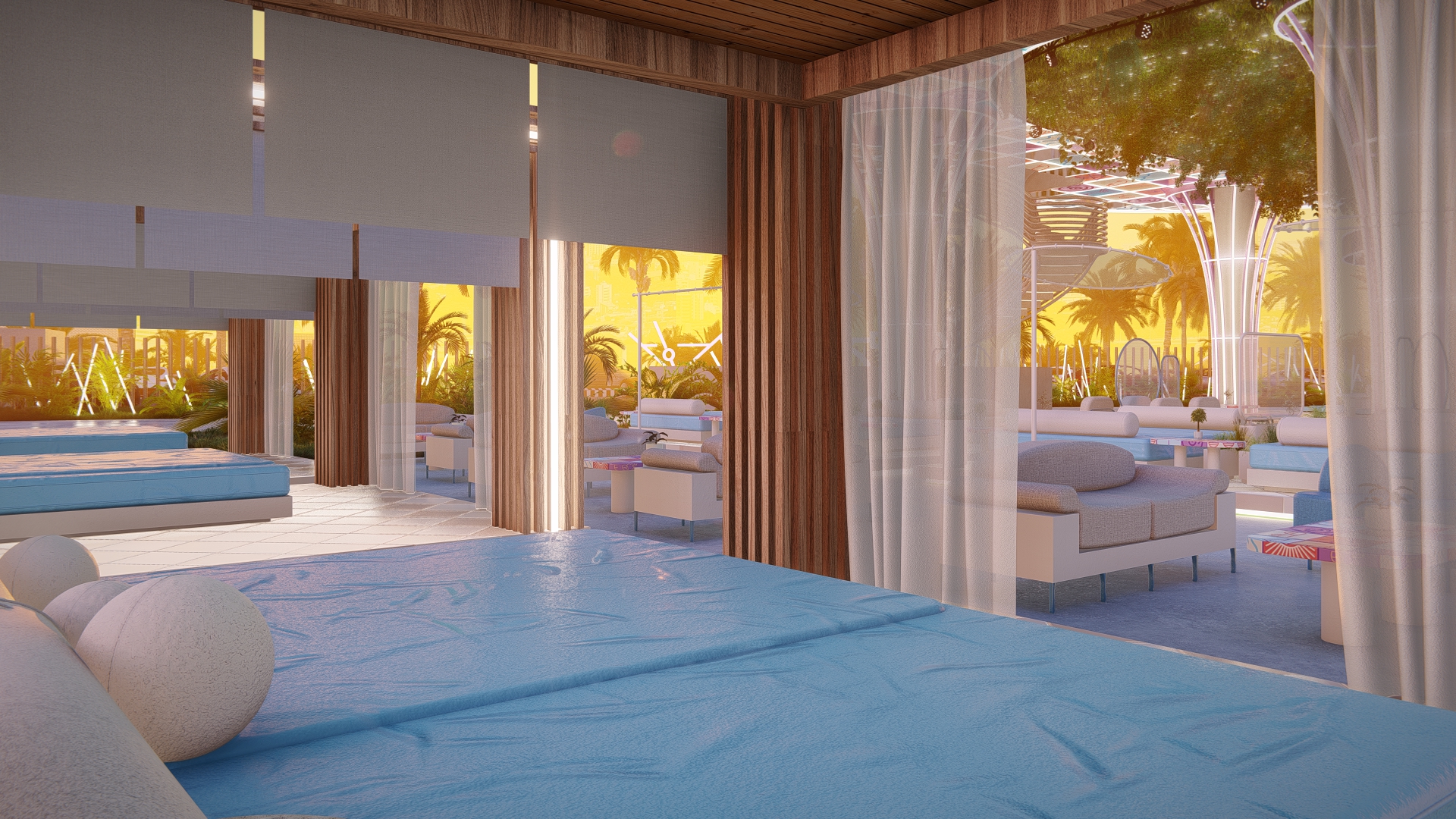
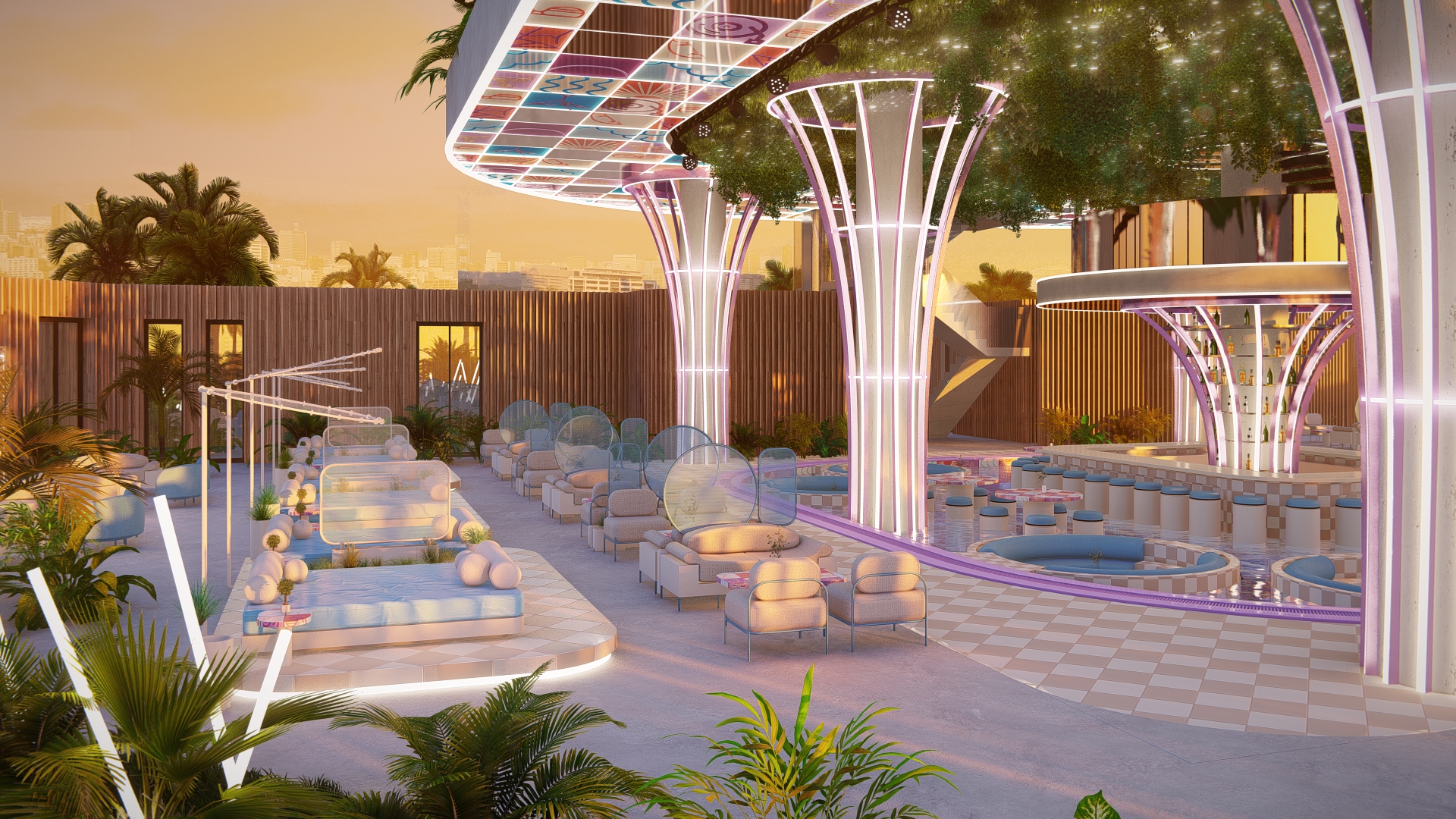
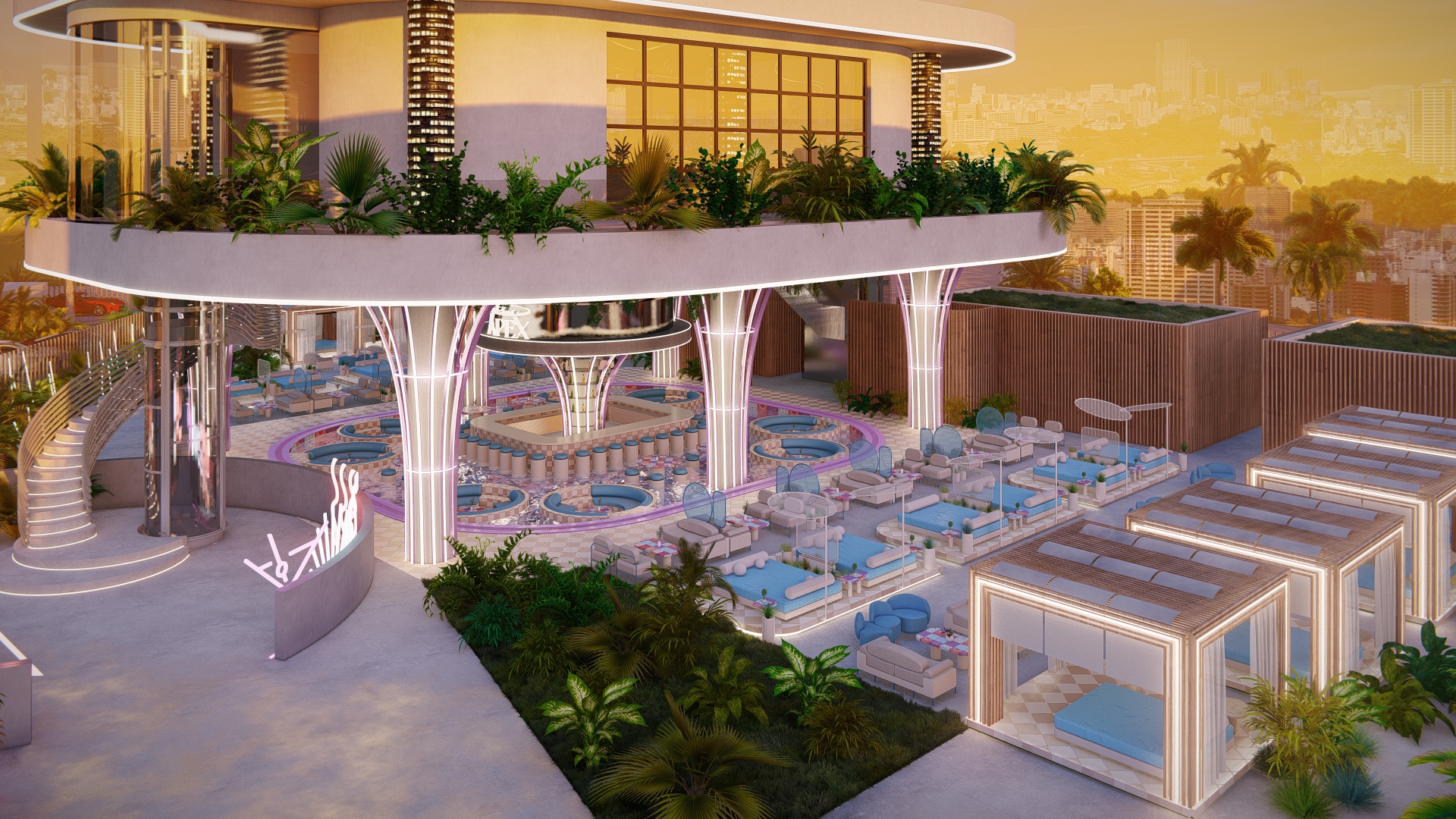
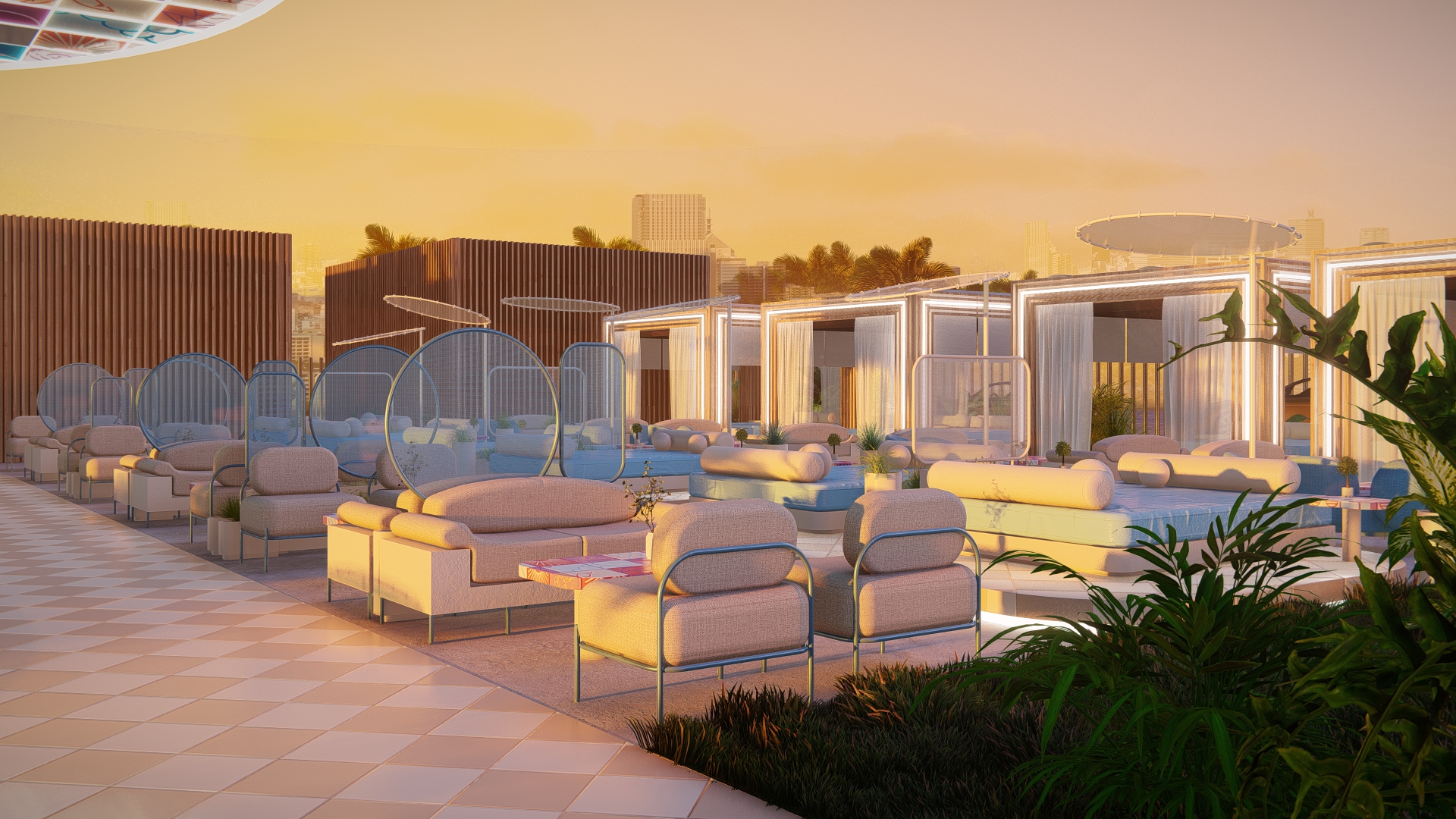
The palette sets the tone before anything else does. Blush stone paving in a generous checkerboard. Sky-blue daybeds raised on illuminated platforms, each one wide enough to make time disappear. Timber-framed cabanas along the perimeter with sheer white curtains that filter the light without closing the view. Rounded lounge chairs in sand and blue scattered across the deck with the kind of deliberate looseness that makes a space feel inhabited rather than arranged. Everything is soft-edged and sun-warm, and the city sits just beyond it all, close enough to remind you where you are.
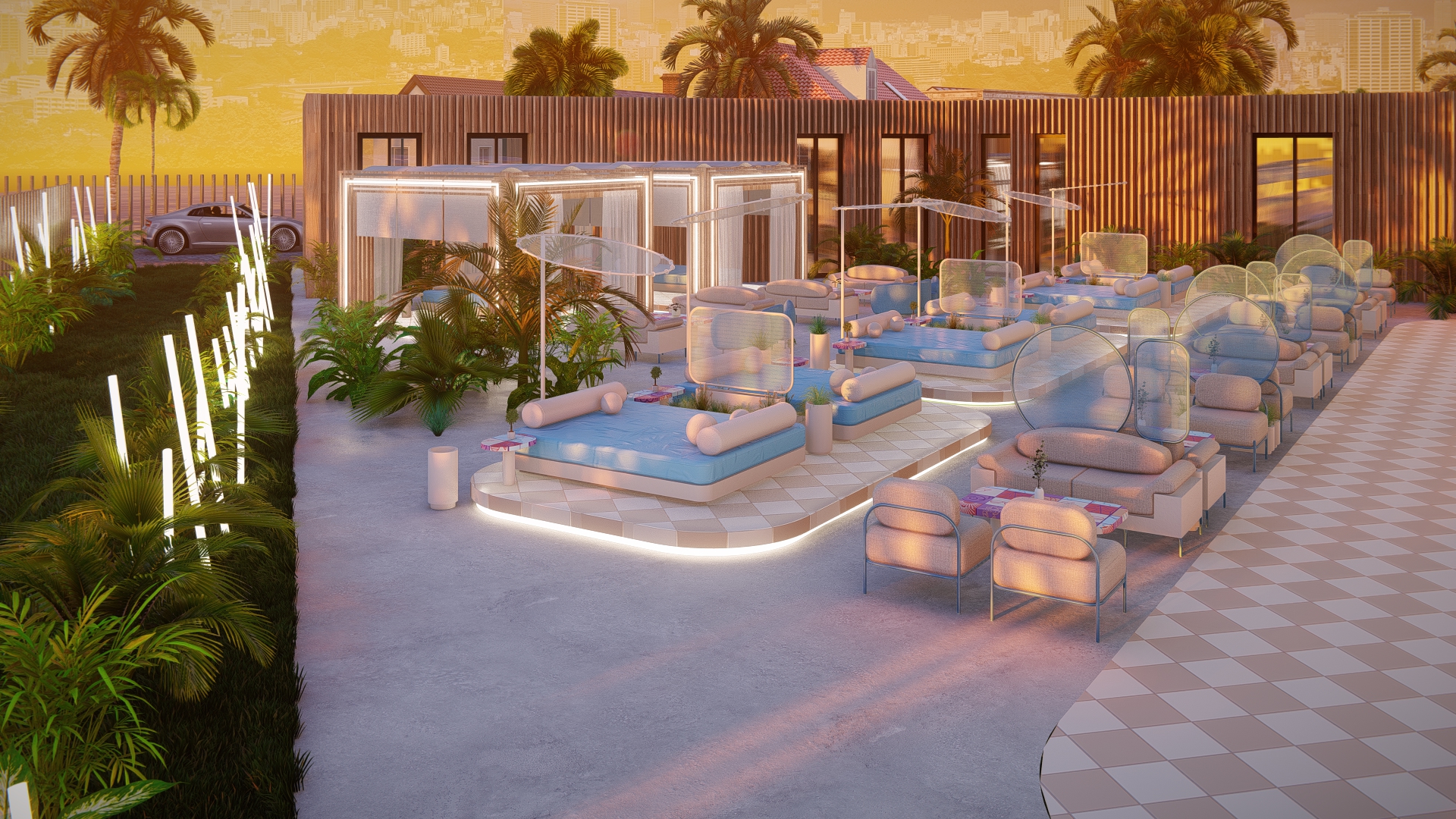
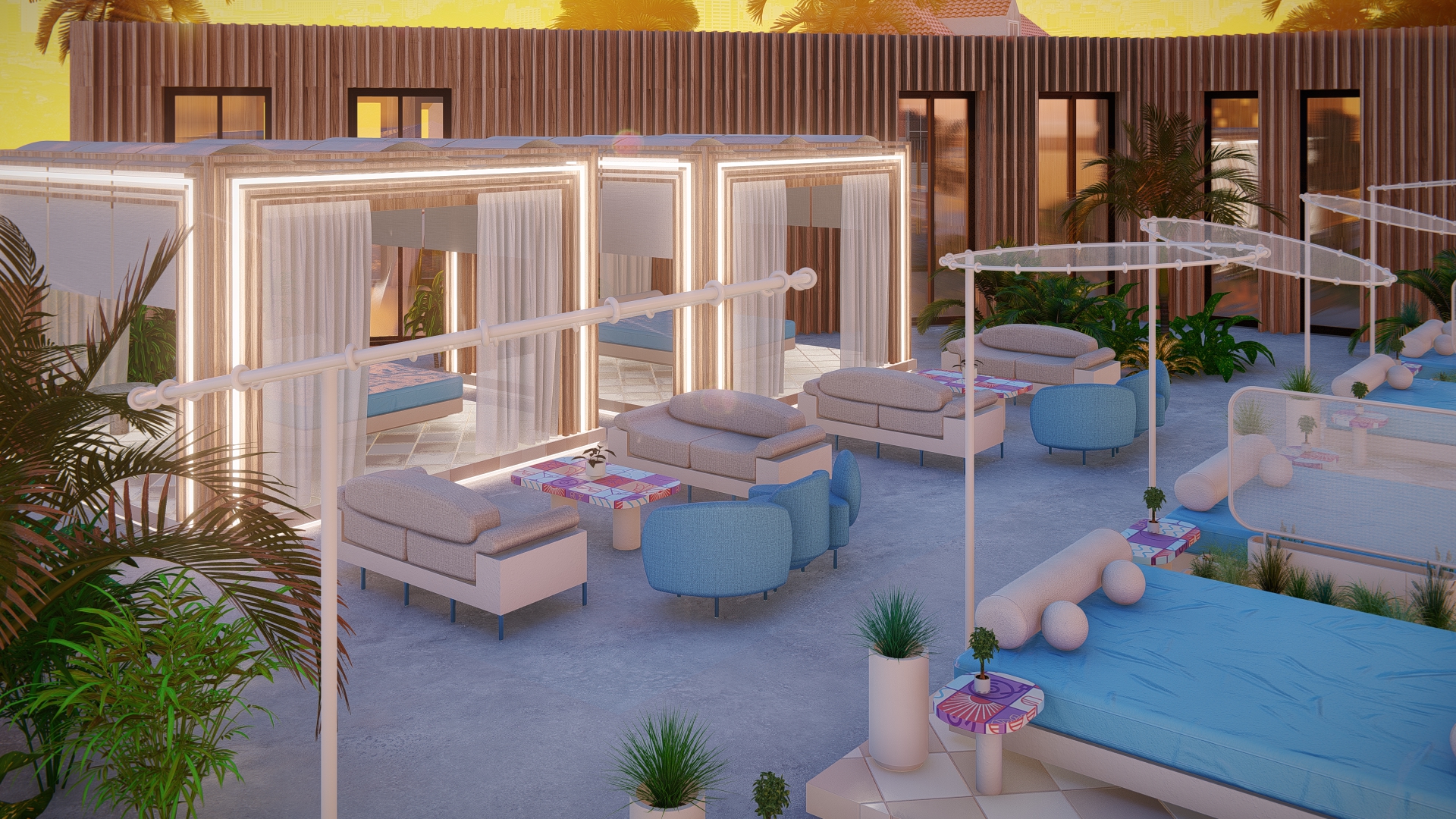
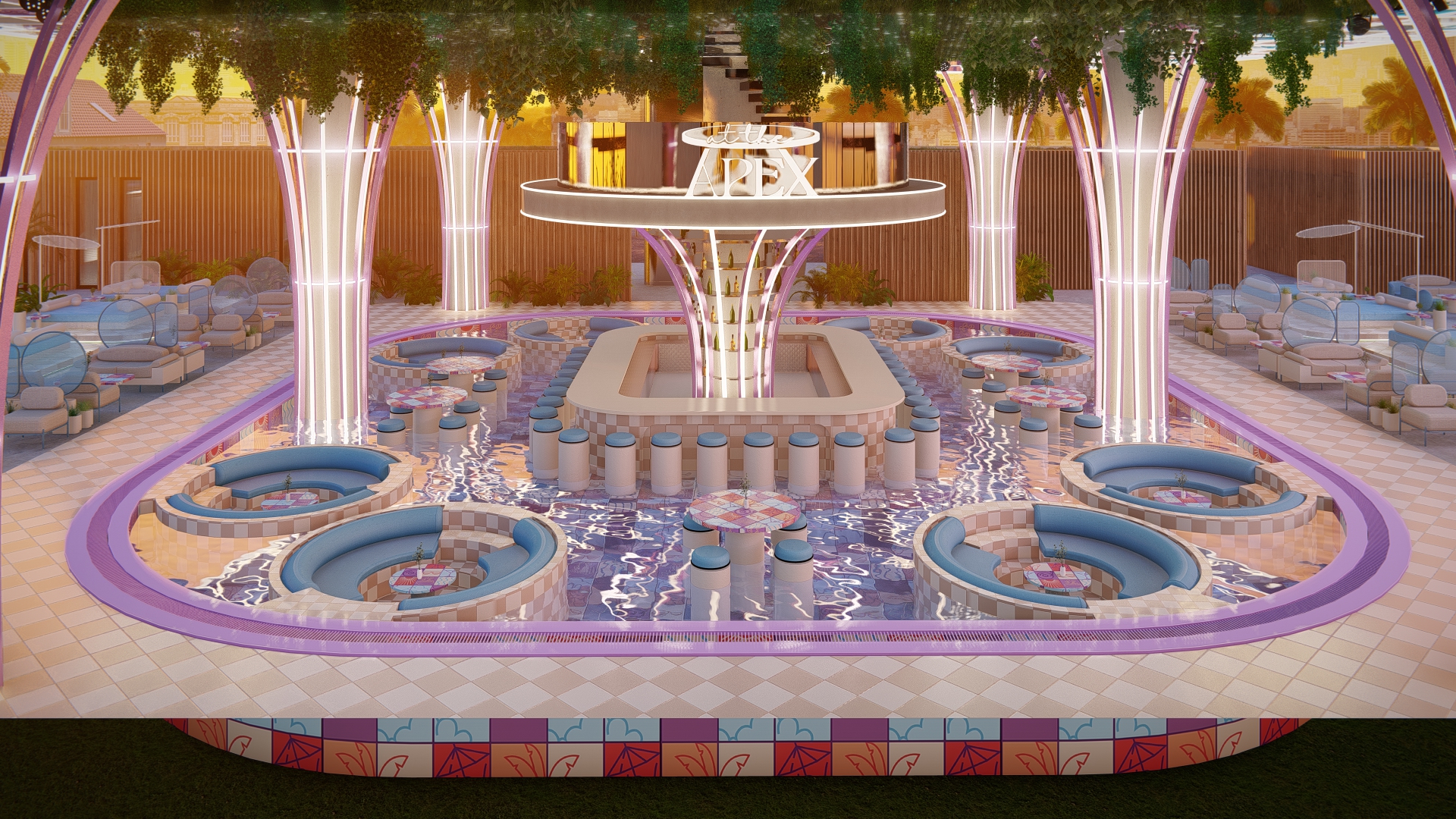
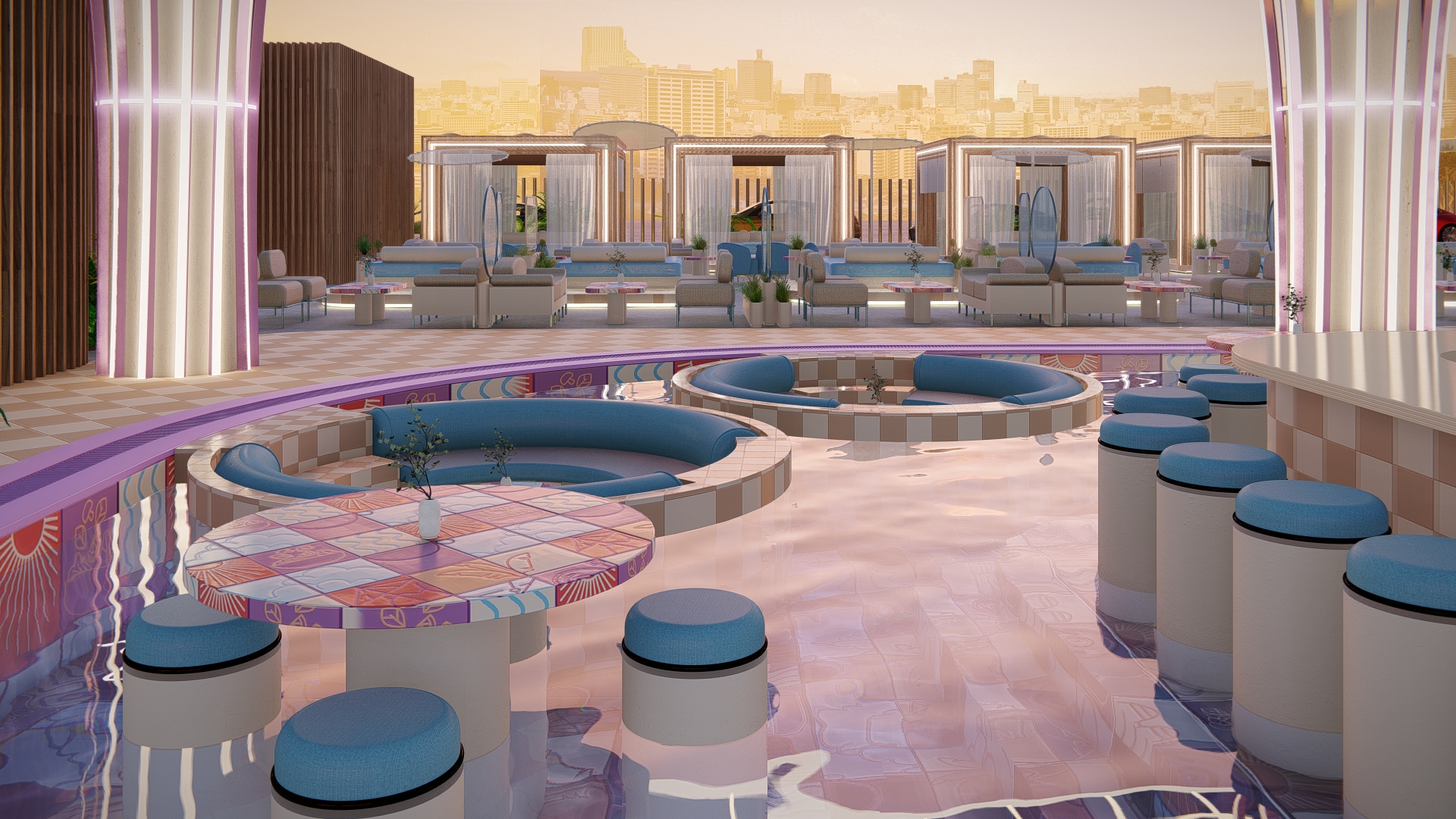
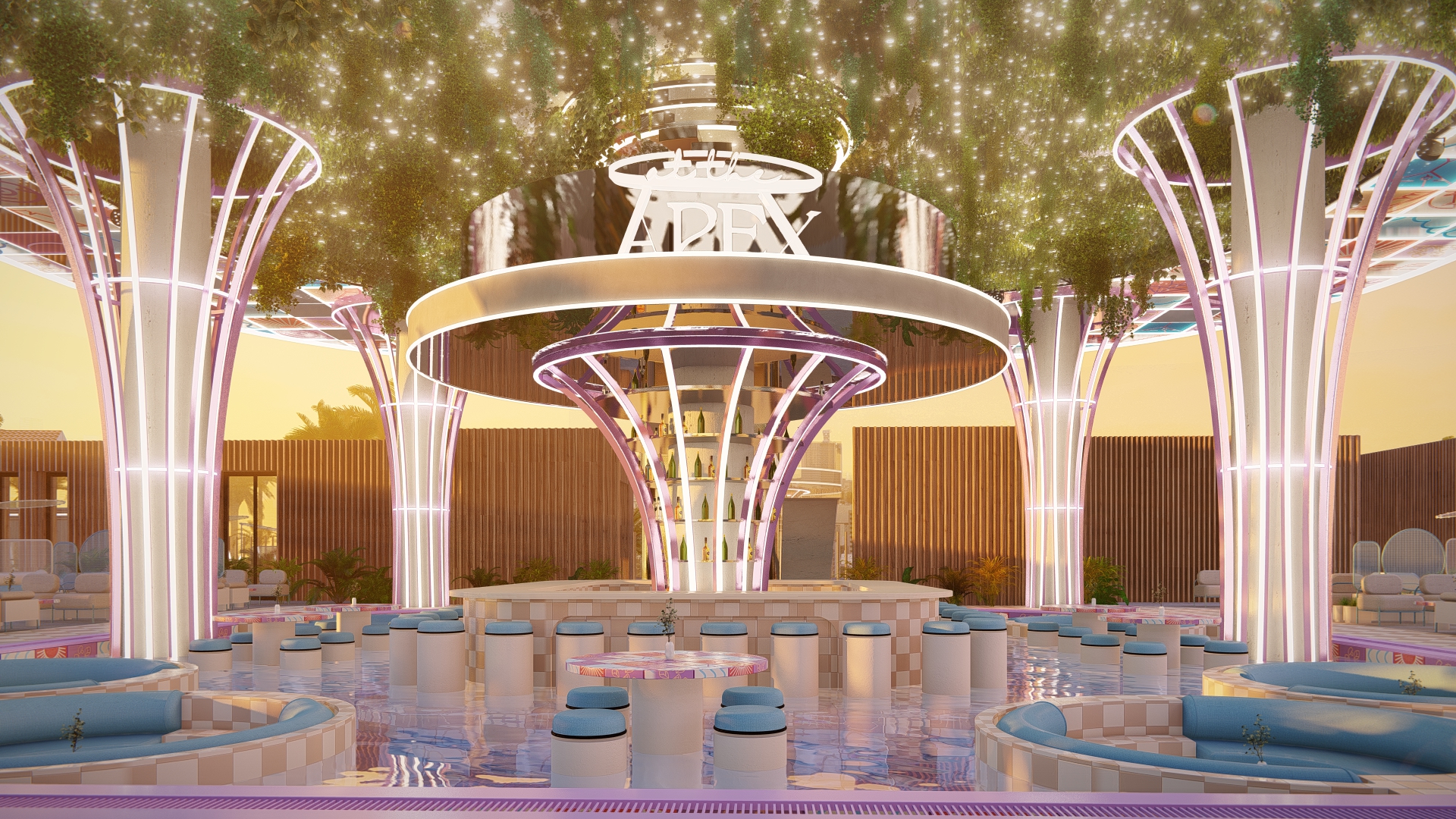
At the centre of everything sits the pool bar. It floats in a shallow reflective pool — a counter surrounded by water, ringed with cylindrical stools and circular sunken banquettes built directly into tiled islands in the pool itself. The banquettes are upholstered in sky blue, tiled around their bases in soft checkerboard, and sized for a group that intends to stay.
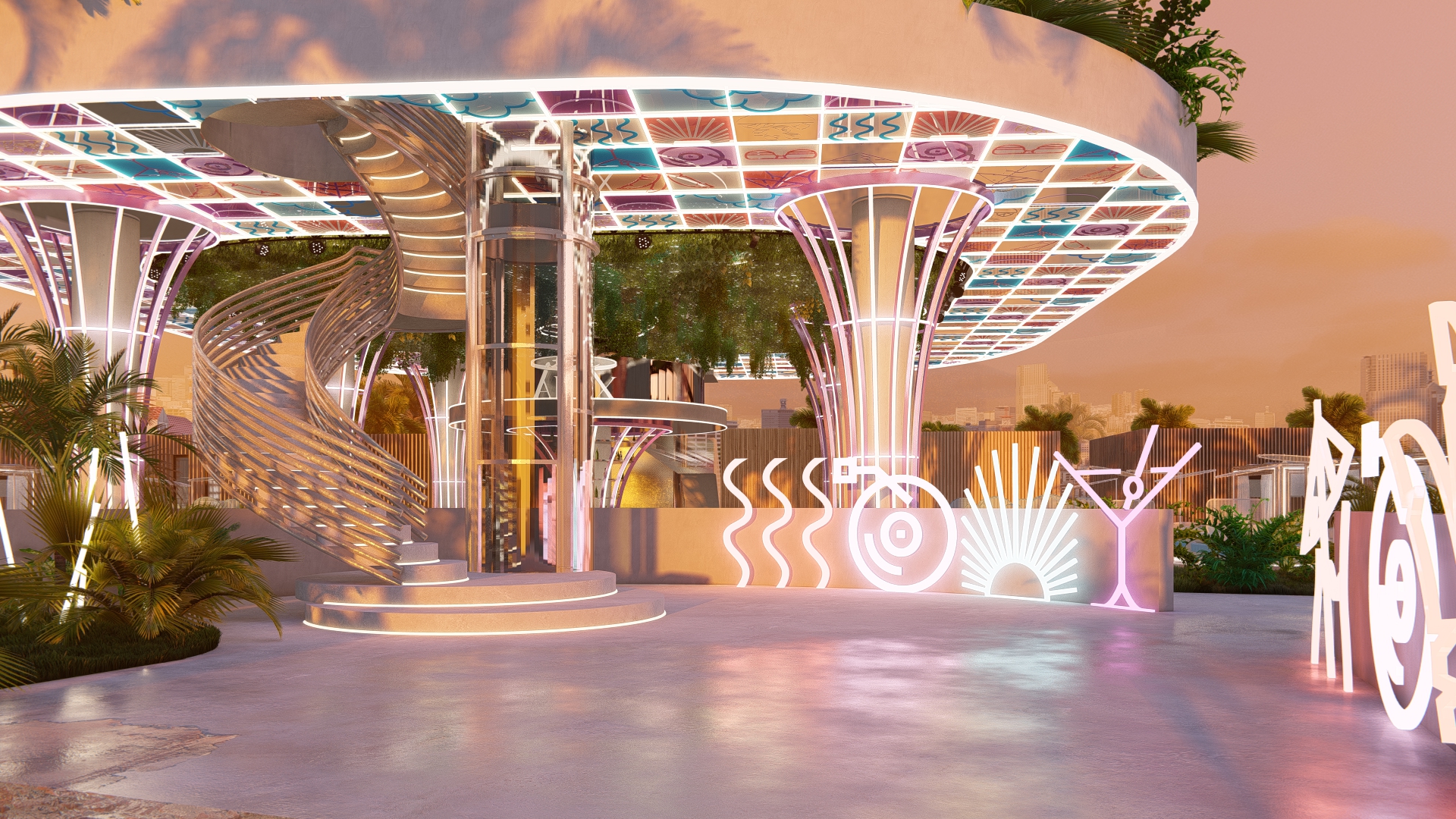
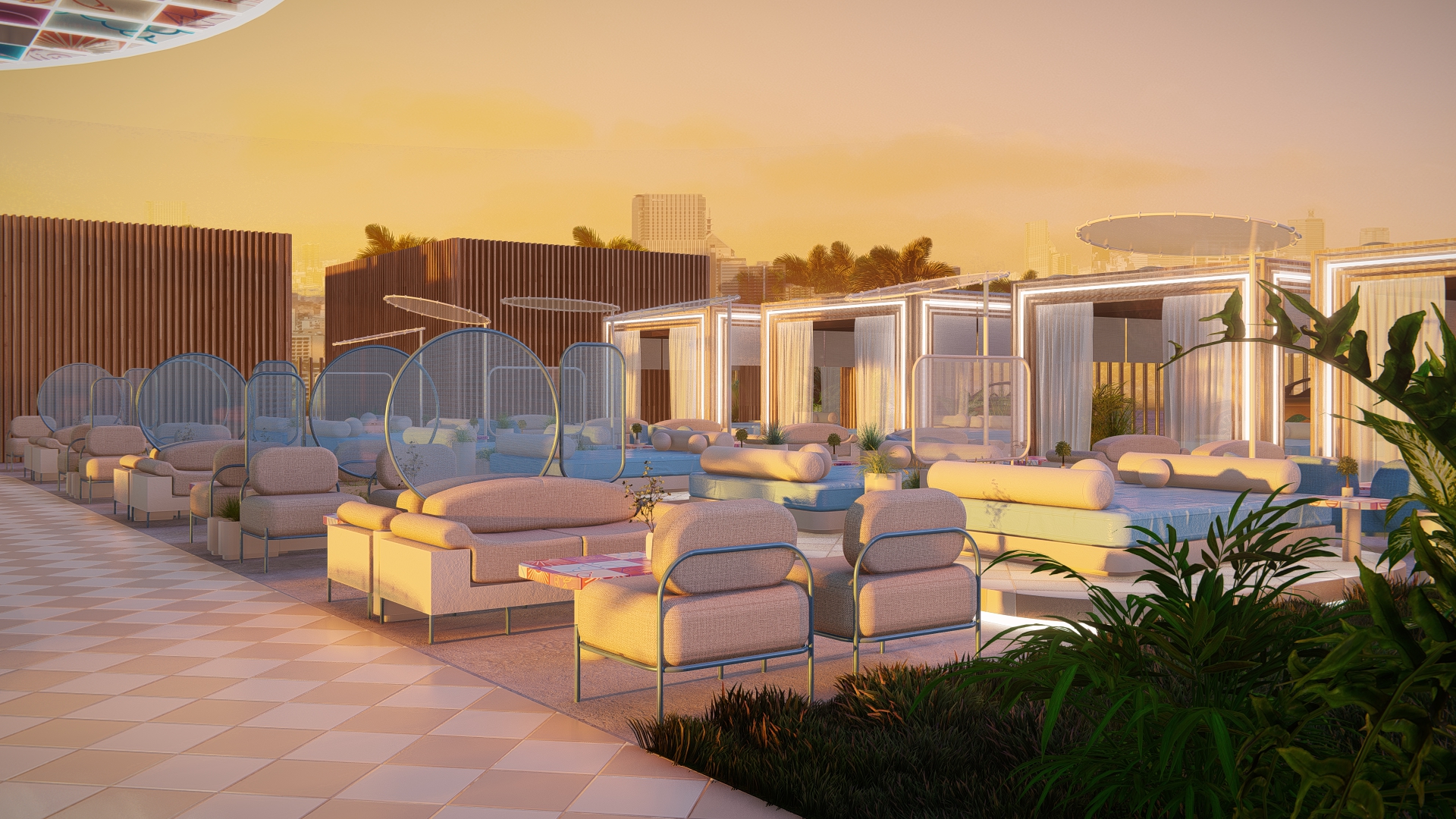
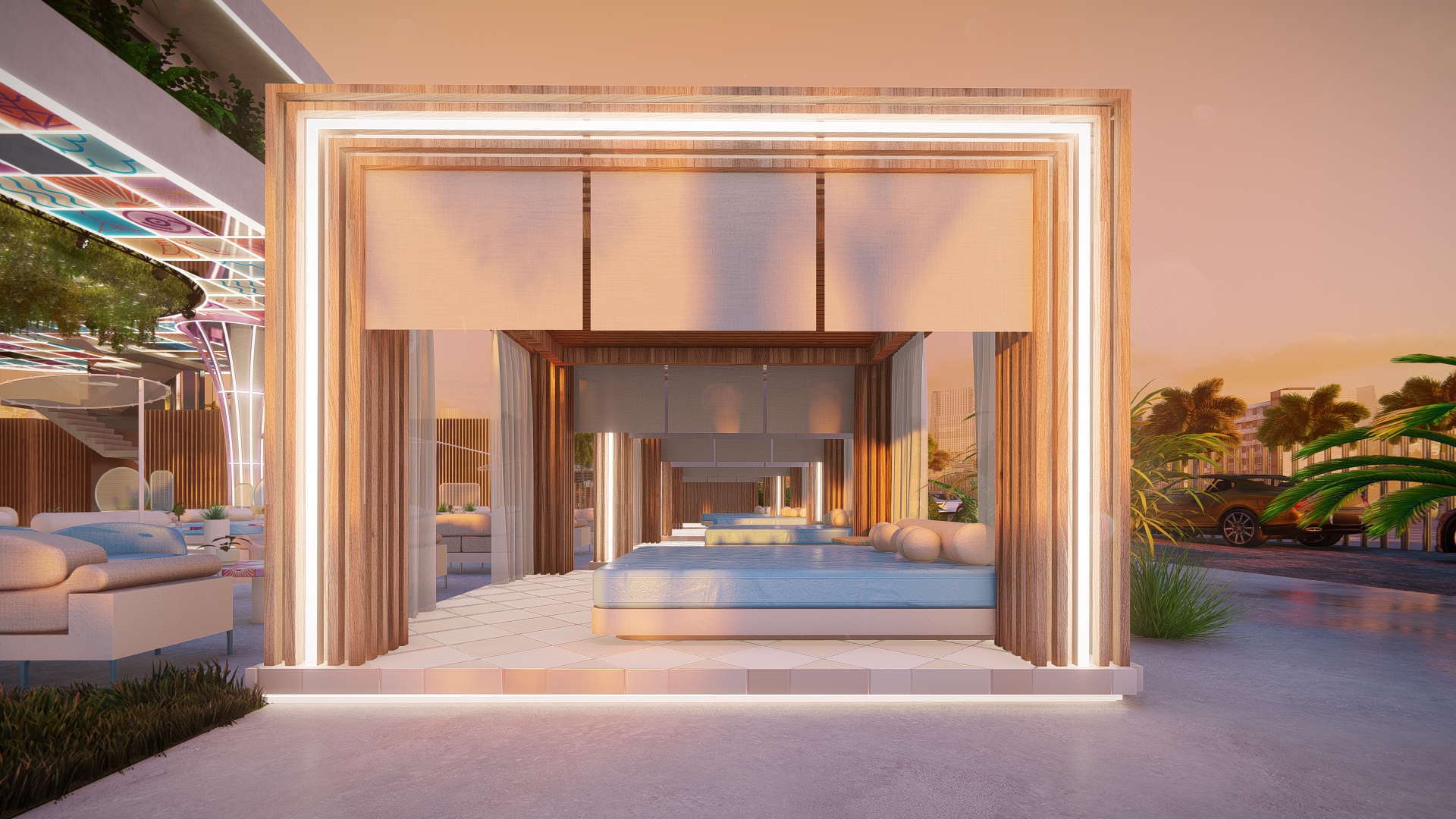
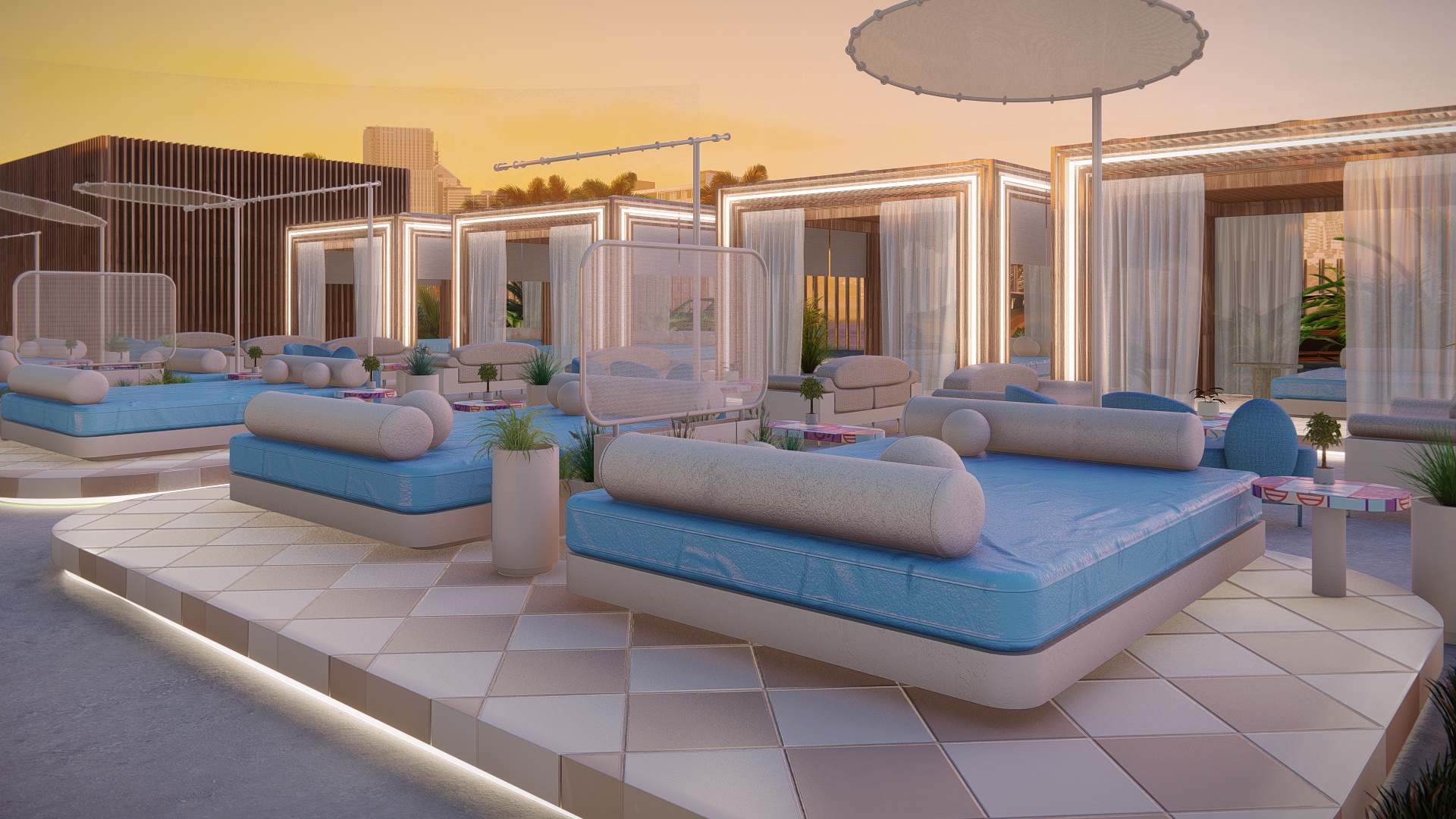
Beside them, illustrated table surfaces carry hand-drawn motifs — suns, waves, cocktail glasses, abstract forms in terracotta, coral, and lavender. The same graphic language appears in the floor insets, on the pool border tiles, on the underside of the canopy above. The space has a visual identity that runs through every surface, and it is playful in a way that takes real conviction to commit to.
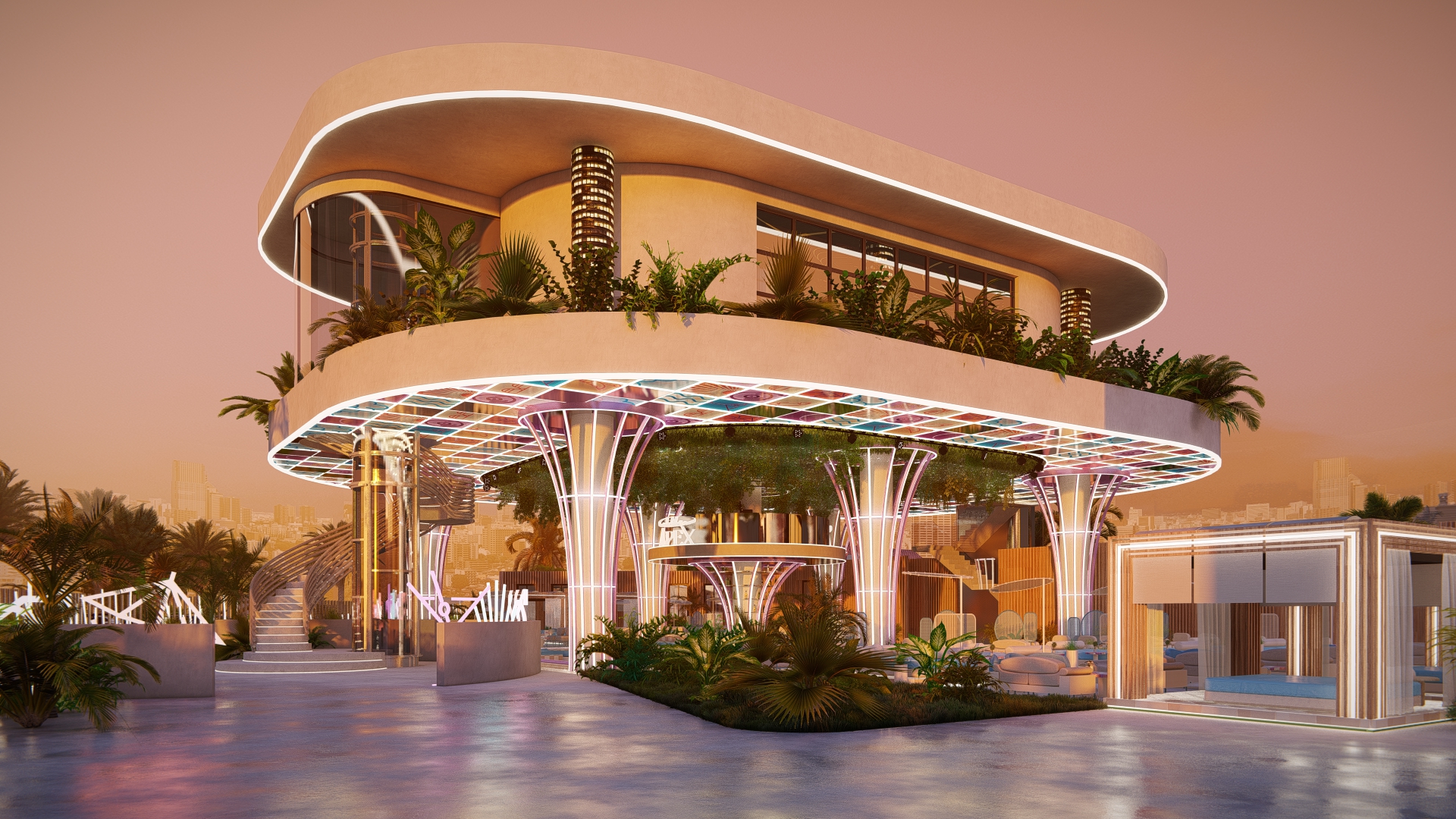
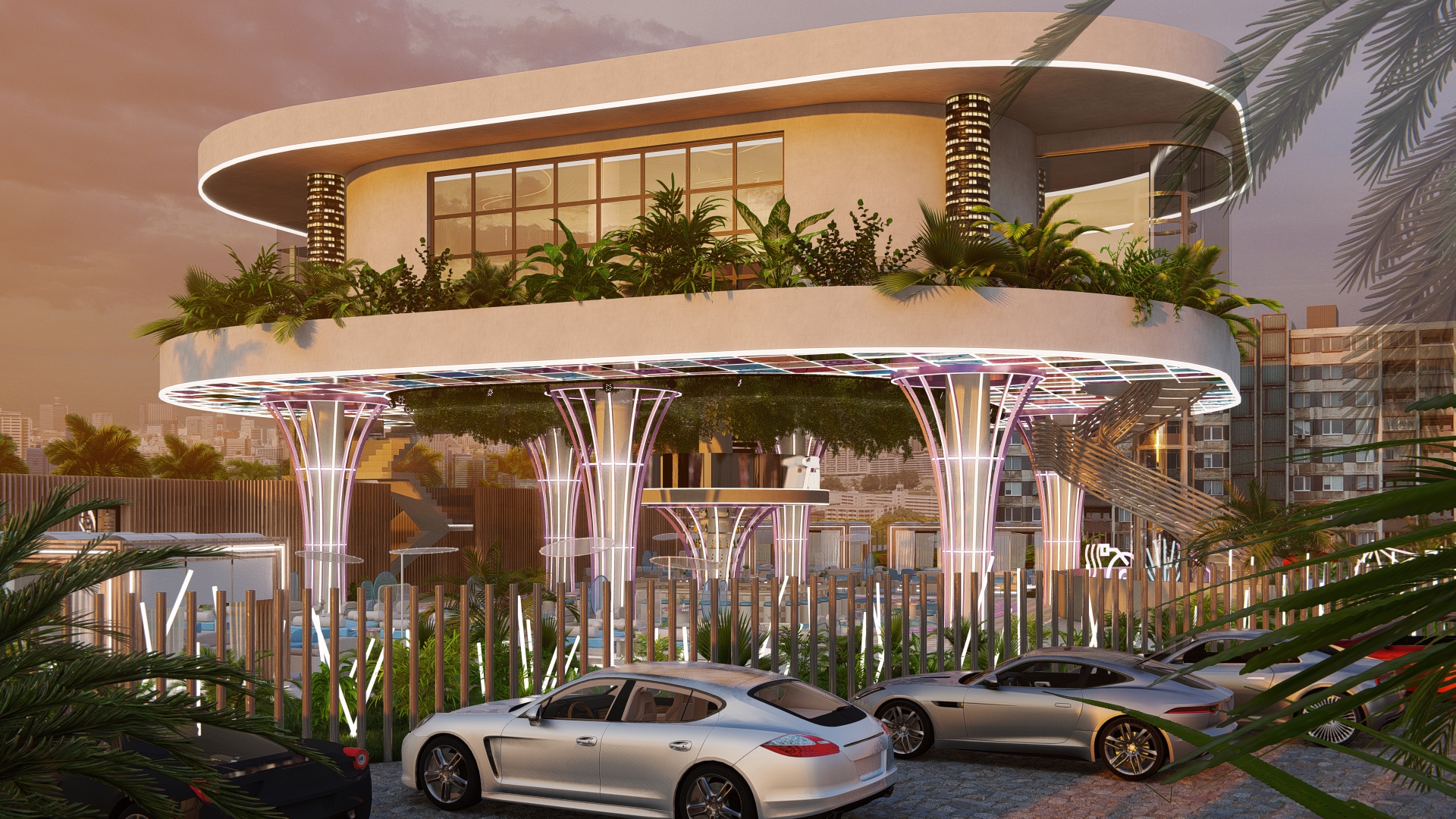
Above the pool deck, the column grove rises — a set of tree-form structural columns that flare as they climb, their frames carrying thin lines of light that shift with the day.
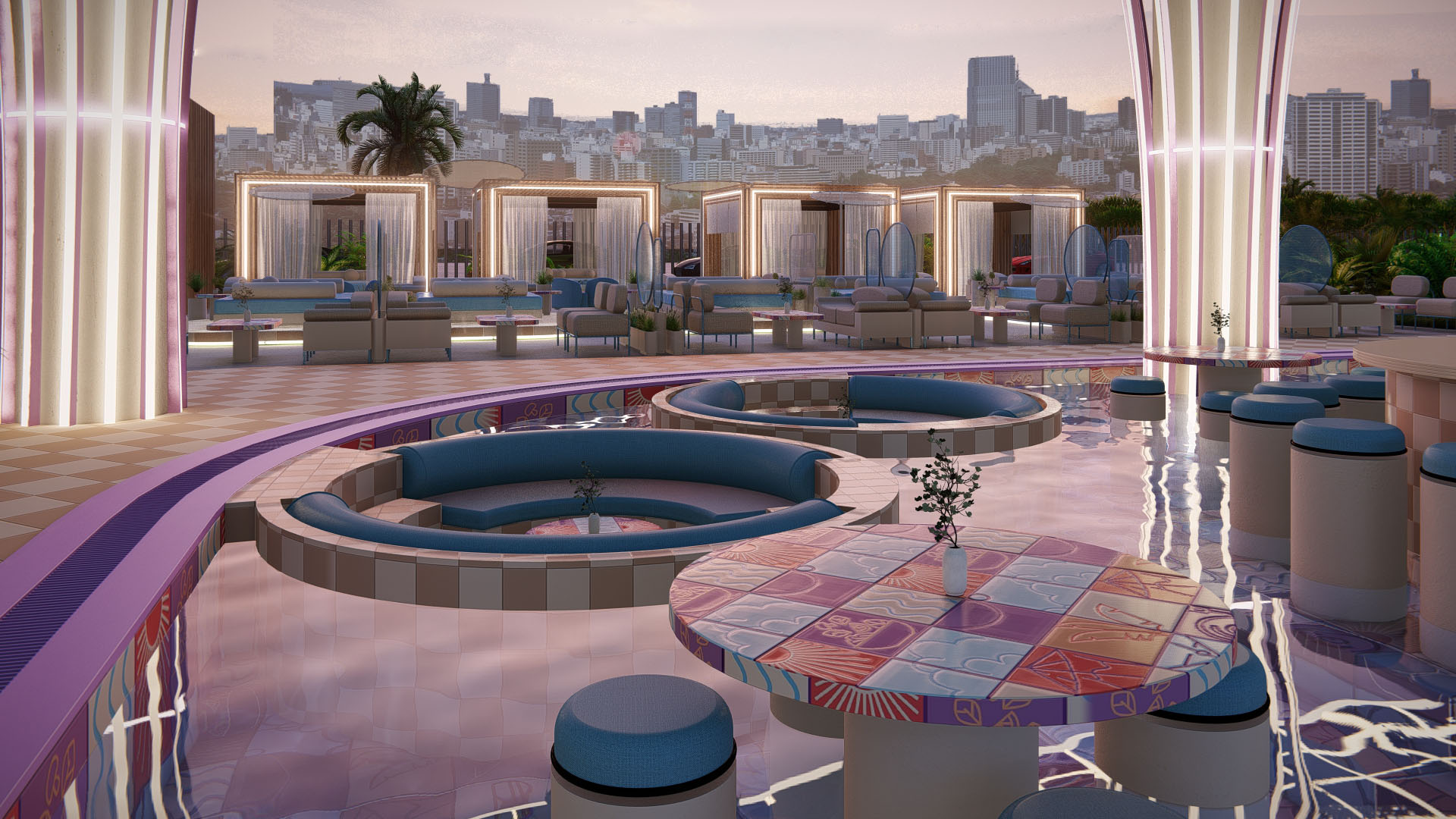
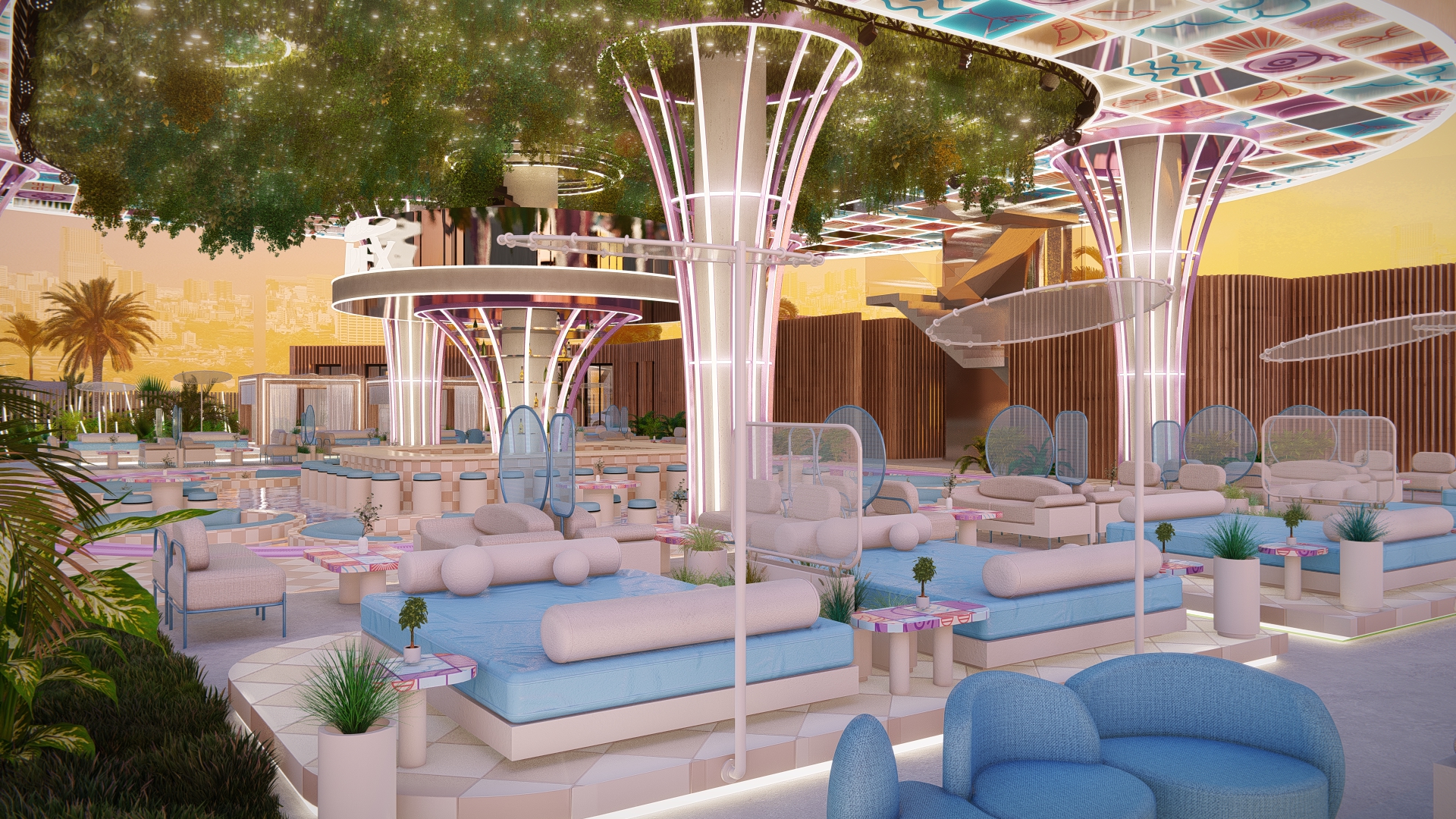
They support the illustrated glass canopy overhead, a circular disc of backlit panels in coral, teal, and blush that diffuses the afternoon sun and begins to glow from within as evening arrives. In the afternoon, the pool water mirrors the sky above it. By the time the neon ring at the canopy edge comes on, the ground level has moved from a daytime space into something else entirely — warmer, more charged, beginning its turn toward night.
But the pool club, for all its completeness, is not the destination. It is the beginning of one.
The Ascent: The Architecture of Anticipation
Between the ground level and the restaurant above it, At the Apex makes the journey a deliberate act.
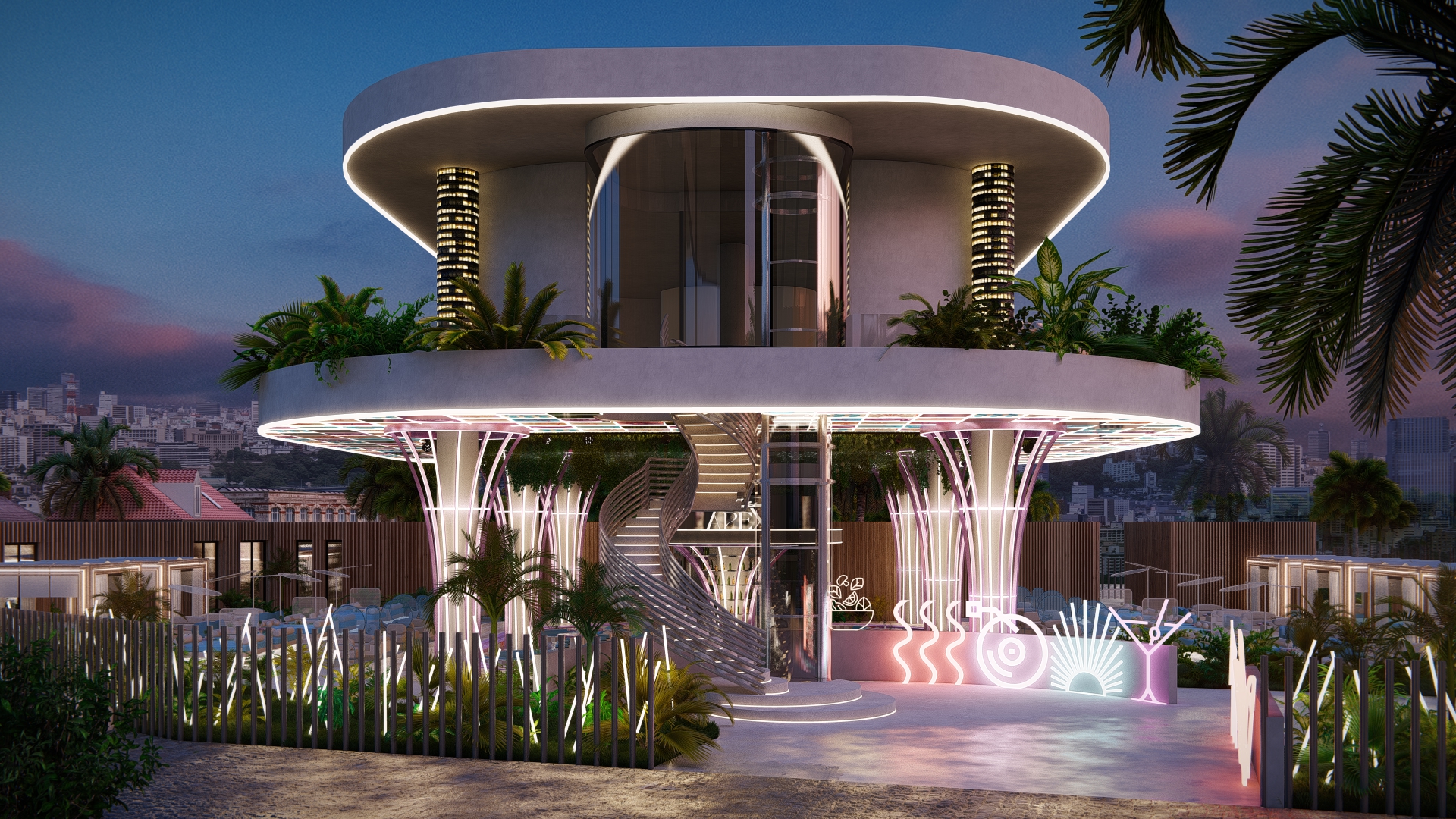
At the building’s centre, a sculptural spiral staircase winds around a cylindrical glass lift shaft. It is visible from outside the gate before you have entered — framed by the column grove, lit from within, announcing itself as something worth climbing.
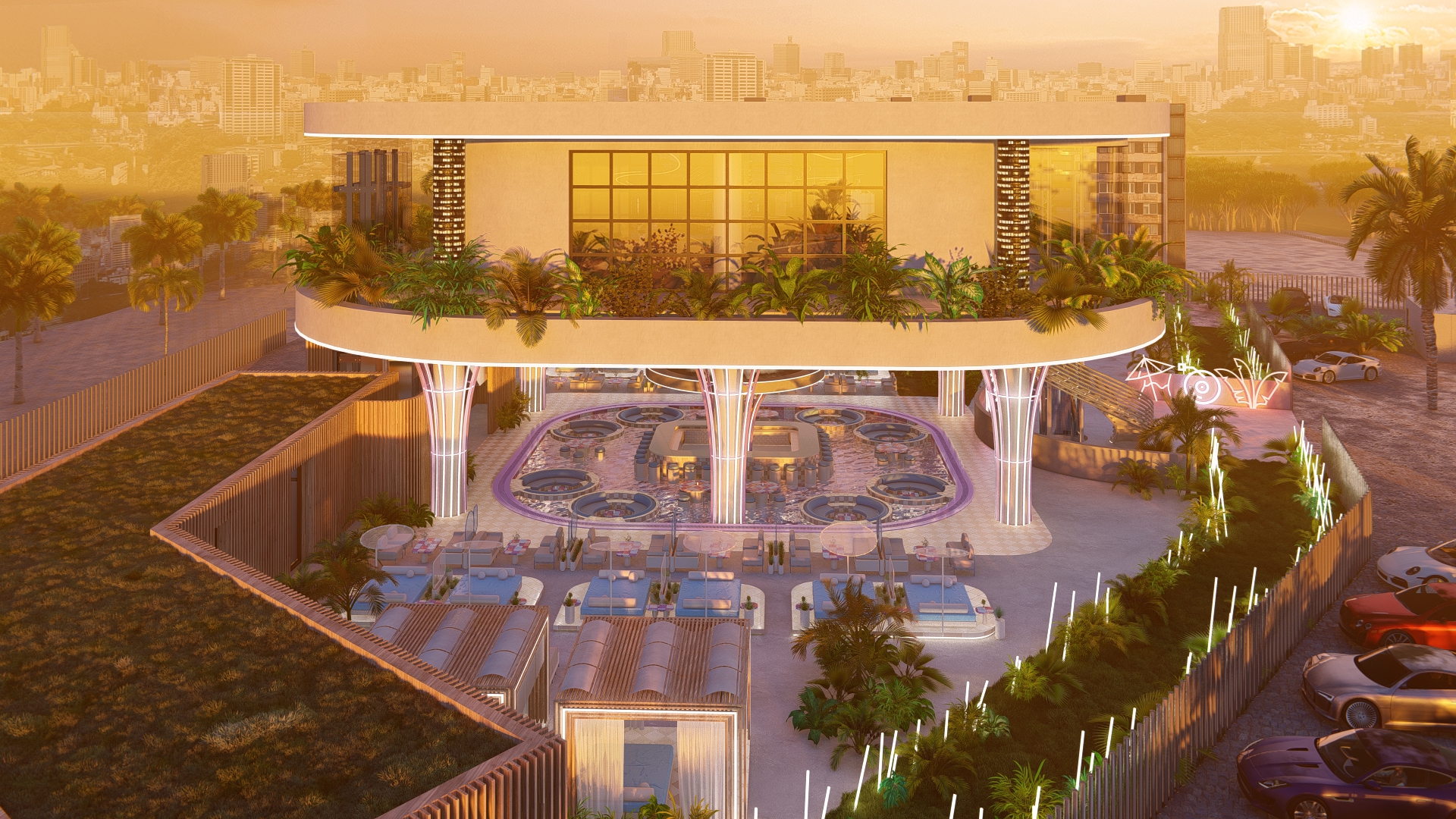
The staircase is not a utility. It is a transition. The decision to make it the visual centrepiece of the arrival sequence was a decision about what the building values: not the shortcut, but the experience of moving through it.
As you ascend, the pool level recedes. The sounds soften. The perspective opens. What was immersive at ground level — the pool, the people, the movement of a busy afternoon — becomes something you can begin to see whole. The city, which was a backdrop at ground level, becomes a panorama. By the time you reach the top, you have already been prepared for what the restaurant is going to show you.
That preparation is not accidental. It is the design working exactly as intended.
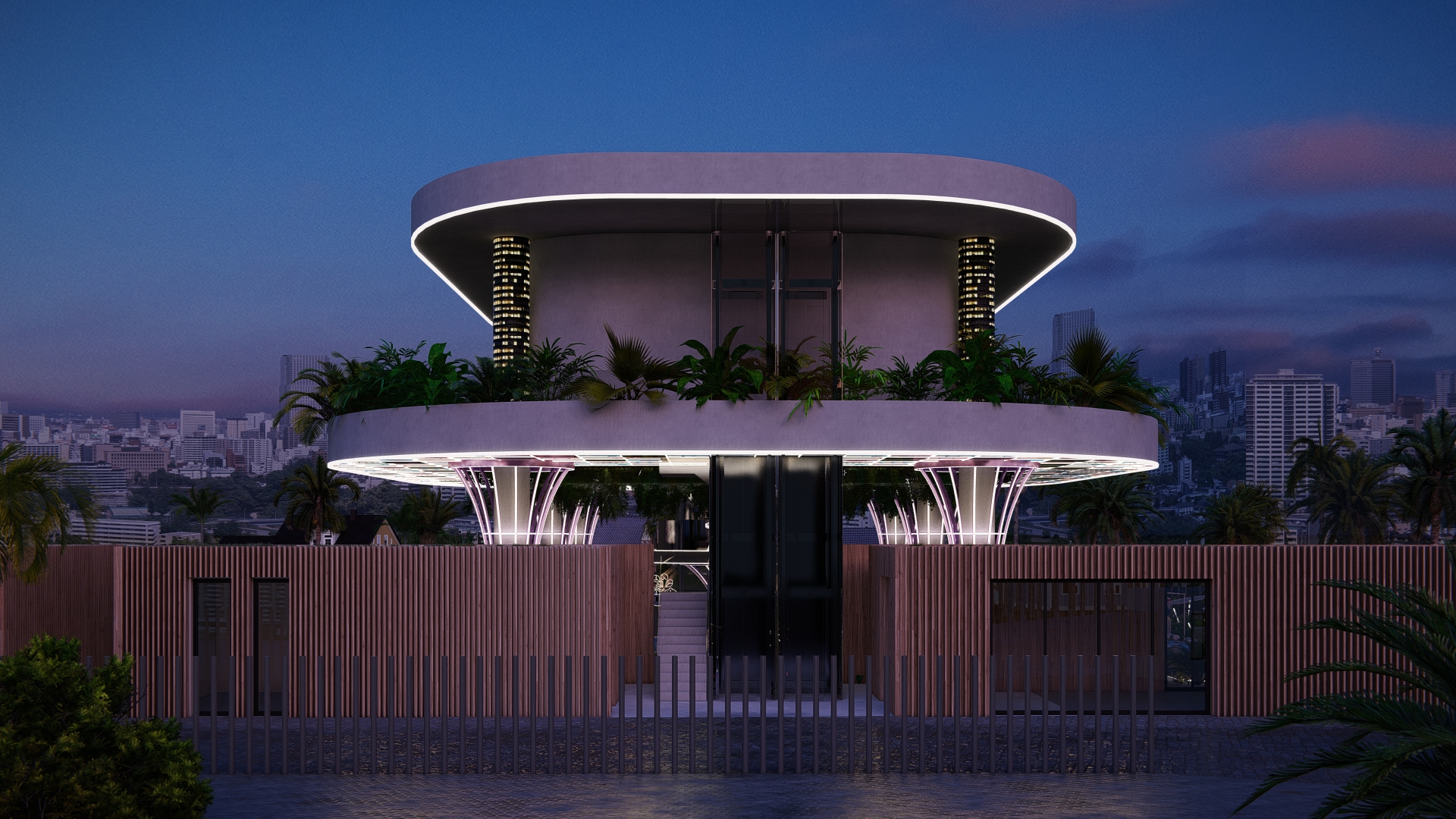
The Apex: A Room With Everything Below It
The restaurant sits inside the disc volume at the top of the building — a rounded, enclosed form that floats above the pool club with the city spread out on every side.
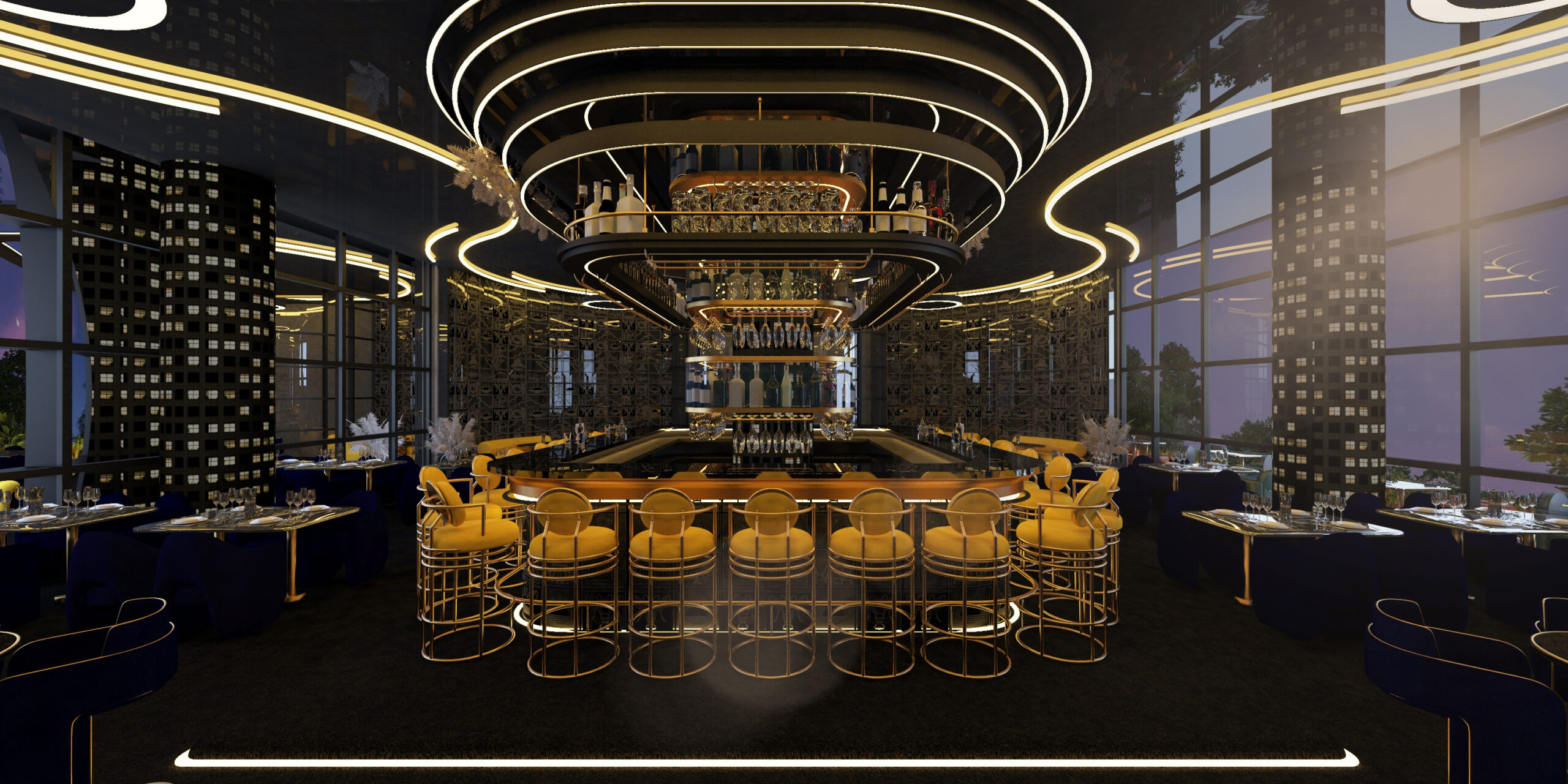
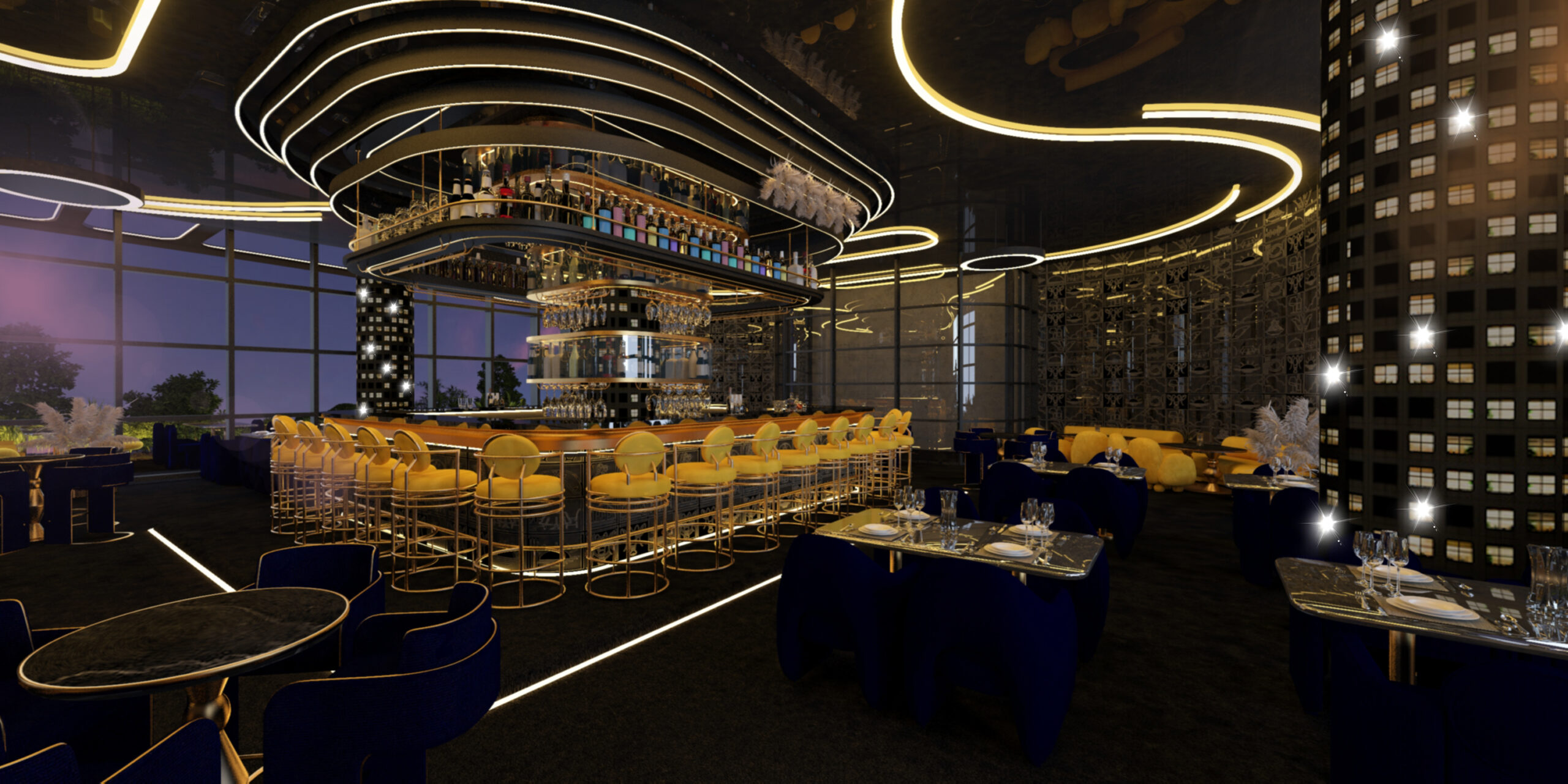
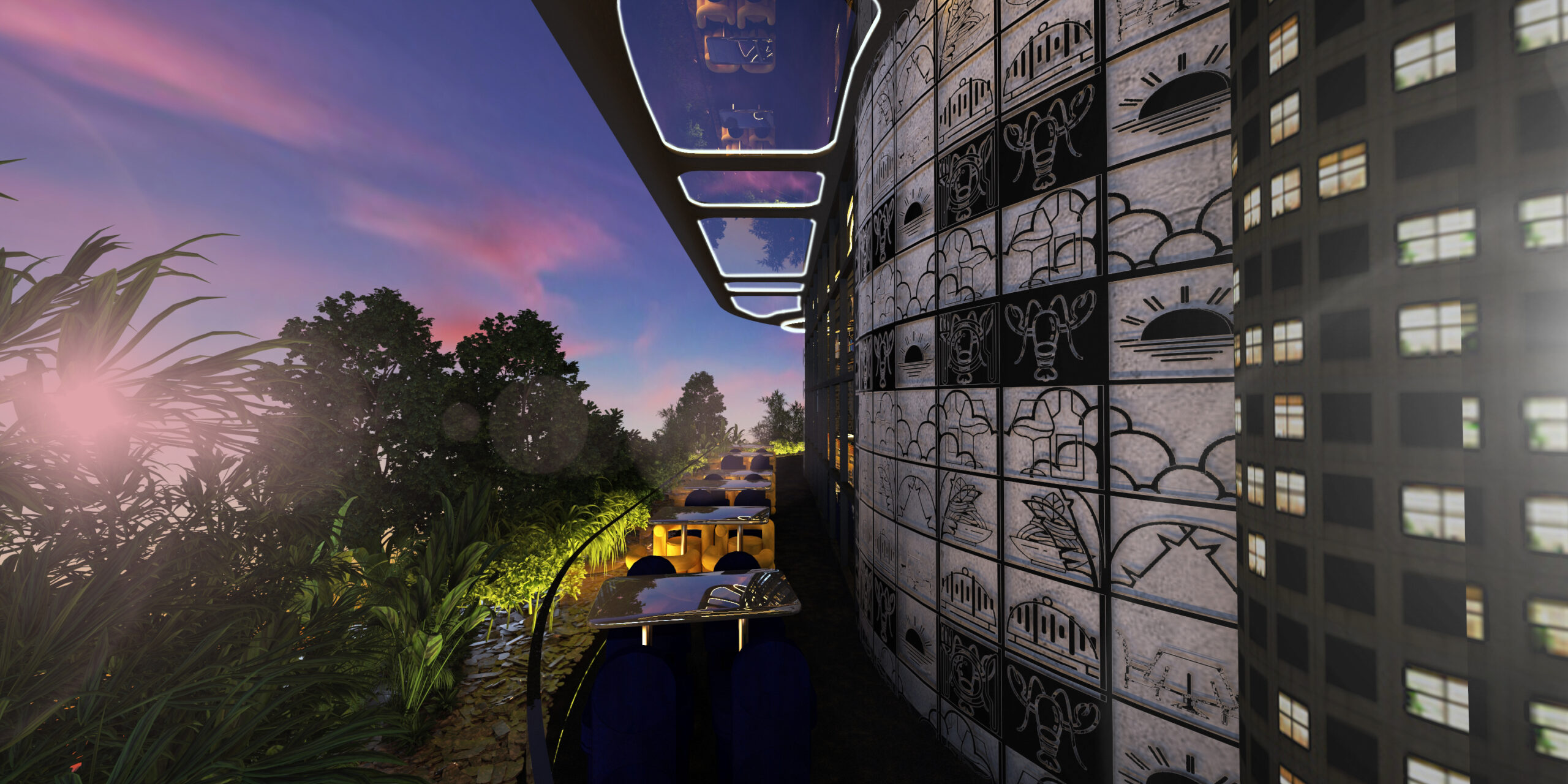
From up here, the view works in two directions at once. Look outward and you have the skyline, the palms, the city at whatever hour you happen to be sitting in it. Look downward and you have the pool club you came from — the water catching light, the people still moving through the afternoon you’ve left behind, the canopy below you reading as a garden from this height.
That downward view is the whole point. It is the thing that makes the name literal.
The interior of the restaurant holds its own entirely separate world. The palette shifts to what the pool club is not: dark lacquered surfaces, deep navy velvet, black marble, and gold that appears only where the light has earned it — in the amber of the dining chairs, in the brass frames of the bar stools, in the warm LED rings that orbit the ceiling at multiple heights and double in the reflective surfaces above.
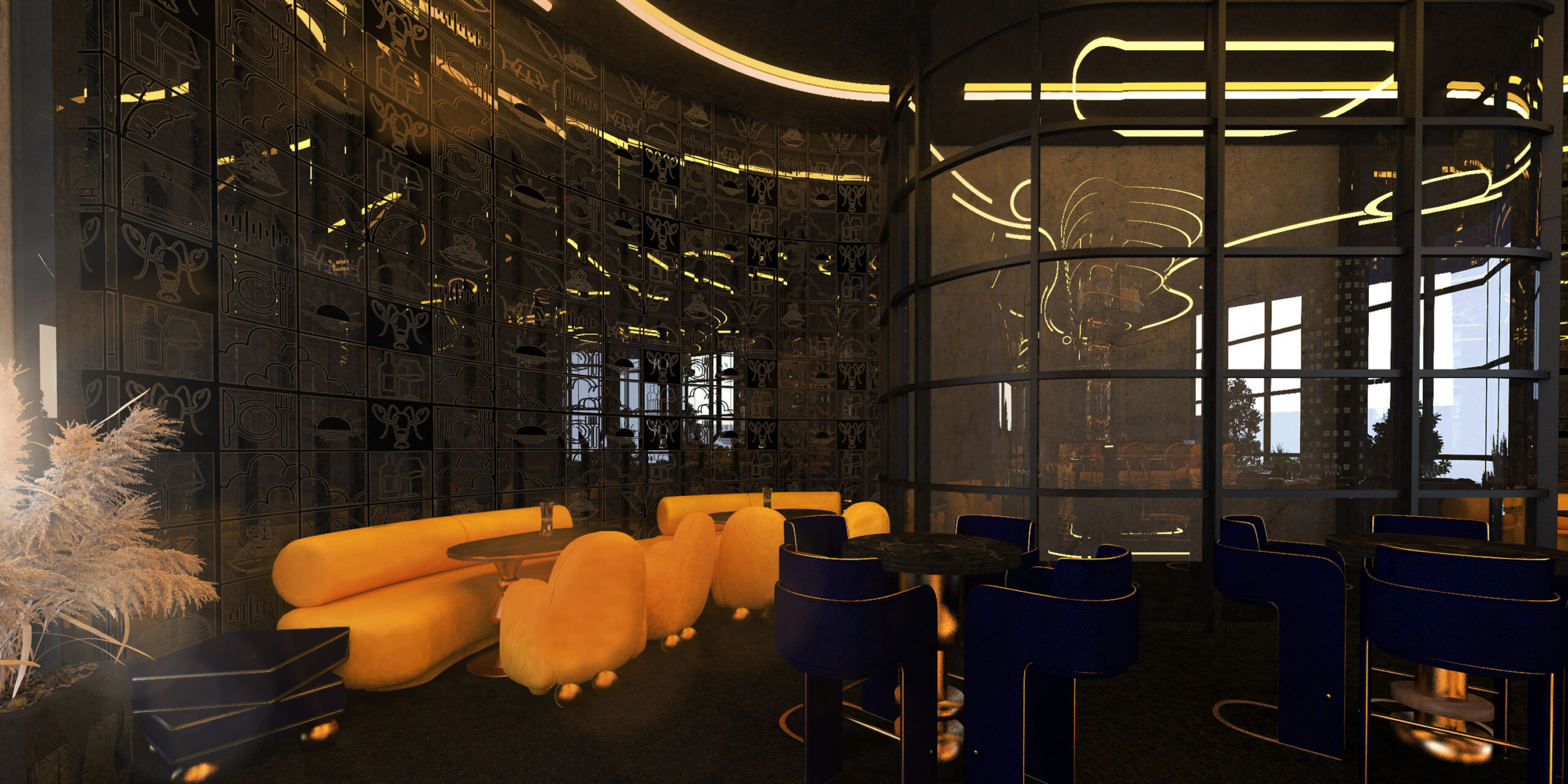
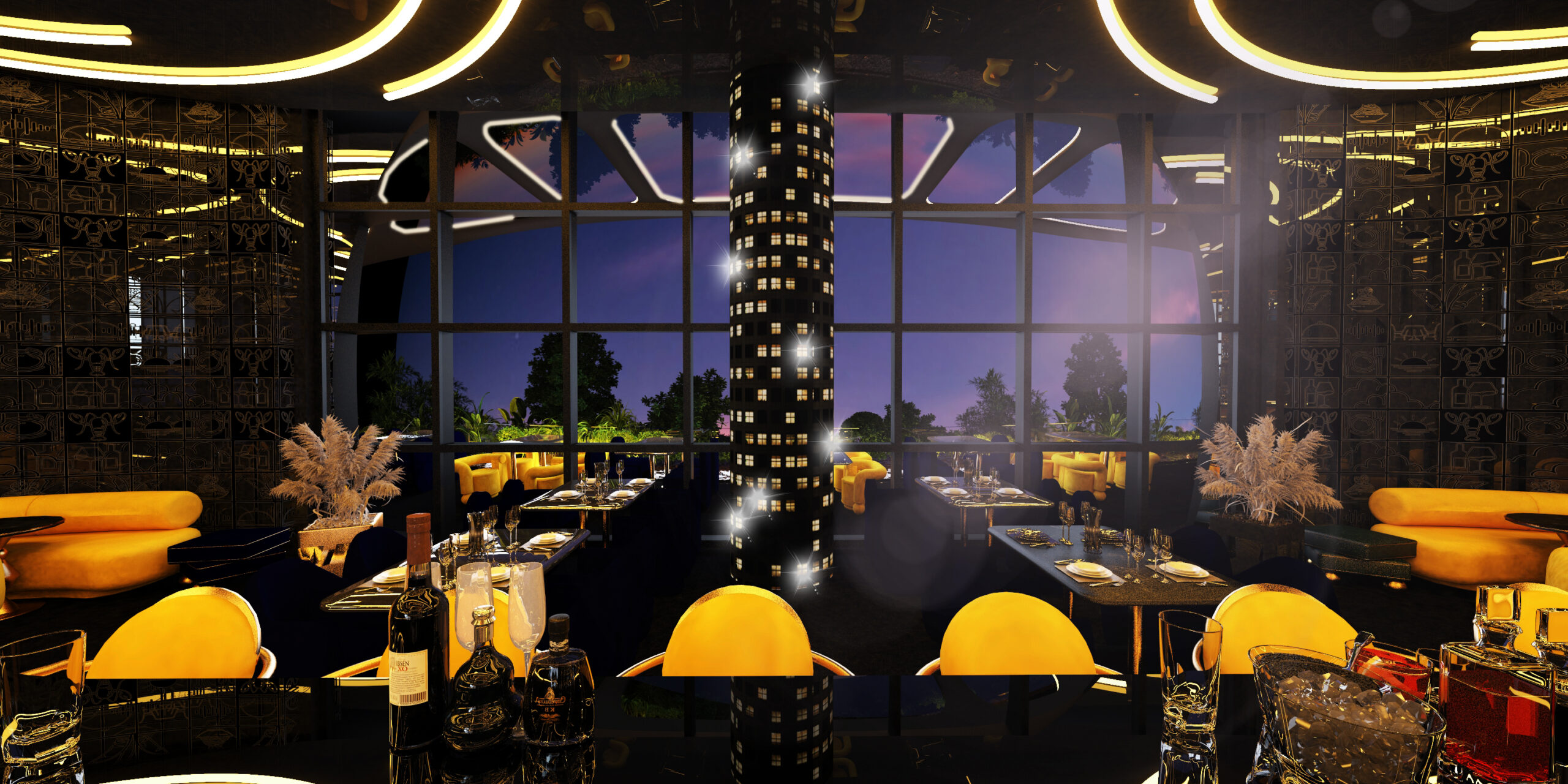
Where the pool club is all warmth and openness, the restaurant is precision and depth. Where the ground level invites you to spread out and stay, the top floor draws you inward and makes you pay attention.
The bar rises through the centre of the room in concentric illuminated tiers — bottles, glassware, and warm light stacked in a vertical structure that reads as sculpture from anywhere in the room. It is the visual anchor of the interior, the thing your eye returns to, the counterpart to the pool bar directly below it. Two bars, two levels, two entirely different energies built from the same design instinct: put the thing that matters most at the centre, and let everything else arrange itself around it.
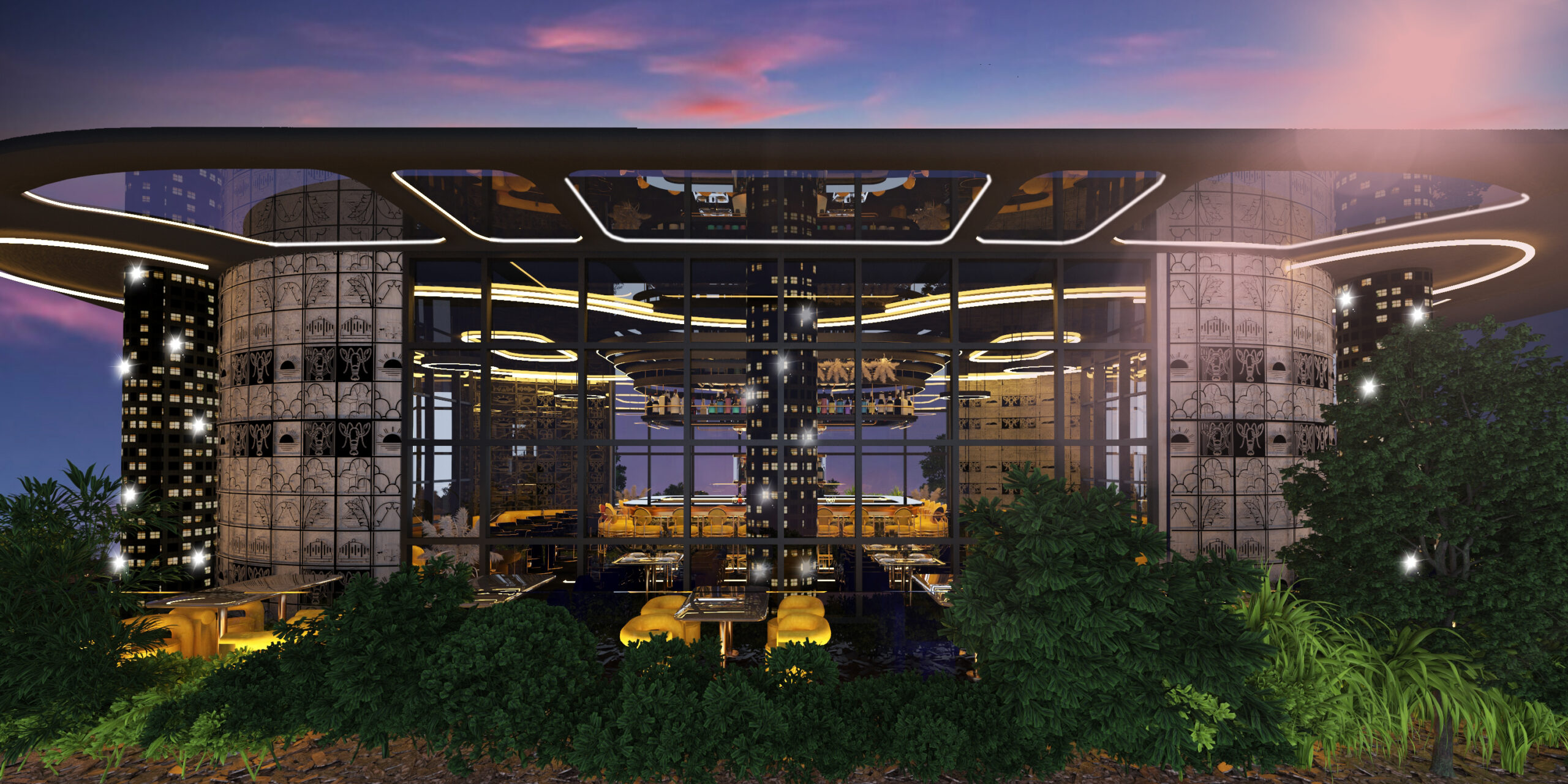
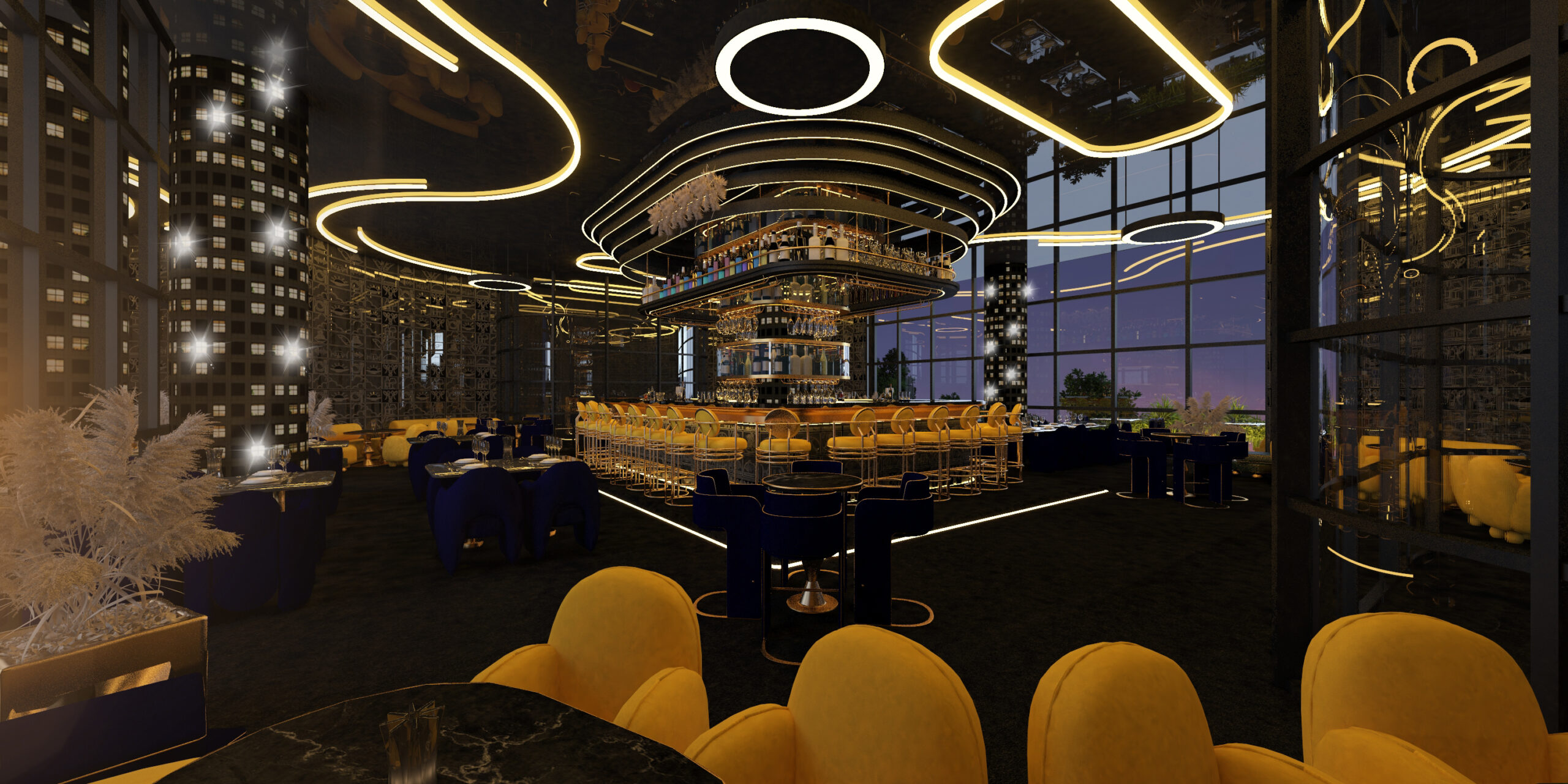
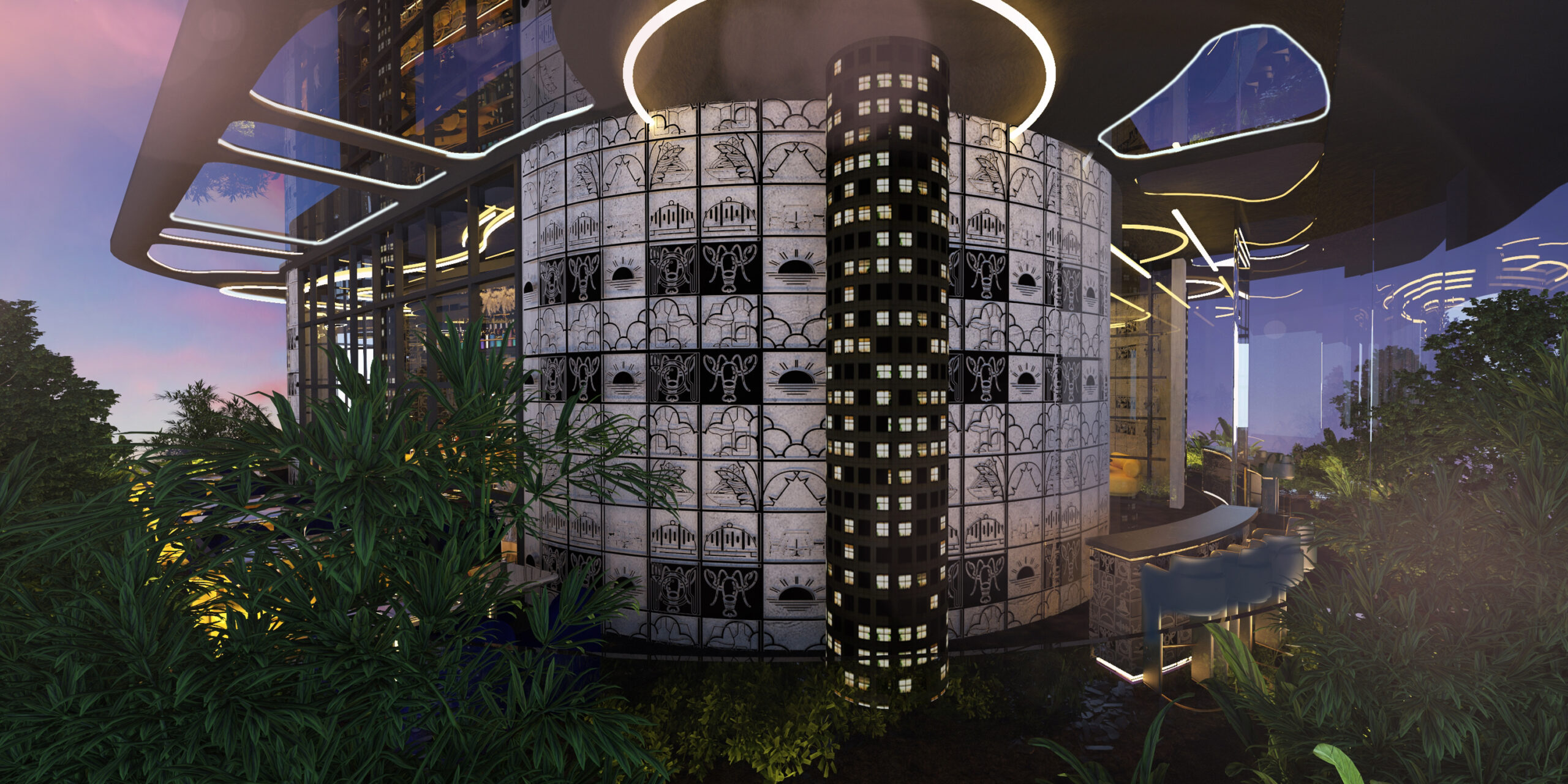
The walls carry an etched city-grid motif — buildings rendered in tile, their windows lit, a skyline at the same altitude as the real one on the other side of the glass. The design does not let you forget where you are. It reminds you of it everywhere you look, and it does so in a way that feels like a decision rather than a coincidence.
What the Name Actually Means
At the Apex is not a name chosen for how it sounds. It is a name chosen for what it describes — the specific feeling of being at the highest point of something and being able to see everything from it.
The pool gives you immersion. The ground level is where you feel the energy of a space from inside it. The restaurant gives you perspective. The top floor is where you understand the whole thing at once — the building you’re in, the city it sits inside, and the evening that brought you from one level to the other.
Most projects choose one register and commit to it. A pool club that is only a pool club. A restaurant that is only a restaurant. The ambition of At the Apex is to make both registers available inside a single address, connected by a piece of architecture — that staircase, that ascent, that shift in everything around you as you climb — that turns the movement between them into part of the experience itself.
You arrive at the pool. You spend the afternoon in it. You climb. And from the top, you can see where you started.
That is the concept. Everything else is the design proving it works.